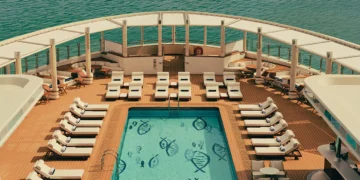



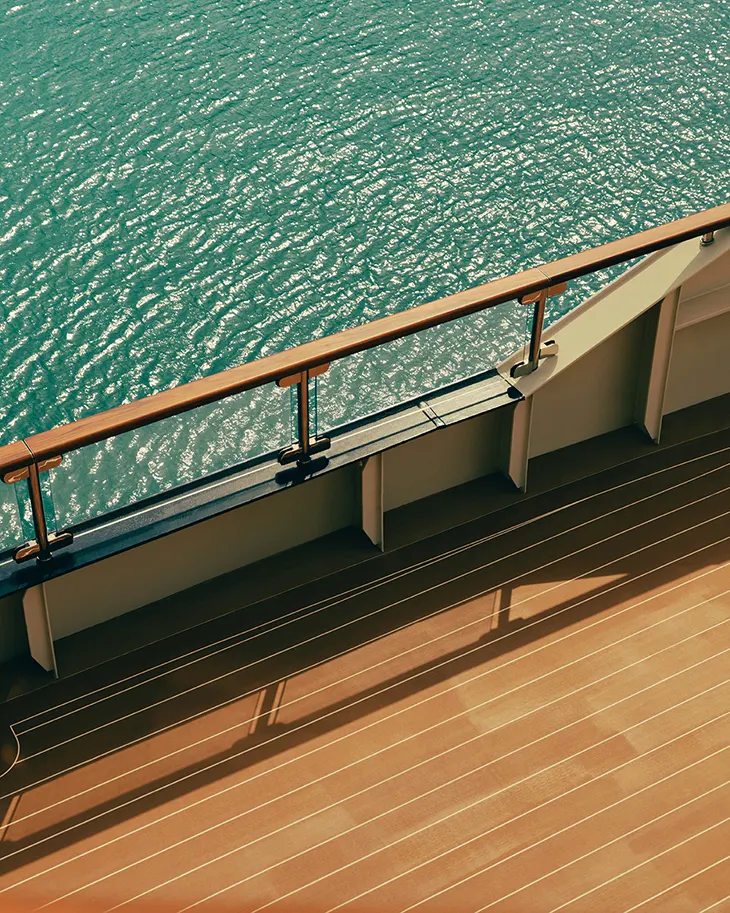
The launch of Four Seasons Yachts is a signal that the luxury travel industry is expanding into a distinct new category: hotel-led yachting. This month, the brand’s inaugural vessel, Four Seasons I, embarked on its maiden voyage in the Mediterranean, translating Four Seasons hospitality into a seaborne product designed from the keel up around service, space, and personalization.
LATEST HOTEL FEATURES ON DSCENE
For travelers who have historically chosen between the intimacy of a private charter and the convenience of a luxury cruise, Four Seasons I positions itself as a third option. It is not cruising with upgraded finishes, and it is not chartering with a scaled-down service model. It is a residential-style superyacht experience, operated with the operational discipline, culinary reach, and guest-recognition systems that made Four Seasons Hotels and Resorts a benchmark on land.
Why The Timing Matters, and Why The Market Is Ready
Luxury has shifted from conspicuous consumption to something more exacting: time efficiency, trust, and consistency. In that context, a hospitality brand with deep service DNA entering the yachting space feels less like a brand extension and more like a logical evolution.
Four Seasons also chose a date with narrative weight. The first sailing coincides with the company’s 65th anniversary and the opening of its first hotel on the first day of spring in 1961, a symbolic alignment that frames the yacht launch as a continuation of the brand’s origin story rather than a side project.
From a category standpoint, the debut also reflects a broader travel trend: guests want “access without friction.” That means the ability to arrive at smaller ports, spend time in yacht-only harbours, and build itineraries around personal interests, while still expecting the reliability of a top-tier hotel group.
Vessel as a Design Statement, Not a Floating Hotel
At 207 metres (679 feet), Four Seasons I is conceived as a residential-inspired vessel with just 95 expansive suites, no interior cabins, and a one-to-one guest-to-staff ratio. Those numbers matter because they reveal the product philosophy: fewer keys, higher space-per-guest, and staffing that supports truly individualized service.
Design is positioned as a core differentiator. The yacht’s creative and build roster includes Tillberg Design of Sweden, Martin Brudnizki Design Studio, creative direction from Prosper Assouline, and construction by Fincantieri. The reference point is the “golden age of yachting,” with an explicit nod to the legendary superyacht Christina O, reinterpreted through a contemporary lens.
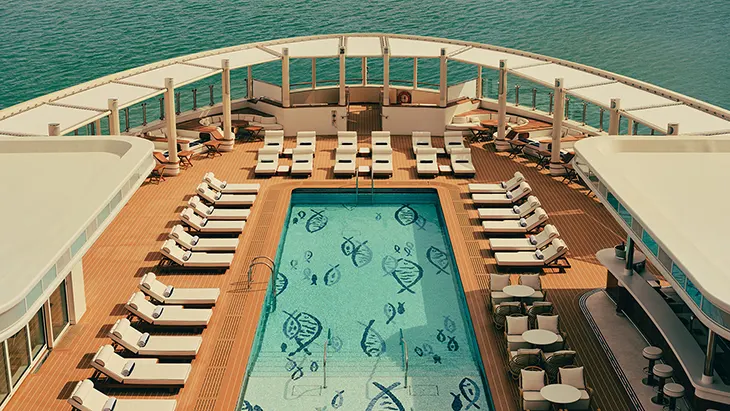
The result, at least on paper, is a ship where the sea remains the focal point. Floor-to-ceiling windows, generous terraces, and indoor-outdoor living are not treated as amenities, they are treated as the baseline.
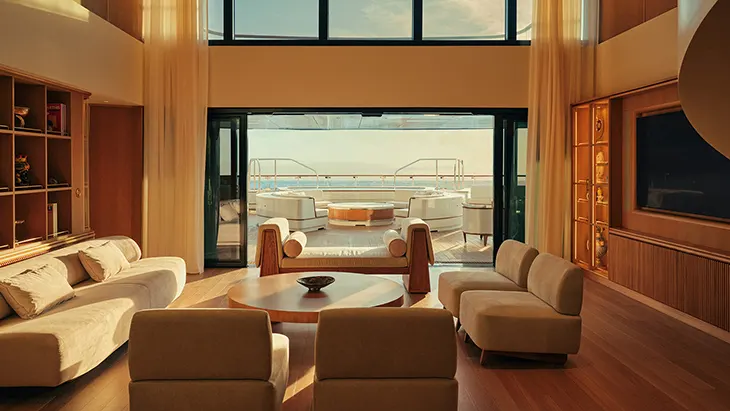
Suites That Define The Headline
Two accommodations function as brand signatures at Four Seasons Yachts.
- Funnel Suite: nearly 10,000 square feet (929 square metres), forward-facing at the prow with panoramic views.
- Loft Suite: nearly 8,000 square feet (743 square metres), aft-facing with an expansive terrace.
These are not simply “largest suite” talking points. They are proof of concept for a hospitality-first yacht: residential scale, privacy, and a sense of ownership over space.
Culinary Excellence as The Onboard Anchor
If most luxury vessels treat dining as a strong supporting act, Four Seasons I is positioning culinary as a primary reason to sail. The yacht features 11 restaurants and lounges, spanning Mediterranean seafood to an intimate omakase experience, with an emphasis on local and seasonal sourcing.
The most strategic move is Sedna, which introduces a Chef-in-Residence series that brings in talent from Michelin-starred Four Seasons restaurants. The announced roster includes Christian Le Squer (Le Cinq, Four Seasons Hotel George V, Paris), Luca Piscazzi (Pelagos, Athens), Guillaume Galliot (Caprice, Hong Kong), Yoric Tièche (Le Cap, Cap-Ferrat), and Paolo Lavezzini (Il Palagio, Florence).
In practical terms, this is how a hotel brand uses its global ecosystem to create differentiation at sea. It is also how Four Seasons Yachts can credibly claim to be an “epicurean platform,” not simply a yacht with good restaurants.
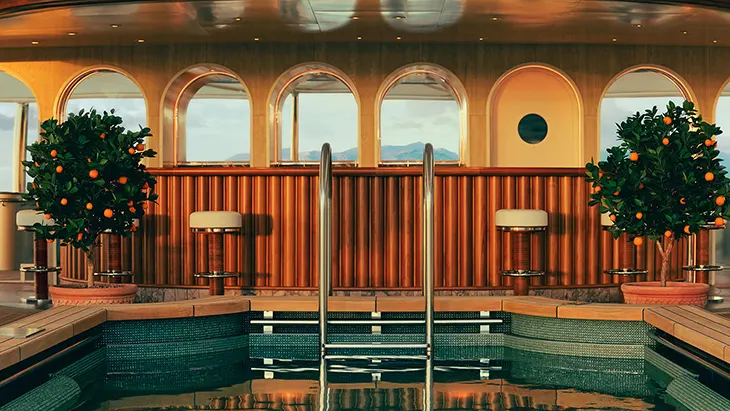
Wellness That Reads Like a Destination Spa
Wellness is framed as an integrated pillar, anchored by L’Oceana Spa and guided by the “five elements of vitality.” The offering includes a hammam and thermal circuit with sauna, aromatic steam, and cold therapies, plus advanced recovery modalities such as cryotherapy, infrared therapy beds, hydrotherapy, and other longevity-oriented treatments.
Programming extends beyond treatment rooms into the daily rhythm of the voyage, including sunrise yoga and meditation on deck, breathwork sessions, personalized fitness training, and guided mindfulness practices. The point is clear: the yacht is designed to support restoration while traveling, not only after returning home.
Transverse Marina, and The Rise of “Marina Days”
One of the most compelling innovations is the yacht’s transverse marina, which opens across both sides of the vessel to create direct sea access for water sports and curated recreational programming. Four Seasons Yachts also introduces “Dedicated Marina Days,” effectively formalizing the idea that time on the water can be an itinerary in itself.
This is important for the category because it reframes the sea from “what you pass through” to “where you spend the day.” For guests, it is a shift from destination-checking to experience-building.
Experiences, Built Around the Guest
Rather than relying on standardized excursion menus, Four Seasons Yachts emphasizes custom Shore and Sea Experiences curated in advance by a dedicated experiences team. The promise is personalization at the itinerary level, shaped around couples, families, or groups, and aligned to individual passions.
This approach mirrors the best of luxury hospitality, where the most valuable service is anticipatory. If executed well, it becomes a competitive moat, because it is difficult to replicate at scale without a mature service culture.
Mediterranean Itineraries, and What “access” Really Means
For its inaugural season, Mediterranean itineraries aboard Four Seasons I pair iconic ports with less-frequented harbours. Highlights include Saint-Tropez, Bodrum, Hydra, and Montenegro, alongside sailings across the Greek Isles and the Croatian coast.
In its debut year, the yacht will introduce 32 voyages across 52 sailings, exploring 130 distinct destinations in more than 30 countries and territories, with summer in the Mediterranean and winter in the Caribbean and Bahamas.
What This Launch Signals for Luxury Travel
The debut of Four Seasons Yachts is best understood as a category-defining move: a hospitality brand exporting its service model into a maritime product built for privacy, space, and curated access.
For travelers, it offers a new way to move through the world, with the intimacy of yachting and the reliability of a global luxury operator. For the industry, it raises expectations. If a yacht can deliver hotel-grade recognition, Michelin-level culinary programming, and destination-spa wellness while maintaining the romance of the sea, the definition of “ultra-luxury travel” expands. And for Four Seasons, the vessel is a statement of intent. It is a new frontier, but it is also a familiar promise, executed in a different element.





To be honest I am not sure how attractive this idea is to a high spending traveler… maybe if it generates you a ton of points at the four seasons but for the rates I have seen chartering a yacht on your own or with a few friends who can afford it sounds much better