


Gagosian will present Nam June Paik Rewind / Repeat in Seoul beginning April 1, 2026, marking the first exhibition in twenty-five years organized by the Estate of Nam June Paik in the artist’s birthplace. The exhibition will take place at APMA Cabinet, the project space located within the Amorepacific Headquarters designed by David Chipperfield. Positioned in the center of Seoul, the exhibition brings together works that span Paik’s career, including important historical pieces alongside works that have rarely been shown publicly.
ART
The exhibition offers a focused view of an artist whose influence continues to shape the relationship between art and technology. Paik trained in classical music and art at the University of Tokyo before developing a radical practice that introduced television and electronic media into fine art. In 1956 he moved to West Germany and joined the Fluxus movement, a group of artists and composers who challenged traditional ideas about performance, sound, and artistic authorship. Eight years later he relocated to New York, where his international background and collaborations across disciplines helped shape a body of work that combined sculpture, music, performance, and electronic experimentation.
Although Paik is widely described as the father of video art, his work anticipated broader cultural shifts in media and communication. He recognized the potential of television and emerging technologies long before they became embedded in everyday life. The exhibition in Seoul reflects this forward-thinking approach through works that connect technological systems with the human body, perception, and ritual.
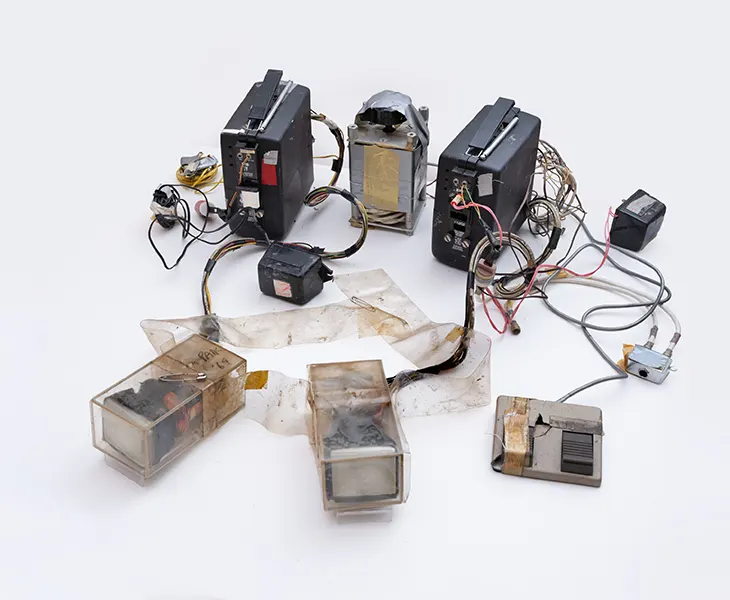
One of the central pieces in the exhibition is TV Bra for Living Sculpture (1969), a work originally created for musician and performance artist Charlotte Moorman. The piece consists of a clear vinyl garment that incorporates two small black-and-white televisions encased in plexiglass boxes. Moorman first performed wearing the piece during the opening of TV as a Creative Medium at the Howard Wise Gallery in New York in 1969. As she played the cello, the sounds of the instrument altered the images displayed on the television screens. Through this interaction, Paik sought to soften the mechanical presence of television and transform it into a responsive element within performance.
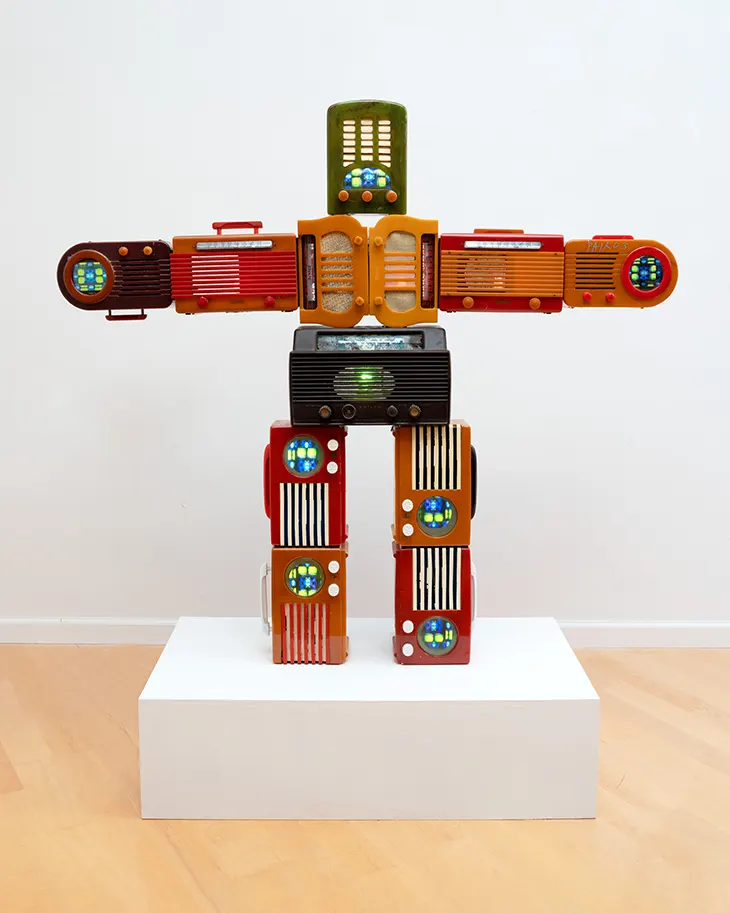
Another work in the exhibition, Bakelite Robot (2003), demonstrates Paik’s ongoing fascination with electronic devices and their cultural associations. The sculpture consists of vintage radios sourced from markets and secondhand shops. Paik replaced several radio dials with small video monitors that display edited footage drawn from science-fiction films, recordings of toy robots, and earlier video experiments. The piece reflects Paik’s interest in the mythology of machines and the evolving relationship between technology and imagination.
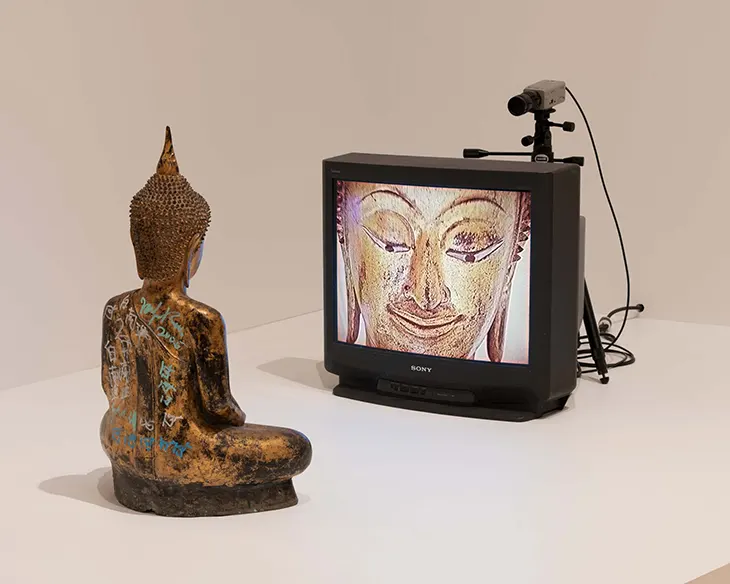
The exhibition also includes Gold TV Buddha (2005), part of Paik’s long-running TV Buddha series developed between 1974 and 2005. In this work a gilded bronze statue of Buddha sits before a video camera and monitor, observing its own image in real time. The piece creates a quiet dialogue between ancient spiritual traditions and contemporary media systems, placing introspection and technological mediation within the same visual circuit.
Other works on view include Orchestra (1991), a carved wood composition that expands Paik’s interest in sound and rhythm into sculptural form, and Untitled [Cage Composite] (2005), a tribute to composer John Cage and choreographer Merce Cunningham, two figures who played a central role in shaping Paik’s experimental thinking. The exhibition also presents Media Sandwich (1961–64), one of Paik’s earliest installations. The work combines German electronics magazines, Japanese phonograph records, and a nineteenth-century rotogravure print, marking the moment when Paik began shifting away from traditional musical composition toward electronic media.
Presented at APMA Cabinet inside the Amorepacific Headquarters, the exhibition situates Paik’s work within a building designed for dialogue between art, architecture, and contemporary culture. Through works that span more than four decades, Nam June Paik Rewind / Repeat revisits the practice of an artist who transformed television from a passive device into a tool for artistic experimentation and reflection.