


At elevation, scale stops behaving the way you expect it to. Distance stretches. Sound disappears. The body becomes an object you carry instead of something that defines the space around you. Mountains reorganize the relationship between body, ego, and permanence without asking for permission. They do it simply by existing at a size that refuses negotiation.
DORIC ORDER
I drove there because the weather did not belong to February. It was too warm, too forgiving. Cabrio weather, I call it, the kind that invites motion even when the calendar insists on restraint. Germany at the end of winter usually holds its breath, waiting. Trees remain bare, fields flattened, light thin and procedural. But that morning, light lingered. It leaned into surfaces. It softened the edges of roads and roofs and skin.
My husband had left for India five days earlier. We had come to Germany together to visit my family, to occupy familiar rooms, to resume familiar conversations. Then he boarded a plane and moved into heat and density and distance. I stayed behind, without deciding in any formal way to stay. It felt easier to remain where I was, suspended between departure and return. There is a particular quiet that follows someone else’s leaving. Not absence exactly, but a redistribution of weight.
I sat in my car and drove south. The Alps begin subtly. They do not announce themselves immediately. The road passes through towns that resemble every other town, past supermarkets and gas stations and low buildings designed without memory. Then the horizon begins to lift. Lines sharpen. The background stops behaving like background and begins asserting itself as structure.
Mountains reorganize the relationship between body, ego, and permanence.
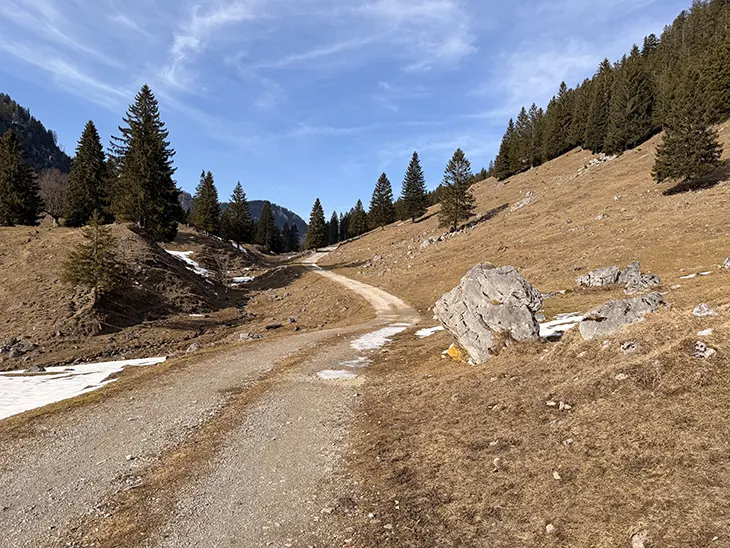
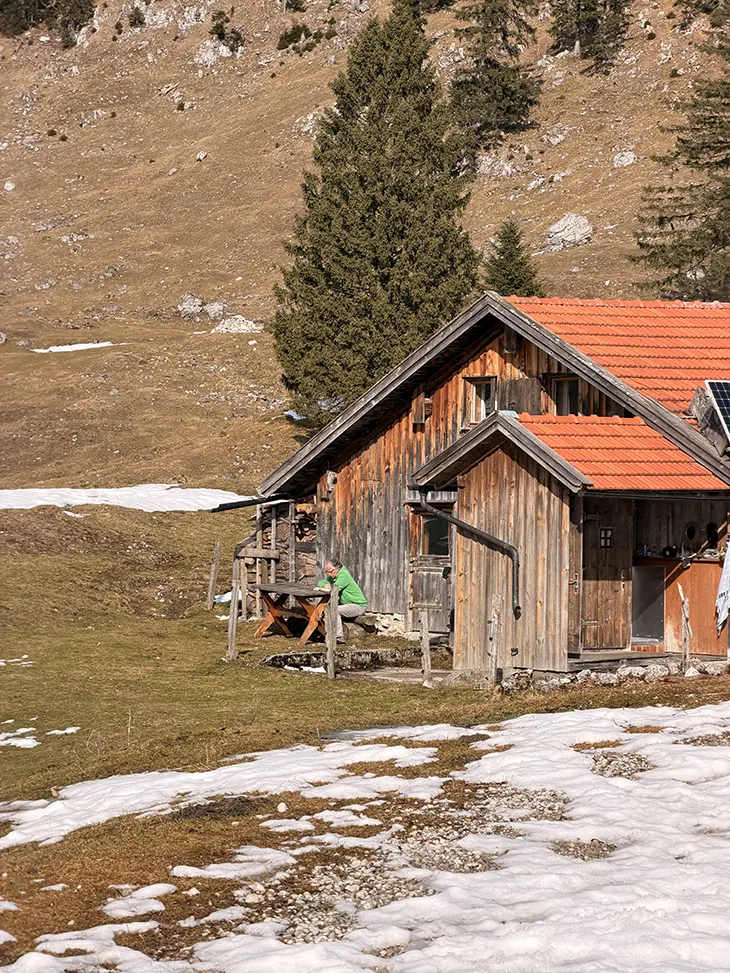
It took a little more than half an hour. I parked near a trailhead without planning the route. Hiking alone removes the obligation to justify direction. No conversation shapes pace. No agreement determines distance. The body sets its own logic. Gravel shifted under my shoes at first, dry and unremarkable. Air carried the temperature of early spring. I remember thinking how easily the season could deceive you, how willing the surface of things is to perform stability.
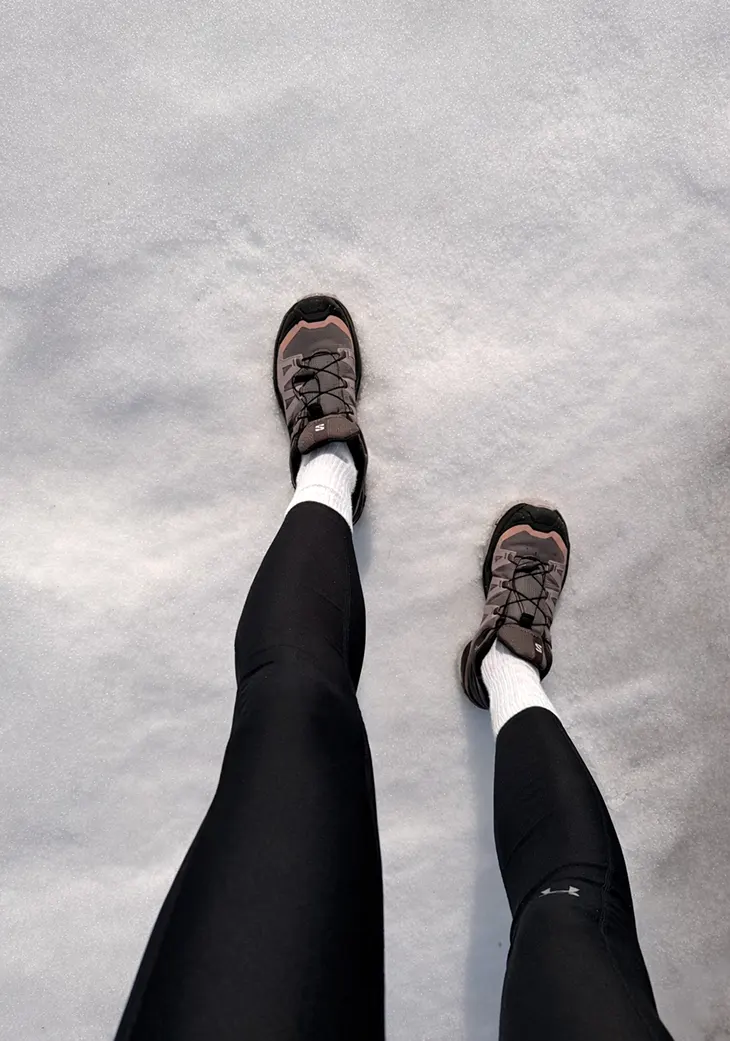
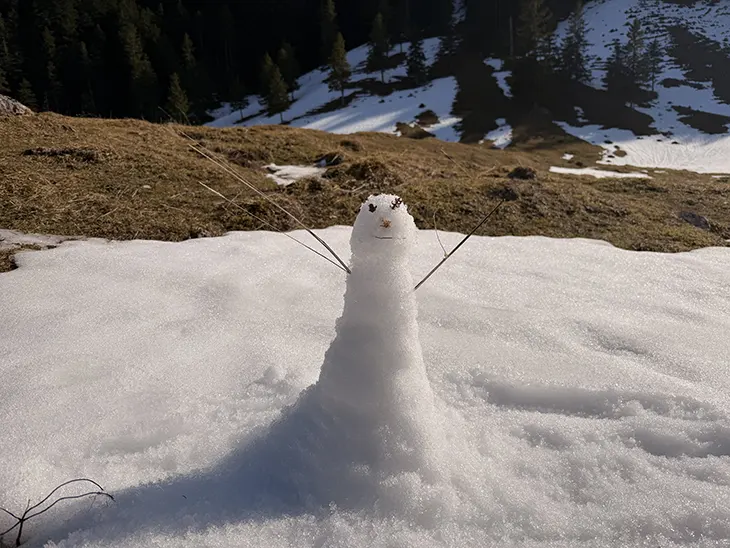
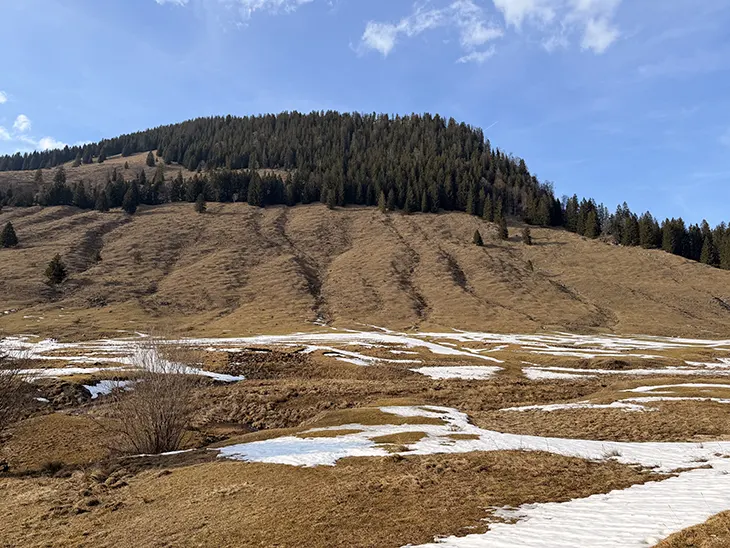
Snow appeared without transition. One turn in the trail and the ground changed color, texture, resistance. White replaced brown. Sound softened. Snow absorbs noise in a way that feels intentional, as if the mountain prefers certain frequencies and erases others. My steps slowed, not out of caution, but because speed no longer made sense. Snow imposes its own tempo.
There is a moment in every ascent when the body realizes it has committed. Turning back would take as much effort as continuing. Muscles warm. Breath reorganizes. The mind stops projecting forward and begins registering the present in fragments. Texture. Incline. Light between branches. The smell of cold water somewhere ahead.
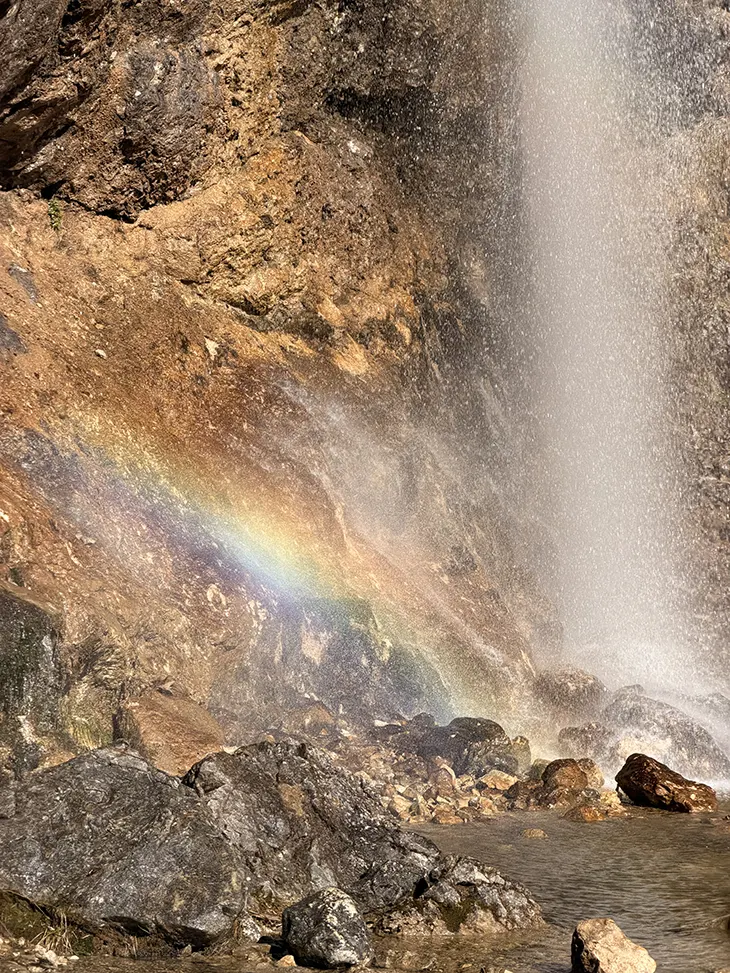
I heard the waterfall before I saw it. Water carries differently in mountains, amplified and contained at the same time. When it appeared, it did so suddenly, without prelude, pouring over rock that seemed older than any structure I have ever known. Sunlight cut across the falling water at a precise angle, producing a rainbow that existed only from where I stood. One step to the left and it disappeared. One step to the right and it returned. Beauty, dependent on alignment.
At elevation, the body becomes something you carry instead of something that defines the space around you.
A man stood below it, submerged to his waist. His body did not resist the cold. He remained still, arms relaxed at his sides, as if the water belonged there. Steam rose faintly from his skin. I watched him without speaking. There is an intimacy in witnessing someone subject themselves to temperature without protection. It exposes the agreement most of us maintain with comfort. He stayed long enough that time stopped measuring him.
I moved closer and reached toward the water, touching it with my fingers. It was freezing. Not metaphorically cold, not bracing, but absolute. The kind of cold that removes sensation almost immediately, replacing it with a sharp awareness of limits. I withdrew my hand and felt the delayed burn that follows. The body reminding itself where it ends.
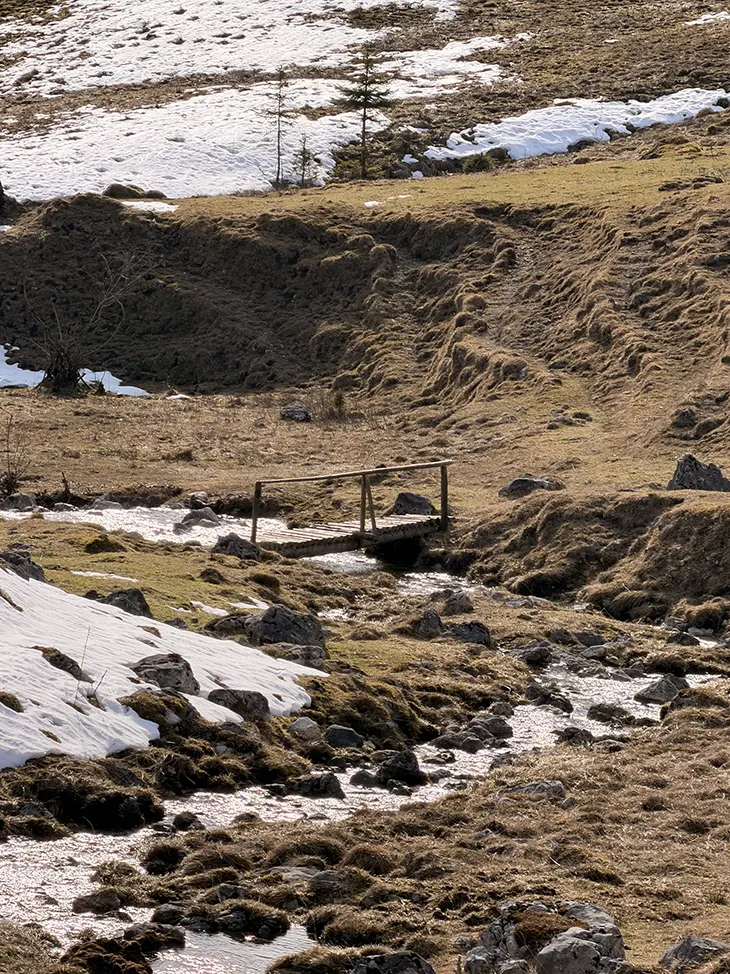
At the base of the waterfall, stones lay scattered, shaped by decades or centuries of repetition. Water applies pressure without urgency. It reshapes without announcing progress. I picked up one stone, smooth and heavier than it looked. It fit into my palm in a way that suggested permanence, though I understood permanence as an illusion. Still, I kept it. Carrying fragments of larger systems is one of the ways humans create continuity.
Mountains do not reward effort. They remain completely indifferent to your arrival.
I climbed higher. The trail narrowed. Snow deepened. Trees thinned until the landscape opened into exposure. There is always a point where forest ends and sky becomes the dominant surface. Without the vertical interruption of trunks and branches, distance expands quickly. The eye loses intermediate reference points. Everything exists either very close or impossibly far.
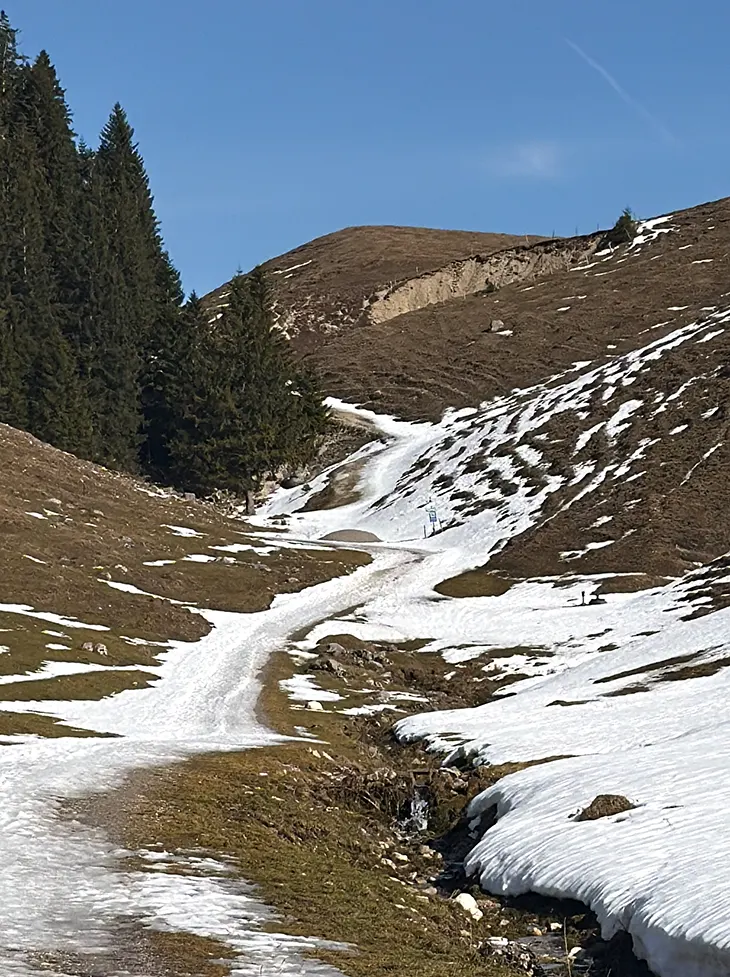
At the top, there was no ceremony. No marker declaring arrival. Only space. Mountains do not acknowledge your effort. They do not reward you for reaching them. They remain indifferent to ascent. This indifference clarifies something essential. In cities, scale is designed to accommodate the human body. Doors, ceilings, streets, furniture, all measured against our proportions. Mountains refuse that agreement. They exist outside human scale entirely.
Standing there, I felt the reduction of my own importance with unusual clarity. Not in a tragic sense. Not as loss. As accuracy. The body becomes measurable against distance in a way that reveals its temporary nature. Breath appears visible in cold air. Heartbeat becomes perceptible inside the chest. Every sensation reinforces the fact of occupying a finite structure moving through an infinite system. Mountains do not diminish you out of cruelty. They simply provide context.
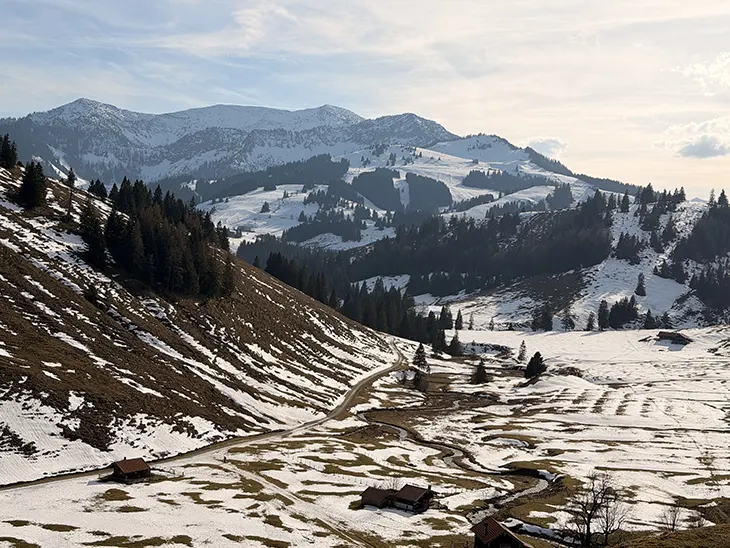
I thought about how much of human life is organized around maintaining the illusion of centrality. Work reinforces it. Cities reinforce it. Technology reinforces it constantly, reflecting our image back to us, enlarging it, preserving it. Standing alone above the tree line, there was nothing to reflect me. No surface to confirm my presence except the ground beneath my feet.
The quiet was not silence. Wind moved across snow with a low, continuous friction. Somewhere far below, water continued its descent. Sound existed, but it belonged to processes that would continue without interruption.
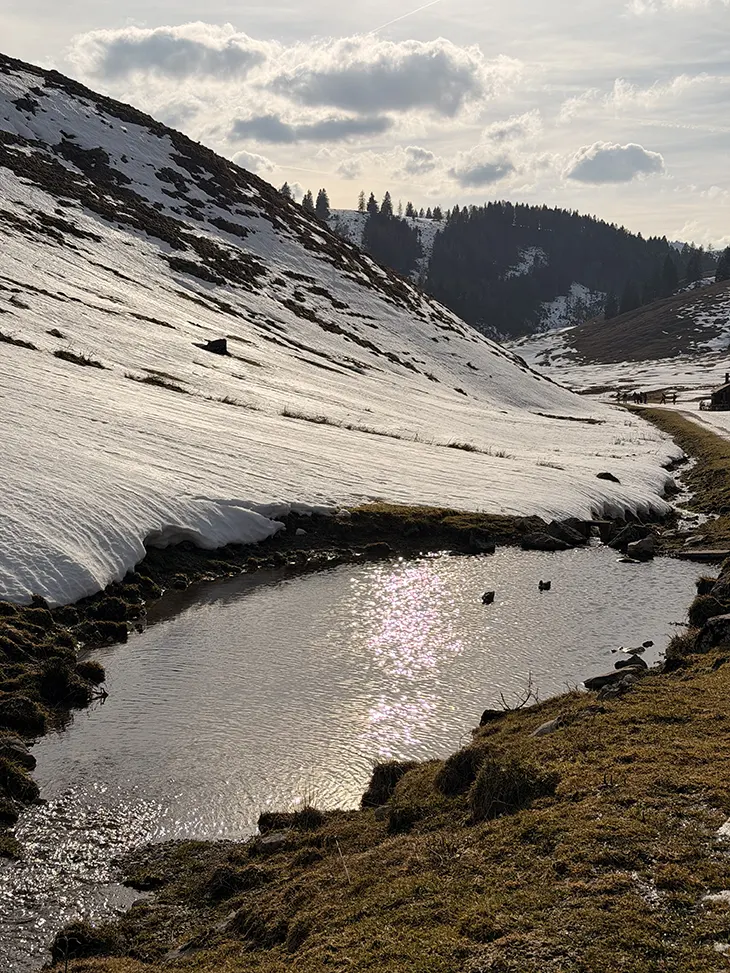
I stayed longer than I planned. Time behaves differently when no structure contains it. Minutes expand without pressure. The mind stops dividing experience into productivity or outcome. It observes instead. It registers without assigning purpose. This state feels unfamiliar at first, then necessary.
The mind stops projecting forward and begins noticing fragments.
Eventually, I began walking down. Descent always carries a different psychological weight than ascent. Gravity assists. Muscles relax into repetition. The body recognizes familiar ground and moves with greater certainty. Snow returned to dirt. Dirt returned to gravel. The mountain released me gradually, without acknowledgment.
When I reached my car, the stone was still in my pocket. It had absorbed cold from the waterfall and retained it. Even inside the warmer air of the valley, it remained cooler than everything around it. I held it in my hand for a moment before placing it on the passenger seat. Objects that originate in different systems carry their origin with them. They resist immediate assimilation.
Driving back, the mountains receded into the background again, returning to their position as distant structures rather than immediate environments. Scale reorganized itself once more around human measurements. Roads narrowed. Buildings reappeared. The illusion of control resumed.
But something remained altered. Mountains do not change you in the way people often describe. They do not provide answers or resolutions. They remove noise. They reduce proportion. They allow you to see yourself at a size that corresponds more closely to reality.
Up there, nothing disappears except the idea that you were ever central.
Scale, once perceived accurately, cannot be entirely forgotten. I arrived home before sunset. The stone remained where I had placed it, quiet and unchanged.