


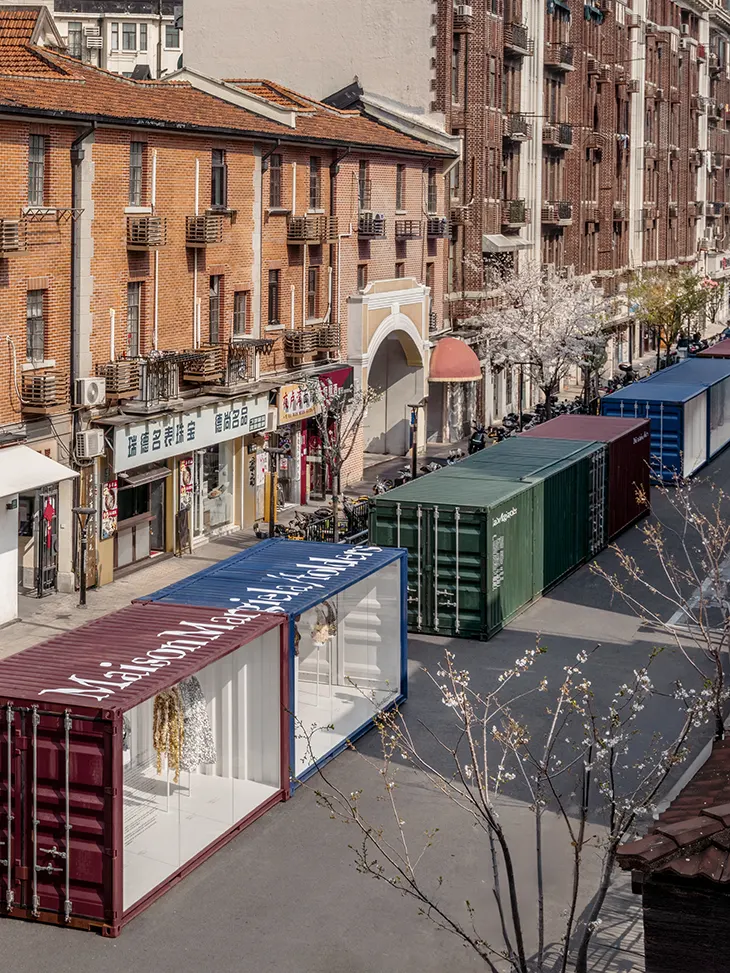
Maison Margiela opens Artisanal: Our Creative Laboratory, a new exhibition in Shanghai that brings the house’s haute couture language into the public realm. Staged on Yan Dang Road in the Huangpu District, the project runs April 02–06 and is open daily from 10am to 8pm, with no reservation required.
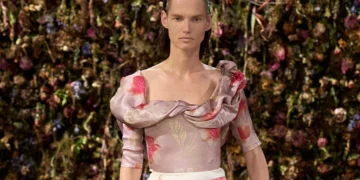
Presented as part of MaisonMargiela/folders, the exhibition showcases 58 Artisanal couture looks selected by the brand’s team and displayed together for the first time. The curation traces a line through the house’s history, from the first Artisanal piece, the AW1989 porcelain plate waistcoat, to an Edwardian gown treated with beeswax from the Fall Winter 2026 show, which took place in Shanghai on April 1.
Street-level Exhibition Built Like a Working Archive
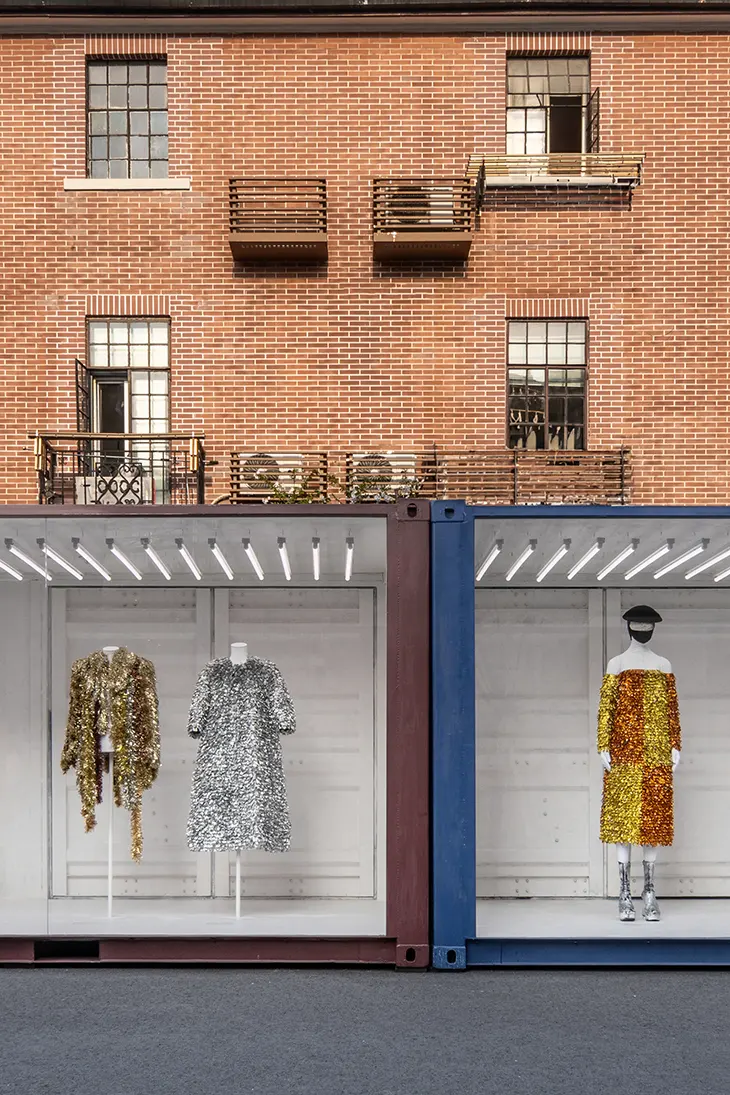
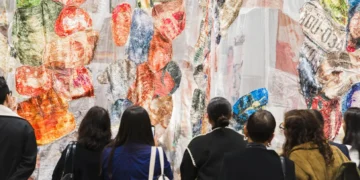
The Maison Margiela Shanghai event, rather than placing couture behind velvet ropes, Artisanal: Our Creative Laboratory is installed in containers set along an open street, a staging choice inspired by the location of the house’s Fall Winter 2026 show. The effect is intentionally direct. Visitors move past a sequence of container-like structures, each functioning like a chapter in a living archive, where couture is framed as process, experimentation, and material intelligence.
This crated presentation matters because it aligns with what Artisanal stands for at Maison Margiela. Artisanal is not only the house’s haute couture line, it is described as the foundation of its creative language, rooted in handcraft, transformation, and the reworking of found materials into new fabrications. In Shanghai, the containers become both display and metaphor, suggesting storage, shipment, and the backstage mechanics of fashion, while keeping the focus on the garments themselves.
What Artisanal Means at Maison Margiela
In the house’s framing, Artisanal refers to garments, accessories, and shoes made by hand by the Paris atelier. It is the origin point for a way of working built on experimentation, handcraft, and the continual reinvention of everyday materials. The exhibition positions Artisanal as a creative laboratory, emphasizing that couture here is not a static category, but a method.
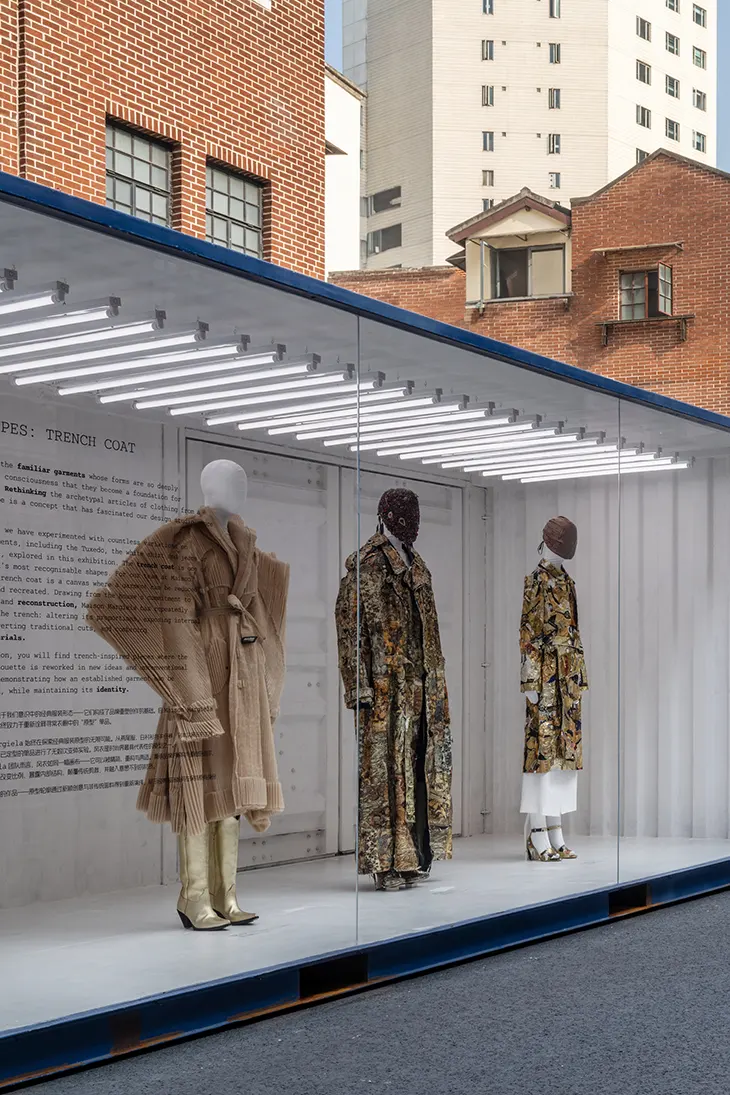
That method is made legible through the exhibition’s thematic structure. The 58 looks are divided into themes that reflect core couture explorations at the house, and each theme reads like a key to decoding Margiela’s approach. Across the containers, visitors encounter upcycling as a practice of reworking existing materials and garments into new forms, where value is created through transformation rather than novelty. Deconstruction, a signature Margiela logic, is present as an insistence on revealing structure, seams, linings, and construction methods as part of the final aesthetic.
Trompe l’oeil appears as illusion deployed through craft, where surfaces and treatments mimic other materials, silhouettes, or objects, challenging what the eye assumes. Archetypes bring familiar wardrobe forms into couture territory, using proportion, fabrication, and detail to shift meaning. Raw materials foreground the physical truth of textiles and components, allowing texture and finish to carry the narrative. The transformation of the everyday, a long-standing house impulse, elevates ordinary references into couture statements through recontextualization and unexpected fabrication.
A Timeline From AW1989 to Fall Winter 2026
The selection spans from the AW1989 porcelain plate waistcoat, cited as the first Artisanal piece, to the beeswax-treated Edwardian gown from Fall Winter 2026. That range is not simply historical, it is strategic. It frames Artisanal as continuous research, where early experiments become a foundation for contemporary couture.
By anchoring the exhibition in Shanghai immediately after the Fall Winter 2026 show, Maison Margiela links runway presentation to public-facing experience. The exhibition becomes a second stage, extending the narrative and offering a closer, slower encounter with the work. The street setting and container format reinforce the idea of couture as something constructed, handled, and tested, rather than only admired at a distance.
MaisonMargiela/folders: Four Cities, Four House Codes
Artisanal: Our Creative Laboratory is introduced as the first chapter of MaisonMargiela/folders, a program that began with the house’s Fall Winter 2026 show in Shanghai and continues through a series of exhibitions and experiences across four cities in China. Each city is dedicated to a distinct code of the house, unfolding as Artisanal in Shanghai, Anonymity in Beijing, Tabi in Chengdu, and Bianchetto in Shenzhen.
Following Shanghai, Anonymity: Our History of Masks Exhibition will take place in Beijing from April 07–12, followed by Tabi: Collectors Exhibition in Chengdu from April 09–13, and Bianchetto: Atelier Experience in Shenzhen from April 11–12. All experiences are open to walk-ins except for Bianchetto: Atelier Experience, which requires reservation.
This multi-city structure reads as both cultural programming and brand architecture. By isolating core codes, Artisanal, anonymity, Tabi, and bianchetto, the house turns its internal language into a set of public touchpoints, building clarity around what defines Maison Margiela beyond any single collection.
Digital Folders and Press Assets
Alongside the physical exhibition, Maison Margiela is making exhibition materials and installation documentation available through its MaisonMargiela/folders working digital folders on Dropbox. The documents are positioned as living files that will be updated as the project develops, reinforcing the laboratory framing and the idea of an evolving archive.
Visiting Information
Artisanal: Our Creative Laboratory Exhibition takes place on Yan Dang Road, Huangpu District, Shanghai, running April 02–06, open daily 10am–8pm, with walk-in access and no reservation required.
With 58 couture looks installed in street-side containers and organized around the house’s defining techniques, Artisanal: Our Creative Laboratory offers a rare, close-range view into how Maison Margiela builds couture as research, material transformation, and method, then brings that method into the city itself.




this just show how important the chinese market is now. this is not happening in New York, it is not happening in Paris anymore. It is happening in Shanghai! Asia especially china is now fashion’s only remaining market. And it clearly shows with Maison Margiela move. OTB is not playing games, they know where the business is. While the lunatics are starting wars elsewhere, terrible moments for Europe and USA fashion industry.