



Design rarely announces what it values. More often, those values emerge from what a system is willing to slow down for, what it treats as worthy of attention rather than efficiency. In a field increasingly shaped by automation and scale, experience designer Yifei Chen’s work is defined by that question of attention: not what a system can process, but what a person actually feels within it.
A Carnegie Mellon-trained computer scientist turned experience designer, Chen occupies a rare position at the intersection of technical fluency and narrative sensitivity. She holds a Bachelor of Science in Computer Science and Human-Computer Interaction from Carnegie Mellon University and a Master of Fine Arts in User Experience Design from the Savannah College of Art and Design. Currently a Designer at OKX, the blockchain technology and trading company with 120 million users globally, where her work spans the OKX app and the Web3 wallet, Chen moves fluidly between digital products, brand systems, visual narrative, and experimental art, unified by a persistent attention to how people feel, perceive, and connect within designed environments.
DESIGN
Her work has earned sustained international recognition. CoMove, a mobility concept she independently designed end-to-end, received the Red Dot Award for Brand & Communication Design, the Good Design Award, the Creative Communication Award (Best of Best), the German Design Award Distinction, the MUSE Design Award (Gold), and honors from the Indigo, London, French, New York, and International Design Awards. She also serves as a Local Leader for the Interaction Design Association (IxDA) and as a New Media Ambassador for the Service Design Network, positions that speak to her growing role in shaping discourse in the field beyond her own project work.
What distinguishes Chen’s practice is not its range but the coherence of its underlying concern. Each project, regardless of medium or scale, returns to the same territory: the space between what a system can process and what a person actually feels.
Redefining Mobility as Social Infrastructure:
CoMove
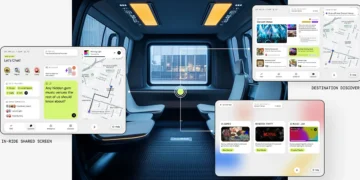
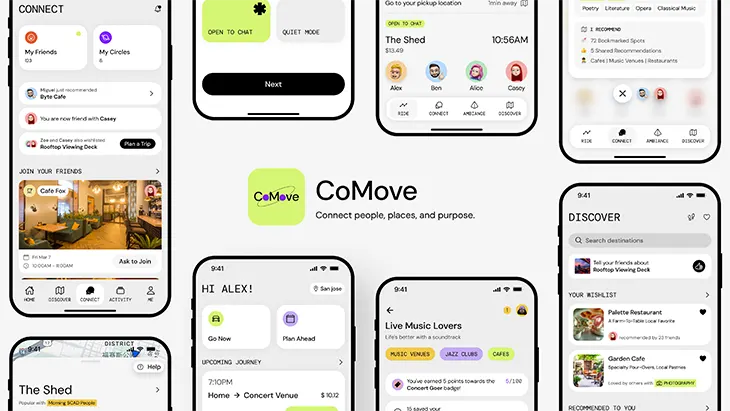
CoMove, the centerpiece of Chen’s recent body of work, proposes something most transportation design does not attempt: that a ride might be the occasion for a relationship. Independently conceived and executed as the project’s sole designer, responsible for research, strategy, visual identity, experience design, interface system, and product direction, Chen reimagines urban mobility not as a logistical problem but as an untapped social canvas. The work earned her the Red Dot Award and ten additional international design recognitions.
“Our research revealed something beyond traditional pain points,” Chen reflects. “A desire for meaningful connection. This realization fundamentally shifted the design approach from optimizing efficiency to orchestrating encounters.”
CoMove is organized around four experiential pillars, Ride, Connect, Ambiance, and Discover, each shaping a different dimension of how passengers encounter the journey. The in-vehicle experience is built around a challenge most designers would bypass: how a system might create the conditions for authentic conversation without engineering it. Context-aware social prompts, shared ambiance controls for lighting, temperature, and sound, and a community architecture that extends the ride into lasting relationships together treat the vehicle interior as a social environment rather than a transit utility. The design’s measure is not what people see on a screen but the quality of presence they feel in a shared space.
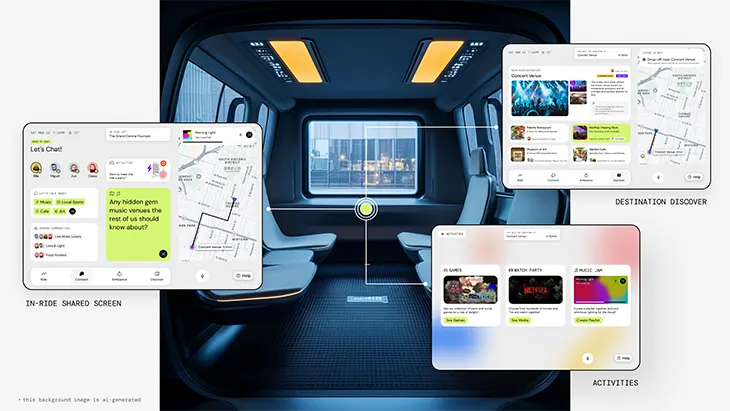
Chen’s broader conviction runs through every decision: that sensory choices are behavioral ones, and that color, sound, spatial composition, and material presence shape how people feel, act, and connect. CoMove’s long-term vision extends that conviction to scale, toward smart city integration and urban planning organized around social transit hubs.

Designing Access as a Human Right:
Olen Arc
Where CoMove works within a system that already reaches most people, Chen’s design leadership on Olen Arc addresses one that consistently fails those it claims to serve. Olen Arc was designed for what had not previously existed: a digital front door for Native and Indigenous communities, a single, centralized platform through which people could access healthcare, government services, and tribal resources that had long been scattered across overlapping federal, state, and local systems, or simply out of reach.
The design challenge was not only logistical but deeply relational. Rural and tribal communities must navigate overlapping benefit structures that were not built for the people seeking resources, in a context where geographic isolation, cultural distance, and questions of data sovereignty make conventional platform design inadequate from the start. Chen’s approach centered on co-designing with community members directly, ensuring the experience was shaped by the people it would serve rather than imposed upon them, and translating systemic complexity into a conversational, culturally informed interface that allowed people to ask for what they need in their own terms.
The project won Alaska’s inaugural AI pitch contest, a recognition that validated the design philosophy as much as the technology: that AI’s most consequential application is not automation, but access. Where most platforms are built to reduce friction for people who already have power, Olen Arc was designed to dismantle barriers for communities that optimized systems have historically excluded.
Chen’s practice becomes most legible at this edge. The conviction that design’s role is to make every person feel seen is, in CoMove, an aspiration for urban connection. In Olen Arc, it is a structural demand.
The Poetic Mirror:
Experiments in the Language of the Machine
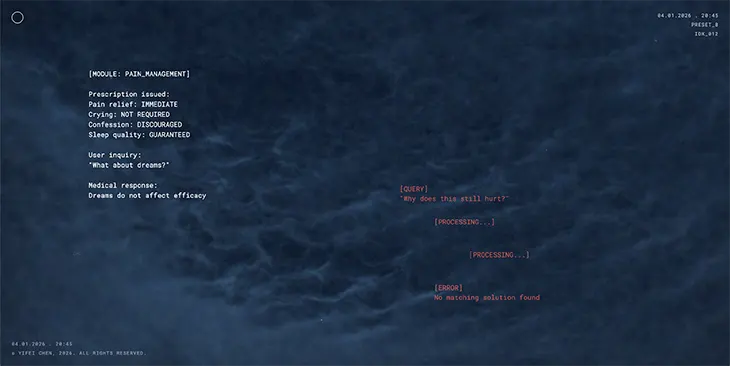
Alongside her commercial work, Chen maintains a self-initiated practice that extends her design philosophy into critical and artistic territory, work that moves between screen-based interactive poetry and new media installation. These pieces turn the formal vocabulary of her discipline, interface conventions, system log syntax, glitch aesthetics, spatial composition, against the assumptions that vocabulary normally serves.
Convenience Optimization Log, published as an interactive web experience, immerses viewers in a poem-as-system-log overlaid onto AI-generated photographs of flowering branches, the experience of encountering nature through a machine incapable of registering it. Its modules process questions the system was never designed to answer: happiness, memory, the gap between a grandmother’s 30 internally memorized songs and a user’s 30,000 algorithmically shuffled tracks. A companion piece places the viewer inside a glitch-fractured sky, surrounded by spatial typography mapping the texture of optimized urban life: identical coffee shops, copy-pasted skies, movement the system flags as invalid.
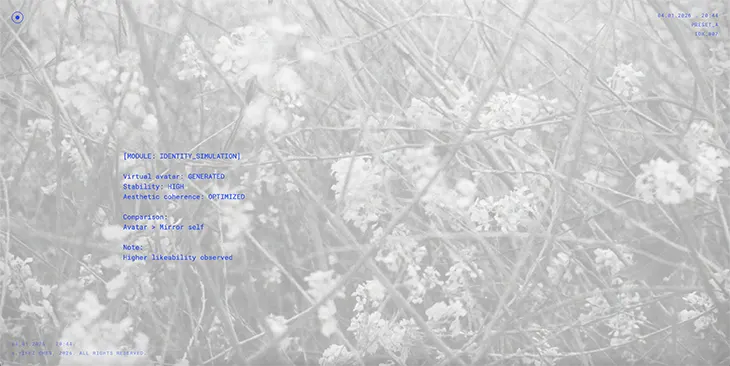
These works hold open the tension that CoMove and Olen Arc resolve, between system logic and lived sensation, as a question rather than a solution. They function as a critical mirror for Chen’s own professional tools, examining what those tools assume about human experience and where those assumptions fail.
The Through Line:
Recovering What Systems Leave Behind
Across these projects, Chen articulates a consistent position within experience design. In CoMove, efficiency without human warmth is a design failure. In Olen Arc, the measure of an AI system is not how much it automates, but who it finally lets in. In her experimental practice, the language of optimization is turned against itself to reveal what frictionless experience costs.
“I began thinking of myself less as a creator of features or interfaces,” Chen has written, “and more as an architect of experiences and relationships.”
What unites the work is not a visual style but a philosophical orientation, one that treats experience design not as a service to technological systems but as a counterweight to them. Chen designs the human layer that algorithms cannot generate: the moment of connection between strangers on a shared ride, the experience of asking for help in your own language and being understood, the disquiet that surfaces when a system is asked to process a question about happiness and cannot.
In this, Chen confirms her role not merely as a practitioner of experience design, but as a designer who insists the field take seriously what it leaves behind.
Words by Editor Maya Lane.