


By the time Euphoria reaches its finale, “In God We Trust,” the question is no longer whether Sam Levinson has lost the plot. He has. The real question is how much of what made this show extraordinary in its first season survives the wreckage of its third, and the uncomfortable answer is: not nearly enough.
Season 3 is a strange, often fascinating, frequently infuriating piece of television. It opens with a five-year time jump, depositing the kids of East Highland into adulthood with the efficiency of a cold shower. The high school melodrama that defined Seasons 1 and 2 is gone. In its place, Levinson has built something that looks more like a prestige crime drama, a fentanyl-smuggling thriller with Euphoria’s signature visual gloss and none of its emotional coherence.
The show’s Rotten Tomatoes score tells one story (a bruising 56%), but the truth is more complicated. Euphoria Season 3 is not a failure so much as a betrayal: of its characters, of its audience, and of the raw, uncomfortable intimacy that once made it essential viewing.
Drug Lord Show That Forgot Its Own Soul
Levinson’s pivot to crime thriller territory is the season’s most divisive decision. Rue Bennett, now in her early twenties, finds herself entangled with a fentanyl-smuggling network almost by accident, and what follows is a season that increasingly prioritizes plot mechanics over the psychological interiority that made Rue worth watching in the first place. The East Highland kids are no longer teenagers navigating trauma. They are pieces on a board, moved by narrative necessity rather than character logic.
The problem is not ambition. Expanding the canvas, as Levinson has said in interviews, is a reasonable creative instinct for a show whose characters have outgrown their suburban milieu. The problem is execution. The drug lord storyline feels grafted onto characters we loved for different reasons, and the seams show constantly. Scenes that should carry emotional weight are undercut by plot logistics. Relationships that took seasons to build are compressed or abandoned. The show’s once-reliable emotional gut-punches arrive muffled, as if through a wall.
Alexa Demie: The Season’s Undeniable Revelation
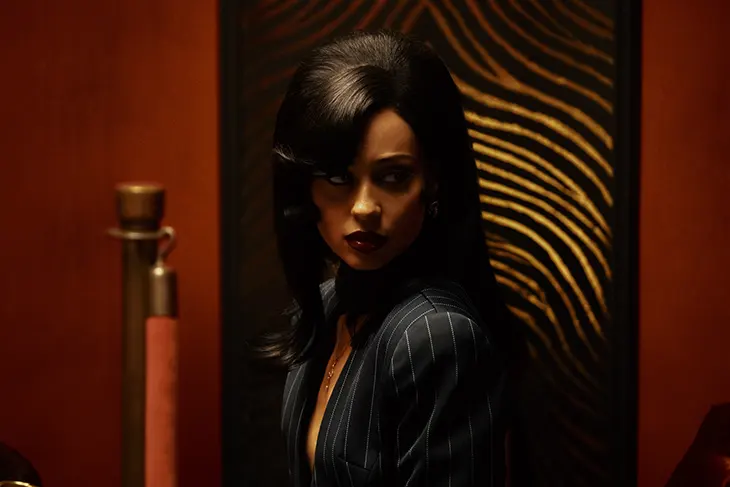
If the season belongs to anyone, it belongs to Alexa Demie.
Maddy Perez was always the show’s most electric supporting presence, a character who functioned largely as a mirror for other people’s chaos. Season 3 gives her something she has never had before: a story entirely her own, and Demie seizes it with both hands. Her arc this season, which involves a deal struck with Alamo Brown (Adewale Akinnuoye-Agbaje), a man with more money than conscience, is the closest the season gets to genuine dramatic tension.
Demie plays Maddy with the wounded precision of someone who has absorbed a lifetime of other people’s carelessness and decided, finally, to be careless on her own terms.
Demie plays Maddy with the wounded precision of someone who has absorbed a lifetime of other people’s carelessness and decided, finally, to be careless on her own terms. Her scenes with Akinnuoye-Agbaje have a coiled, dangerous chemistry. Her scenes with Cassie (Sydney Sweeney) carry the particular bitterness of a friendship that was never quite friendship to begin with. Demie has always been a performer who operates at full intensity. This season, she has been given the architecture to match it.
The comparison to Jacob Elordi is apt. Elordi’s career was irrevocably shifted by what Nate Jacobs did for his range, transforming him from a conventional heartthrob into someone audiences were genuinely afraid of. Demie’s Season 3 work may do the same: prove that she is not merely compelling but dangerous, in the best possible sense. She is overdue for a film career that matches this level of work, and this season makes the argument loudly.
Adewale Akinnuoye-Agbaje: Season’s Best Performance, Full Stop
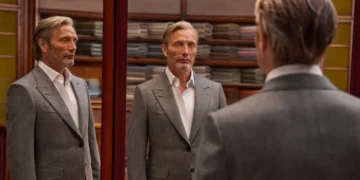
Credit where it is absolutely due. Adewale Akinnuoye-Agbaje, as drug kingpin Alamo Brown, is the single most compelling reason to watch Season 3. His screen time nearly matches Zendaya‘s, which would have seemed like an odd creative choice going in, but by the finale it feels inevitable. He plays Alamo with an operatic, theatrical menace that is both absurd and genuinely frightening, a man who treats cruelty as performance and performance as art.
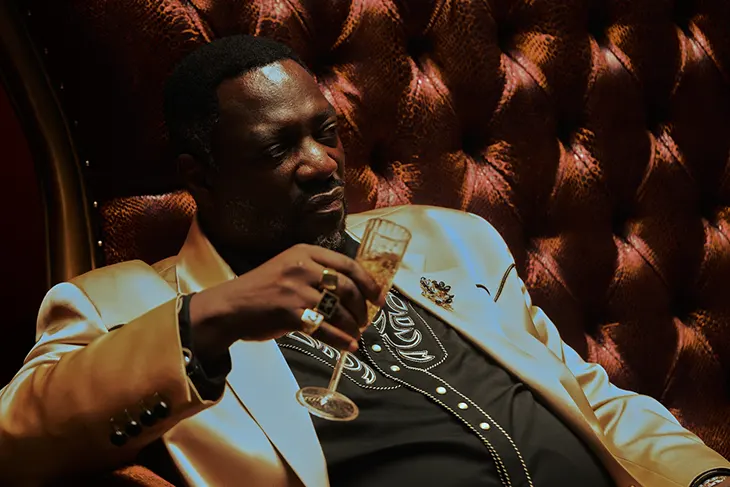
Akinnuoye-Agbaje method-acted the role extensively, and the work shows. Alamo is not a stock villain. He is a specific, strange, almost Shakespearean creation, someone whose charm and his brutality share the same root. His scenes in the finale are among the most gripping the show has produced in three seasons. The actor is 58, and if there is any justice, this role becomes his defining late-career moment. A performance like this does not come from a character brief. It comes from an actor doing something close to transformation. Alamo is the main character of the season.
Colman Domingo and the Season’s Most Wasted Opportunity
It is genuinely painful to write this, but here it is: Colman Domingo, one of the finest actors working in American television, has been handed a storyline so awkward and so theologically muddled that even he cannot salvage it. And hardly had the best of use of the 1 hour and 40 minute finale, and yet was made to spiral forward the finale with his monologues, giving us uncalled for reflection into Sam Levingston himself.
The concept is not without merit. The execution is. The writing reduces Ali to a function rather than a person
Ali Hassan‘s arc in Season 3 casts the character as a deeply religious recovering addict turned sponsor, a man who has found God with the intensity of someone who has lost everything else. The concept is not without merit. The execution is. The writing reduces Ali to a function rather than a person. He exists to guide Rue toward questions of faith and higher power, an admirable dramatic idea that Levinson approaches with the subtlety of a sermon. The scenes between Domingo and Zendaya in the diner were the emotional centerpiece of Season 2. Season 3 recaptures something of that dynamic in flashes, but the surrounding material is so schematic that it undercuts everything. Domingo brings his full instrument to the role, every time, without exception. The show does not give him enough to play.
Zendaya: Still the Show’s Conscience
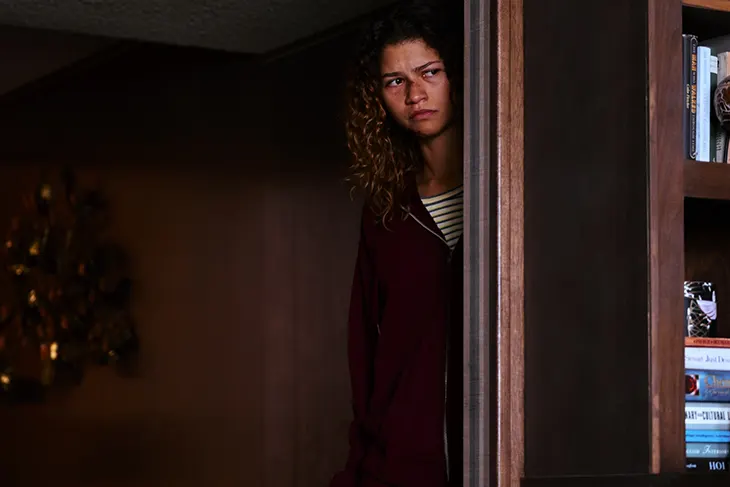
She remains extraordinary. Let us be precise about that. Whatever has gone wrong with Euphoria Season 3 at the level of writing, structure, or creative vision, Zendaya‘s performance as Rue Bennett continues to be among the most technically accomplished and emotionally truthful work on American television. The season asks her to inhabit a version of Rue who is older, more guarded, and in some ways more lost: not the teenage girl drowning in grief and substances, but a young woman who has learned enough to be dangerous and not enough to be safe.
Zendaya plays this with extraordinary precision. She has developed a physical vocabulary for Rue that communicates inner states without announcing them. The way Rue holds her body in scenes of forced calm. The micro-adjustments in her eyes when she is calculating rather than feeling. The moments, fewer this season but devastating when they arrive, when the calculation drops entirely and what is underneath is raw and immediate.
Zendaya is operating at a level the show’s writing does not consistently meet, which makes watching her this season an experience simultaneously thrilling and frustrating. She is holding up a structure that keeps threatening to collapse around her.
Critics who have praised the performance while condemning the season are not being contradictory. The two assessments are both accurate. Zendaya is operating at a level the show’s writing does not consistently meet, which makes watching her this season an experience simultaneously thrilling and frustrating. She is holding up a structure that keeps threatening to collapse around her.
Her Emmy consideration for this season should be automatic. Whether the Academy continues to recognize what she is doing is a different, more cynical conversation.
Hunter Schafer and the Artist Who Never Quite Exists
Then there is Hunter Schafer, and Jules, and the season’s most visually ambitious and dramatically hollow subplot. Jules is now an art school dropout turned working artist, and Sam Levinson leans into that identity with the enthusiasm of someone who has watched one too many biopics about tortured creatives. What we get are sweeping shots of massive canvases, time-lapse brush strokes, abstract compositions filmed with the kind of reverence usually reserved for surgery or prayer. It is television’s shorthand for artistic genius, the same playbook Tyler Perry has used for decades when a character needs to be read as talented without the show having to do the actual work of demonstrating why. The problem is that Jules’s art is never consistent. Her style shifts from scene to scene without logic, not as a character choice or a sign of evolution, but because nobody in the writers’ room appears to have asked whether a real artist’s practice would actually look like this. Her boss rejects her work. Lexi outs her at the worst possible moment. And her ending, like Nate Jacobs‘s before her, arrives as if written by a different show entirely, resolving nothing that was actually set up and resolving plenty that was not. Schafer, for her part, does what she has always done: she makes Jules’s opacity feel intentional, makes the questionable writing look like depth. She is better than the material. She has been better than the material for three seasons running.
Sydney Sweeney: Humiliation as Storyline
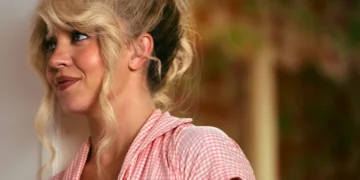
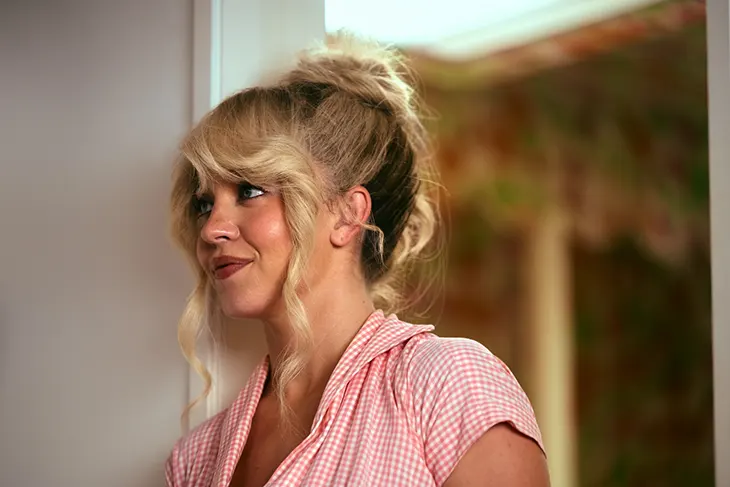
Sydney Sweeney arrives at the Euphoria finale having spent eight episodes in what critics have not unfairly described as a humiliation ritual. Cassie Howard marries Nate Jacobs in an over-the-top ceremony in Episode 3, and from that point the show treats her with a cruelty that feels less like dramatic intention and more like indifference. Sweeney is a capable actress with real comic instincts and an underrated ability to play self-delusion with genuine pathos. None of that is particularly useful here, because the writing gives Cassie almost nothing to do except unravel, repeatedly, in the same key.
She reportedly filmed three different endings. Sam Levinson chose one. Whatever it was, it is difficult to argue that any version of this season served the character, or the actress, particularly well.
The finale offers her a conversation with sister Lexi (Maude Apatow) anchored in biblical language and the season’s exhausting preoccupation with God, surrender, and faith, a scene that lands with all the dramatic weight of a pamphlet. Two sisters, one of them in crisis, and the best the show can offer is scripture as emotional shorthand. It is the kind of writing that mistakes solemnity for depth, and it is precisely the wrong scene for the wrong character at the wrong moment. She reportedly filmed three different endings. Sam Levinson chose one. Whatever it was, it is difficult to argue that any version of this season served the character, or the actress, particularly well.
A Finale That Answers Questions Nobody Was Asking
“In God We Trust” closes the season with a kind of grim resolution. It answers the plot questions while leaving the emotional ones open in ways that feel less like intentional ambiguity and more like unfinished thinking. The Alamo storyline reaches a conclusion that is violent, abrupt, and narratively satisfying in a shallow sense. Rue’s arc ends on a note that is deliberately unresolved, which would be powerful if the season had built toward it more carefully.
What the finale cannot undo is the cumulative effect of a season that mistook scale for depth. Season 1 of Euphoria was brilliant because it was intimate, because it understood that the most devastating stories are often the smallest ones. Season 3 spent eight episodes pursuing something larger and arrived at something considerably smaller. The irony is acute.
Euphoria ends not with a bang or a whimper, but with a shrug dressed up in very expensive and painfully copied cinematography. For a show that once made you feel everything, that might be the unkindest cut of all.
Find the latest TV show reviews and news on DSCENE.