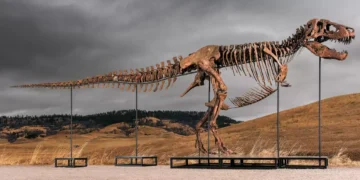



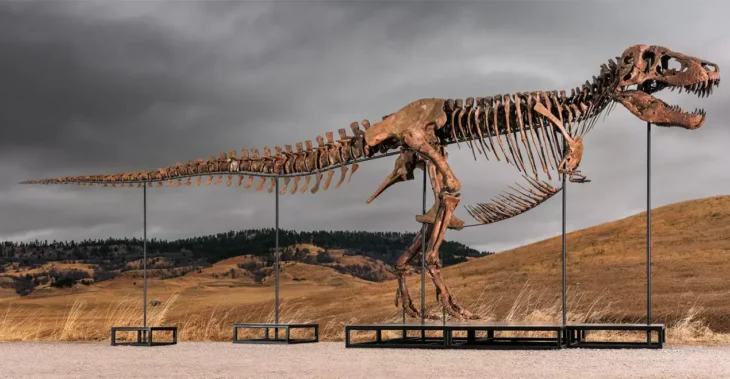
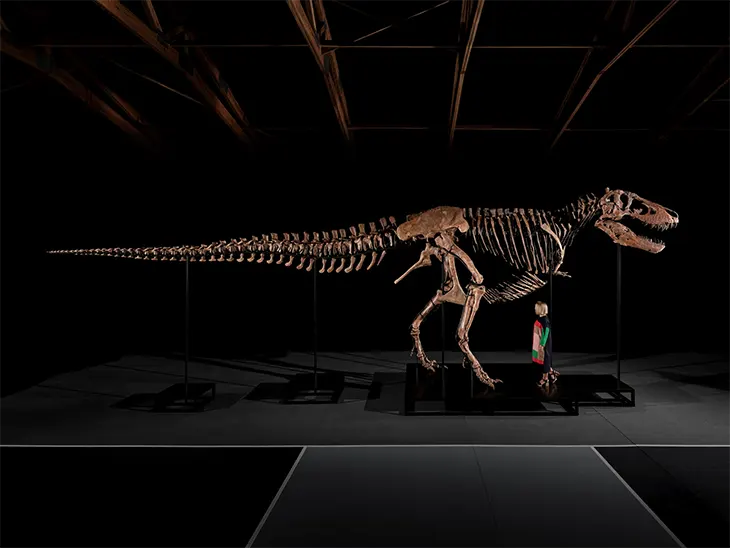
On July 14, 2026, Sotheby’s sold a Tyrannosaurus rex skeleton named Gus for $50.1 million, dethroning a stegosaurus that had held the commercial fossil record for two years. The bidding war lasted nearly ten minutes. Seven bidders competed. The unnamed buyer remained a mystery. The sale marked something larger than a single blockbuster transaction: it signaled a fundamental repositioning of what the world’s most prestigious auction houses consider valuable, collectible, and culturally significant enough to stake their future on.
This was not Sotheby’s first foray into prehistoric remains, nor is it an isolated experiment. The 267-year-old institution, synonymous with Old Masters paintings and Renaissance sculptures, has quietly rebranded itself as a dealer in natural history. The shift reflects a deeper anxiety within the auction world. As contemporary art markets contract and traditional collecting categories mature, auction houses are branching into new territory to sustain profit margins. Fossils, once the exclusive domain of museums and paleontologists, are now luxury commodities. The pivot is strategic. It is also revealing.
The Art Market Pivot
The contemporary art market has cooled considerably. Sales volumes have declined, price volatility has increased, and younger collectors have shown less appetite for the speculative collecting that characterized the 2010s and early 2020s. Auction houses, dependent on transaction volume and seller commissions, are feeling the squeeze. Their response has been to diversify aggressively into categories that promise growth and novelty. Enter natural history.
Sotheby’s launched “Geek Week” in 2023, a deliberate rebranding of natural history auctions designed to appeal to collectors interested in science, pop culture, and rare objects. The framing was shrewd. By situating fossils alongside comic book memorabilia, vintage posters, and entertainment collectibles, the auction house positioned them not as scientific artifacts but as cultural objects worthy of the same market attention as fine art. Gus was sold under this banner. The strategy worked, it is beyond a simple dinosaur skeleton auction.
The parallels between art collecting and fossil collecting are not accidental. Both rely on scarcity, provenance, and the belief that ownership confers status. A complete T. rex skeleton is extraordinarily rare. Fewer than 50 have ever been found. The specimens valuable enough to auction are rarer still. Gus comprises 183 fossil bones and 30 gastralia (belly ribs), making it approximately 61 percent complete by bone count but representing 75 to 80 percent of the animal’s total bone mass. The metrics are precise, the language scholarly, the authentication rigorous. Every listing reads like a museum catalog entry, complete with scientific pedigree and condition reports.
This market logic has begun to reshape the entire fossil trade. A specimen’s scientific completeness matters, but primarily insofar as it affects marketability. Pathologies, signs of ancient injury or disease, are now marketed as desirable features because they increase price. The practice inverts scientific value. In a museum context, pathologies are studied as evidence of evolutionary adaptation and survival. In the auction context, they become marketing features that justify higher price tags.
The Wealth Redistribution Machine
The ultra-wealthy have, in recent years, diversified their collections across categories it didnt start or stop with dinosaur skeleton auction. The old guard of art collectors still exists, but they are supplemented now by tech billionaires, cryptocurrency magnates, and newly minted fortunes who lack the traditional knowledge required to navigate Old Masters but who crave the cultural cache of ownership. A fossil requires no aesthetic judgment. It requires capital.
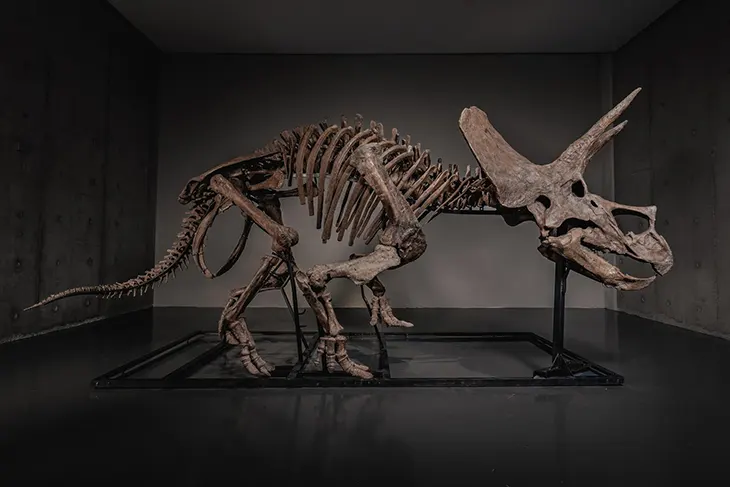
JOOPITER, the digital-first auction platform founded by Pharrell Williams, sold a Triceratops skeleton named Trey for $5.55 million in March 2026, establishing a record for a dinosaur sold in an online-only auction. Trey had been on continuous public exhibition for nearly 30 years, viewed by more than one million people. When JOOPITER announced the sale, it framed Trey not as a scientific specimen but as a “cultural icon of prehistoric life.” The language was deliberate. So was the merchandise strategy: JOOPITER partnered with Los Angeles fashion brands 424 and Hoorsenbuhs on a commemorative capsule collection to mark the sale. Owning a dinosaur was no longer merely a financial transaction. It had become a lifestyle statement, a marker of taste and access to rare objects and exclusive drops.
The dinosaur skeleton auction model works because it targets a specific demographic: wealthy collectors seeking objects that signal sophistication but do not require connoisseurship. A fossil does not demand years of study to appreciate. Its value is self-evident: it is old, rare, and valuable because everyone agrees it is valuable. This circular logic is precisely what makes it attractive to new money.
Following the Money
The escalation has been relentless. In 2020, Stan, a T. rex skeleton, sold for $31.8 million, igniting what paleontologists now call a “fossil gold rush.” Since then, a Deinonychus sold for $12.4 million, a Ceratosaurus for $30.5 million, and an unusually complete Stegosaurus named Apex for $44.6 million. Each sale begets the next. According to reporting on the Gus sale, the market for major specimens shows no signs of slowing. Auction houses are competing overtly to sell the most expensive dinosaur ever. The economics are simple: as traditional art categories mature and their growth potential flattens, new categories offer higher margins and less saturated competition.
This is what a market in transition looks like. Auction houses are not abandoning art; they are supplementing it. They are hedging their bets by positioning themselves as dealers in rare objects across multiple categories. A collector who might have spent $50 million on a Pollock or a Basquiat in 2015 might now spend it on a T. rex. The auction house captures commission either way. The object itself is almost irrelevant.
Cost of Invisibility
The rise of fossil auctions has ignited a fierce debate within the paleontological community. The Society of Vertebrate Paleontology released a statement cautioning that “when private individuals buy fossils, opportunities for future research, education and public engagement may be permanently diminished.” The concern is not abstract. It is structural.
When a specimen like Stan is purchased privately, it vanishes from public view. Initially, secrecy surrounded its purchaser, sparking fears the skeleton would disappear into a billionaire’s mansion, lost to science. It eventually emerged that Stan had been purchased for the Natural History Museum Abu Dhabi, which opened with the specimen as its centerpiece. But the opacity was revealing. No one knew where the fossil had gone or whether it would ever be accessible again.
Gus presents an identical dilemma. Sotheby’s declined to name the buyer or reveal their location. The skeleton could be destined for a museum, a private mansion, or a storage vault. The public may likely never know. What is certain is that the fossil, which was excavated from private land in South Dakota over three summers and prepared to museum standards, will not be available for the kind of open-access research that academic institutions require.
The consequence is a two-tiered system of ownership. Public institutions house incomplete skeletons, reproductions, or specimens deemed less commercially valuable. The finest, most complete, most scientifically informative specimens go to private collectors. This inverts the traditional hierarchy. For centuries, major museums have been the custodians of the world’s most important natural history specimens. Now, billionaires are.
Thomas Carr, a paleontologist at Carthage College in Wisconsin, articulated the stakes plainly when it comes to a dinosaur skeleton auction: “The auction houses are in a competitive race to sell the most expensive dinosaur ever. No museum could afford this.” His statement captures the structural problem. Museums operate on fixed budgets. A major natural history institution might allocate $5 million to $10 million annually for acquisitions across all categories. Gus cost $50.1 million. The math is impossible.
When Billionaires Play Patron
Not all wealthy collectors are indifferent to science. Kenneth C. Griffin, the hedge fund billionaire, purchased Apex, the stegosaurus, for $44.6 million in 2024. Rather than sequestering the specimen, he arranged a four-year loan to the American Museum of Natural History in New York. The loan included funding for research, 3-D scanning of the fossilized bones, and documentation that the museum has committed to making accessible to paleontologists worldwide. It was a model of enlightened collecting.
But Griffin is the exception, not the rule. His willingness to loan a specimen and fund research demonstrates what is possible when a collector possesses both wealth and social consciousness. It also underscores how dependent paleontological science has become on the whims of private collectors. The field is no longer self-sufficient. It is hostage to generosity.
The deeper question is whether a world in which the finest fossils are owned by private collectors is sustainable. It is also whether science should be contingent on the decisions of billionaires to grant access or fund research alongside their acquisitions. Peter Larson, the commercial paleontologist whose team excavated Stan, has defended high prices as reflecting “the years of painstaking work it takes to excavate and prepare a specimen for sale.” The economics are compelling from a commercial perspective. Yet the defense sidesteps the larger issue: who bears the cost, and who reaps the benefit?
The Red Flag
The pivot to fossils should concern anyone watching the broader health of cultural institutions. This is not simply about auction houses diversifying their portfolios. It is about what happens when traditional markets soften and institutions that were once stewards of culture become primarily profit-maximization machines. When art market conditions change, auction houses do not fade quietly. They absorb new categories, commodify new objects, and engineer new collecting desires to maintain revenue streams.
Fossils, in this logic, are not objects of scientific or cultural significance. They are inventory. They are alternatives to art, which has become too mature, too saturated, too resistant to the kinds of price appreciation that drove speculative collecting in the previous decade. The market does not care whether a specimen goes to a researcher or a collector’s private vault. It cares whether it sells for more next year than it did this year.
This represents a fundamental inversion of purpose. Museums and universities acquired fossils to understand the past. Auction houses acquire fossils to profit from the present. The two objectives are not compatible. When auction houses set the market price for major specimens, that price becomes the baseline for what institutions must pay if they want to acquire them. Museums, dependent on public funding, cannot compete. The market thus extracts the finest specimens from the public sphere and relocates them to private hands.
There is also the question of conservation and authenticity. The fossil market is vulnerable to fraud. In 2022, Christie’s withdrew a T. rex fossil from auction after accusations that marketing materials had made the skeleton seem more complete than it actually was. The incident revealed that auction houses, despite their reputation for rigor, are not always reliable arbiters of authenticity. A specimen sold into private hands, with minimal future scrutiny, could be misidentified, misrepresented, or damaged by an owner indifferent to its scientific value.
The Epistemological Cost
There is an ironic paradox at the heart of the fossil boom. These specimens are valuable precisely because they are old, rare, and scientifically informative. Yet the market that assigns them ever-higher monetary values treats them as mere objects of possession, severed from their scientific context. A T. rex skeleton hanging in a billionaire’s penthouse ceases to be a window into the Cretaceous. It becomes a status symbol.
This distinction matters profoundly. Art objects and timepieces are aesthetic experiences. Their value lies partly in the pleasure of ownership. Fossils are different. They are temporal documents. Their deepest value lies not in possession but in knowledge extraction, in the questions they allow scientists to answer, the hypotheses they allow to be tested. A fossil in private hands, unavailable for research, retains its monetary value but loses its epistemic value entirely.
Thomas R. Holtz Jr., a vertebrate paleontologist at the University of Maryland, made the point starkly after Gus sold: with $50.1 million, a small paleontological institution could fund two full seasons of fossil excavation and research. The money spent on a single skeleton could finance years of scientific discovery. Instead, it has purchased one specimen for one owner.
What Comes Next
If the past six years are any indication, fossil prices will continue to climb. The supply of major specimens is finite and dwindling. Each sale increases demand among wealthy collectors who view fossils as alternative investments. Sotheby’s has signaled that natural history will remain a core category. JOOPITER has demonstrated that digital platforms can successfully reach younger, more digitally native collectors. The infrastructure of the fossil market is solidifying.
The paleontological community faces a choice. Some institutions have chosen to engage constructively with collectors, facilitating loans and research access. Others have adopted a more adversarial posture, criticizing the market and advocating for restrictions on fossil sales. Neither approach has proved effective at slowing the market or reversing its trajectory.
The real question is whether society should allow the privatization of scientifically invaluable specimens to proceed unchecked. Fossils are records of deep time, evidence of the evolution of life, and bridges between the past and present. If they become mere luxury goods, sequestered in private collections and inaccessible to researchers and the public, something essential is lost. Not just scientific knowledge, but the shared understanding that the past belongs to all of us.
For now, the market has spoken. Gus sold for $50.1 million at a dinosaur skeleton auction. The buyer remains unknown. The skeleton will go wherever its new owner decides. And in some warehouse, mansion, or freeport, a 38-foot-tall T. rex that walked the earth 67 million years ago has entered the world of exclusive ownership. Whether it serves science or merely sits as a trophy remains to be seen. But what is clear is that auction houses have found a new category to monetize, and they will not stop mining it until scarcity, not science, is the only thing left.
Browse the latest art stories on DSCENE.