


Jeanne Friot introduces Hysteria for Spring Summer 2027, turning the title of her ninth collection into a force of refusal. The designer looks at those who scream too loudly, cry at the wrong time and reject demands for calm. The collection asks who defines madness, who holds that authority and who receives the label of hysteric in a world where reality itself seems unstable.
SPRING SUMMER 2027
Friot approaches hysteria through its history as a tool of control over bodies. At the Salpêtrière, Charcot arranged weekly spectacles where Parisian bourgeois audiences watched interned women. Freud later began to understand that these women had suffered violence and that their bodies expressed what their era forbade them to say. Society chose diagnosis over listening and the asylum over truth. Friot brings that history into the present through figures such as Niki de Saint Phalle, Yayoi Kusama, Marilyn Monroe and the Italian poet Alda Merini, who wrote across hospital walls in lipstick.
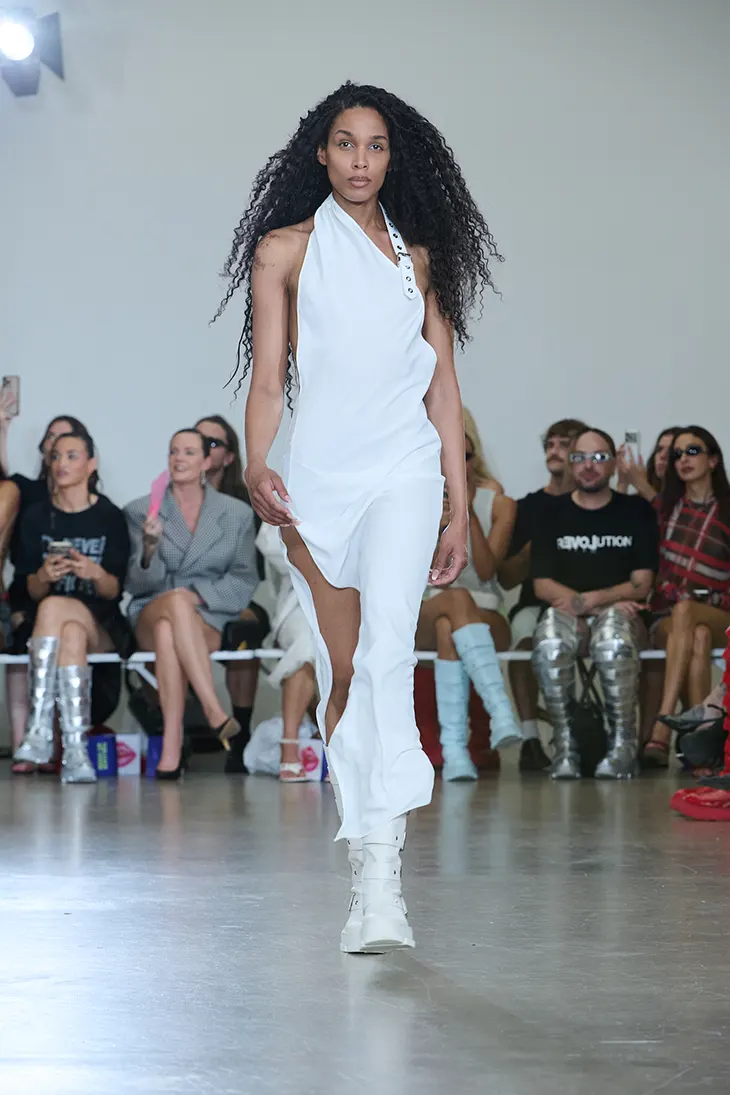
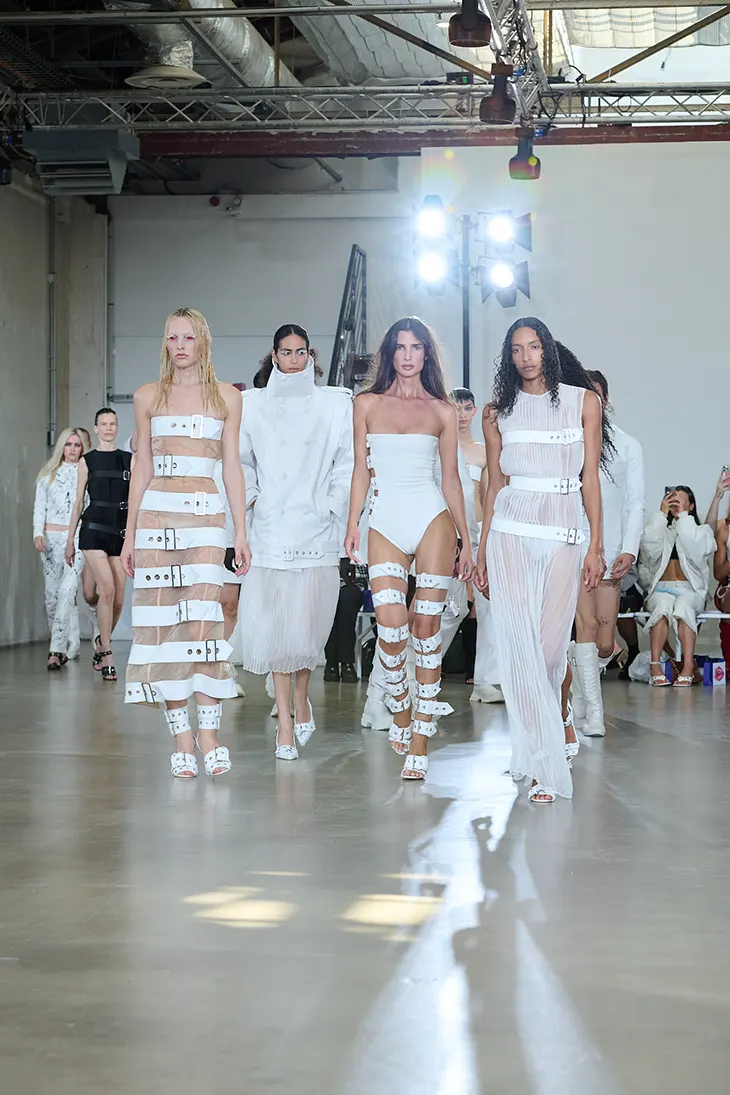
Escape drives the collection. Friot imagines women breaking out of the asylum in clothes built for flight and combat. The color story follows that movement, starting with clinical white, moving into spotted looks and closing in deep black. White carries the language of walls, smocks and institutions. During the making of the collection, the team washed hands compulsively, saw stains everywhere and entered a state of paranoia, turning the process into part of the performance.
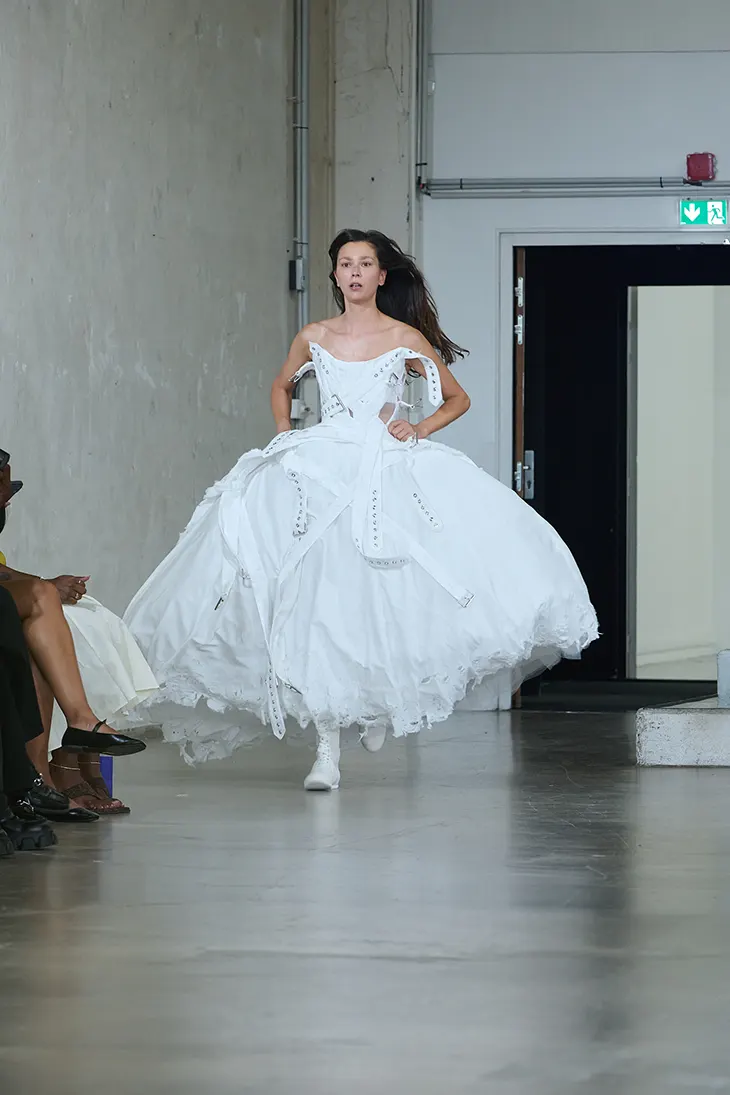
The silhouettes hold restraint and release in the same frame. Friot’s signature belts return in displaced forms, sometimes as constraint and sometimes as armor. Trench coats rise above the nose, covering half the face while hair spills out, reclaiming a symbol long tied to feminine seduction. A dramatic crinoline dress opens the show with direct references to Galliano, McQueen and Westwood, placing Friot inside an independent fashion lineage drawn to theatricality and refusal.
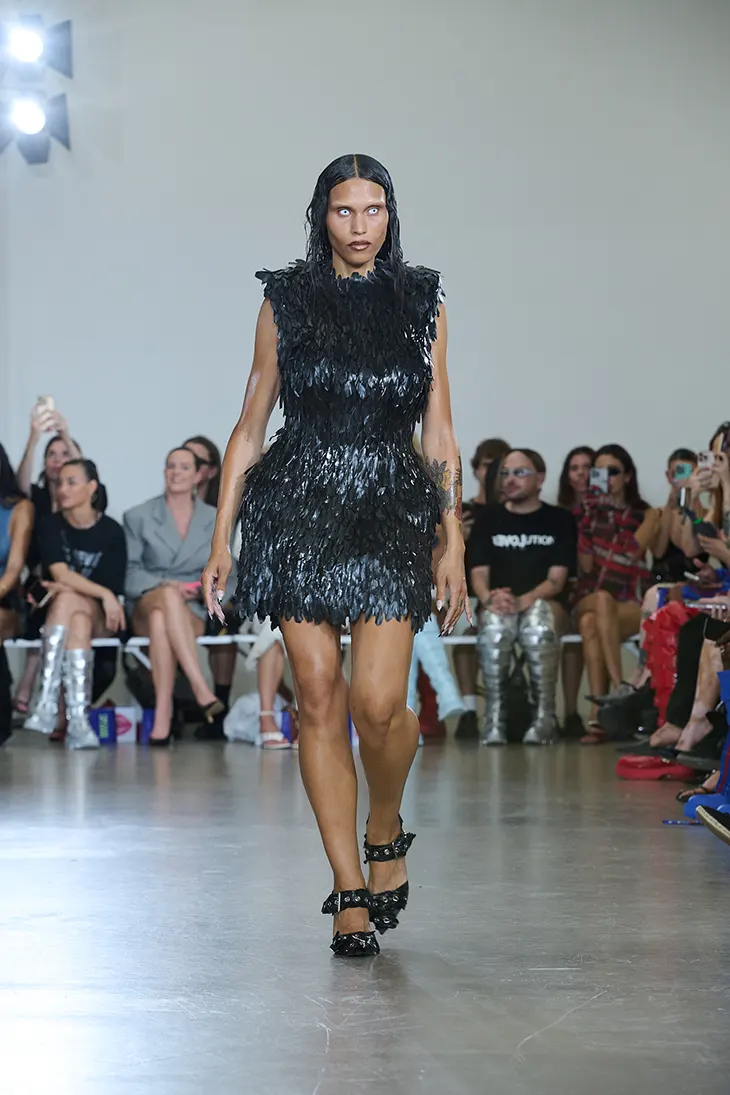
The closing looks sharpen the body through mini dresses with accentuated hips and shoulders covered in latex feathers by Matisse Di Maggio. House muse Claude Emmanuelle wears this final image as a feathered woman unfeathering patriarchy. Friot also pulls from sport and lesbian culture, using boxing, motorcycle and racing references to create clothes that free movement and prepare the body for confrontation.
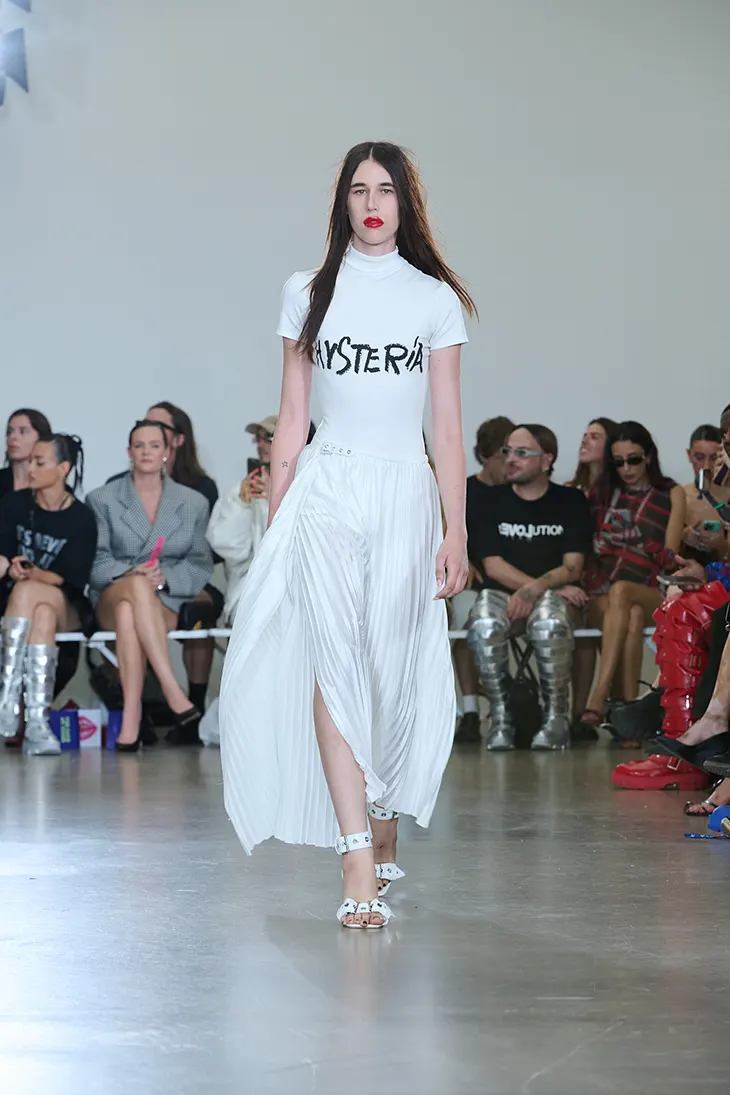
In partnership with Domestique, the collection introduces carabiner belts, AirPods clips, lipstick holders and cigarette cases. Details carry the collection’s references. The slogan appears in lipstick, echoing Alda Merini’s hospital walls. Stains on garments recall the exploded surfaces of Niki de Saint Phalle’s shooting works. White covers the lashes, while red lenses sharpen some eyes.
Friot also looks to Foucault, who called the hysterics of the Salpêtrière “the first true militants of anti-psychiatry.” The collection uses that idea to show resistance through the body, through exaggerated symptoms and through spectacle turned against those who tried to control it.