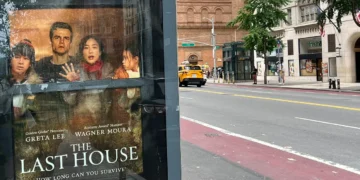




The Last House arrives on Netflix as a high-concept sci-fi thriller that never quite justifies the confidence placed in it. Directed by Louis Leterrier (Now You See Me, Lupin) and starring Greta Lee and Wagner Moura, the film traps a family inside their home with no escape, dwindling resources, and a mysterious external threat. The premise is solid. The execution is where things unravel.
That Netflix felt compelled to publicly confirm the script wasn’t generated by artificial intelligence says everything you need to know about the state of streaming cinema in 2026. The clarification itself became the story, which is rarely a good sign.
Concept Built on Loose Logic
The film’s central conceit, a family imprisoned in their own home by an unexplained force, taps into genuine anxiety. Director Leterrier understood this, assembling a survival consultant and marine coordinator to ground the family’s ordeal in tactical reality. The cast underwent intensive dive training. The attention to detail was deliberate, methodical, professional.
And yet the story itself consistently undermines that labor.
Plot holes don’t simply accumulate; they calcify. The mystery that seals the Delgados inside their home demands explanation, but the film offers resolution that feels rushed and improvised, as though the writers had reached a contractual page count and moved toward the exit. Survival sequences that should carry weight become exercises in mechanical problem-solving. When the family finally confronts the source of their predicament, the answer is so underdeveloped that it reads less as revelation and more as surrender.
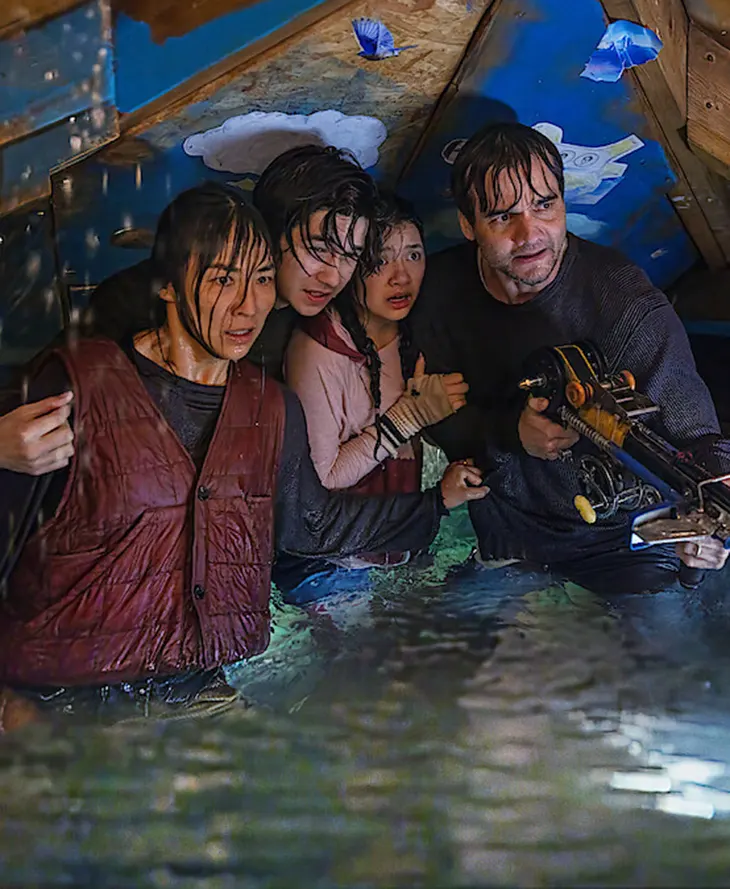
Greta Lee carries the emotional spine of the film as Ann, the family’s unstoppable force of will. Her performance, rooted in what she describes as “hysterical strength,” the phenomenon of ordinary people summoning extraordinary physical reserves under extreme stress—is the film’s most convincing element. She deserves far better material. That an actor of her caliber (Past Lives, Russian Doll) agreed to carry this project is genuinely baffling. Perhaps she saw something in the early drafts that didn’t survive production. Perhaps she needed the paycheck. Whatever the reason, her presence only magnifies the gap between intention and result.
Symptom of Streaming’s Bigger Problem
The Last House is, at minimum, not a second-screen experience. It demands attention. The cinematography pulls you forward. The score, composed by Yair Elazar Glotman and built around unconventional textures, even a rusty door treated as an instrument, maintains constant pressure between sanctuary and dread.
But attention alone doesn’t equal engagement when the story can’t sustain it.
This is the real crisis Netflix faces heading into 2027. The streamer has the resources to assemble world-class talent, bring in directors who understand tension, hire consultants to obsess over survival authenticity. What it cannot reliably produce anymore is a coherent narrative that justifies the time audiences invest. The Last House is the perfect artifact of that failure: polished, methodical, expensive, and fundamentally hollow.
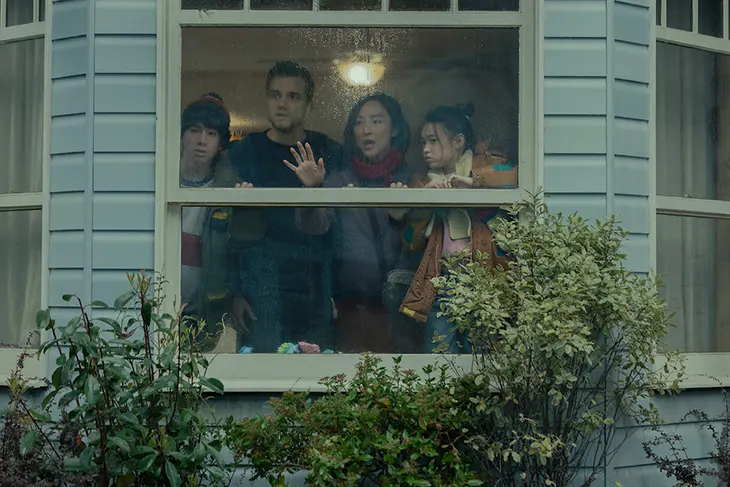
The film doesn’t fail from a lack of ambition or care. It fails from a structural laziness that no amount of craft can disguise. When you reach the climax, you’ll understand that the filmmakers had painted themselves into a corner and chose the quickest exit rather than the most earned one.
Should You Stream It?
Yes, but with calibrated expectations. The Last House is the rare Netflix release that won’t dissolve into background noise. The performances hold. The visual language works. Greta Lee at her best is worth ninety minutes of your time.
Just don’t expect the film to know what it’s about by the time it ends. As for Oscar consideration come February 2027, Netflix’s silence will be answer enough.
The Last House is streaming now on Netflix.