


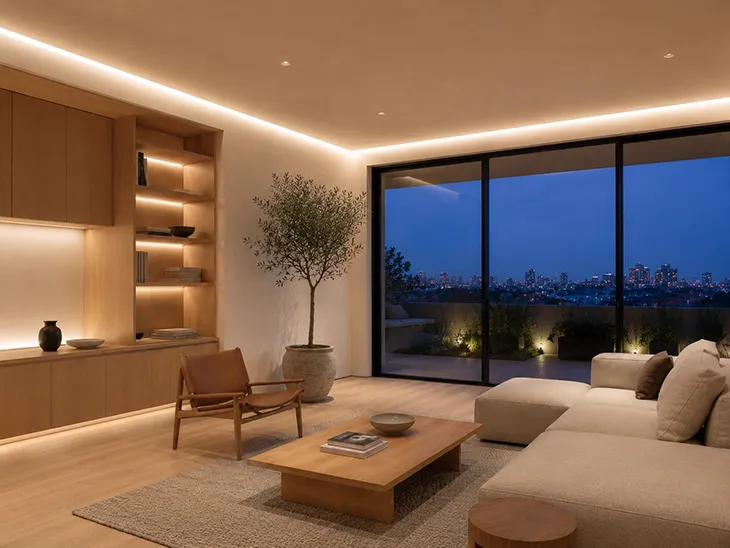
Most linear LED specifications stop at the strip datasheet: lumens per foot, CCT, CRI, wattage. Those numbers matter, but they describe the part you can swap in an afternoon. The aluminum extrusion that carries the strip is doing the engineering, and it usually gets nothing more than a finish code on the drawing. The ranking is backwards.
A strip sets the numbers on paper. The extrusion decides whether they still hold a year later, through how it moves heat, how it controls glare, and how it meets the ceiling. Get the strip wrong and you lose a few points of efficacy. Get the profile wrong and you get color shift, early lumen depreciation, and a glare source over someone’s desk. What follows is what separates a commodity extrusion from an engineered one, and why it belongs on the drawing before any strip is ordered.
The profile is a heat sink before it’s anything else
An LED’s life and color stability come down to junction temperature, which is simply how hot the diode runs. Push it roughly 10 °C past its rated point and you about halve the expected life. The only thing pulling that heat away is the aluminum the strip sits in, which makes heat the profile’s first job rather than a footnote.
So a real specification does not ask whether a strip fits inside the channel. It states watts per meter at a stated ambient temperature, and the case temperature the profile settles at. Published figures from a European extrusion range give the shape of it: a compact 20 mm surface body carries around 22 W/m and settles near 47 °C; a mid-power 35 mm body takes about 30 W/m; a 55 mm recessed body rated for office glare handles roughly 36 W/m at around 48 °C; and a wide architectural body of about 116 mm, carrying some 1.4 kg of aluminum per meter, clears 55 W/m. At the small end, a 6×14 mm micro profile tops out near 10 W/m, which tells you plainly that a tiny extrusion is an accent fixture whatever strip you force into it.
| Profile class | Thermal load | Case temp @ 25 °C | Typical use |
|---|---|---|---|
| Micro (6×14 mm) | up to 10 W/m | accent-level | Furniture, coves, accent |
| Compact surface (20 mm) | up to 22 W/m | ~47 °C | Cabinet, residential cove |
| Mid-power (35 mm) | up to 30 W/m | ~55 °C | Commercial general lighting |
| Recessed, UGR-rated (55 mm) | up to 36 W/m | ~48 °C | Office and screen-based work |
| Wide architectural (116 mm) | up to 55 W/m | wide-body | High-load architectural runs |
One catch belongs on the drawing: those figures are measured at 25 °C. Real ceiling voids often run 30–35 °C, and every extra degree eats into the profile’s spare capacity. Take the strip’s actual wattage rather than its headline maximum, leave margin for the plenum you will really see, and pick a profile rated above that. “Supports up to X W/m” with no temperature attached is not a thermal spec.
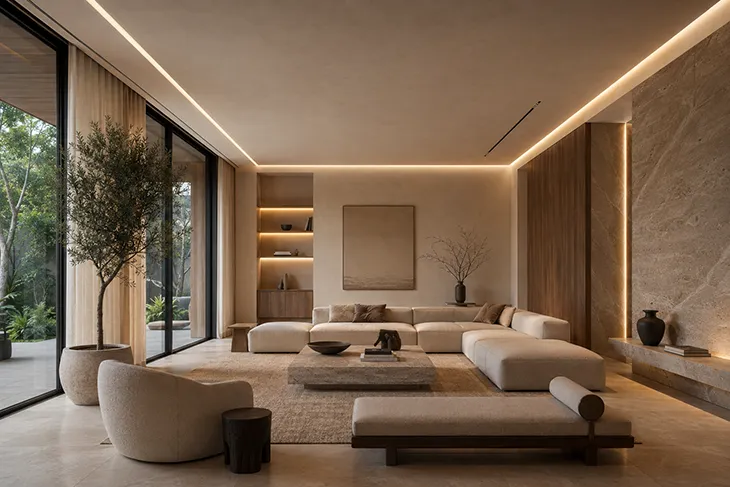
Glare and comfort live in the diffuser
Every diffuser trades output for comfort. An opal diffuser wipes out the LED dots and gives a soft, even line, and passes roughly 70–75% of the light. A micro-prismatic, or honeycomb, diffuser lifts that to about 85–90% and still hides the dots, which is why it is the one to reach for when output matters.
Glare is the part that lands on complaint lists. In any room where people sit under the line or face it, whether an office, a classroom or a reception desk, the diffuser wins or loses it. EN 12464-1 sets UGR ≤ 19 for offices and screen-based work, and recessed bodies specified for those rooms are now published at UGR < 17, tighter than the standard requires, with either a micro-prismatic or an opal diffuser. That number belongs on the drawing, because finding the glare after the strip is energized is the expensive way round.
One more check: a diffuser should stay clear for years. Yellowing or haze after three to five seasons is a material decision rather than fate, and UV-stabilized polycarbonate or acrylic is what prevents it.
Reflectors and optics move real lumens
The inside of an extrusion is not dead space. Bare aluminum reflects about 70–75% of the light that hits it, while shaped reflectors above 95% reflectivity put roughly 18–20% more light out of the diffuser face for the same strip wattage. For a specifier that is not a vanity number: 18–20% more delivered light means a lower-wattage strip reaches the same lux target, which means less heat, longer life and a smaller driver.
Where you need to aim light rather than spread it, the optic does the work. An asymmetric body throws its beam to 55–65° for walls and shelving, while a louvered profile pulls output into a controlled 60° cone and kills direct glare under low ceilings. Two profiles running the identical strip can read completely differently depending on reflector and diffuser, which is why the photometric file, the IES or LDT download rather than the strip’s lumen rating, is the document to read.
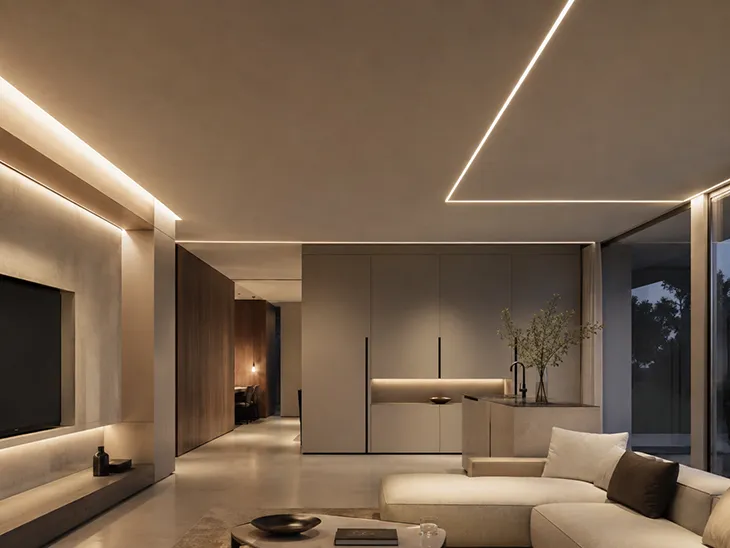
Mounting is the architecture
Once heat and optics are handled, mounting sets both the look and the order of work on site. A trimless or plaster-in line goes in two stages: a framing profile before the plasterboard is taped, then the lit module after the room is finished. On the better systems that module drops onto magnets, so it lifts out for re-lamping without touching the ceiling. Recessed bodies carry side flanges that hide the cut; surface and suspended versions suit ceilings you cannot or will not break into; and IP67 bodies carry the same light line into bathrooms, pools and façades.
What keeps a project coherent across all of that is one optical body offered in several mounts. The better ranges of aluminum LED profiles put the same profile in surface, recessed, trimless and suspended form, so the line keeps its character when the ceiling condition changes from one room to the next.
Four numbers that belong on the drawing
Strip the linear detail back and four values carry it, none of them the finish code:
- Rated W/m at the ambient you will actually see, with the case temperature there, not the 25 °C lab figure.
- The diffuser’s glare rating for the room: EN 12464-1 sets UGR ≤ 19 for offices and screen work, and going tighter is worth it wherever glare comfort matters.
- CRI and CCT judged at the diffuser face, after its light loss, not off the strip datasheet.
- The IP rating for the location: IP20 dry, IP44 splash, IP67 wet or outdoor.
The strip is a commodity you will swap on the next job or the next LED generation. The extrusion is the part doing the engineering, and specified that way it will outlast several strips. The manufacturers worth their listing publish thermal data, photometric files and BIM objects per profile, and those three downloads tell you more about how a line will age than any lumen figure on a strip reel.