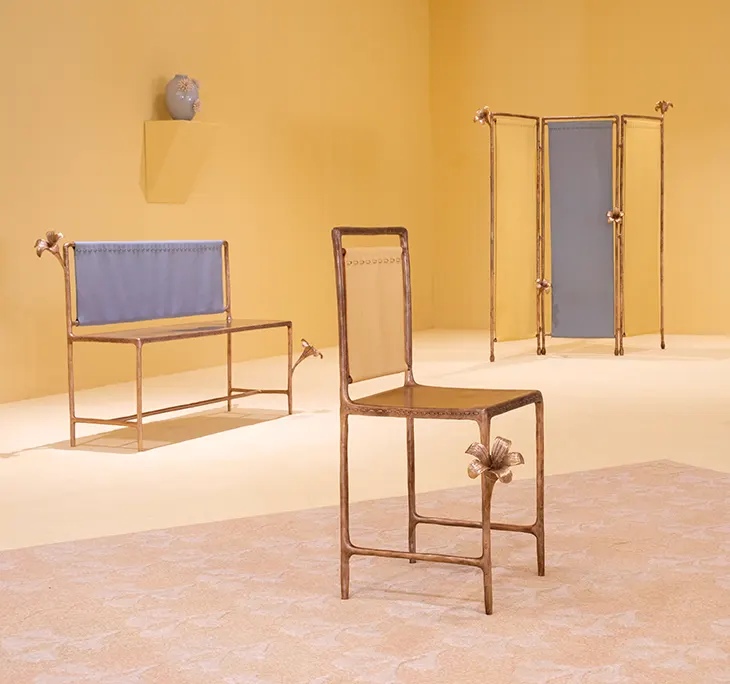



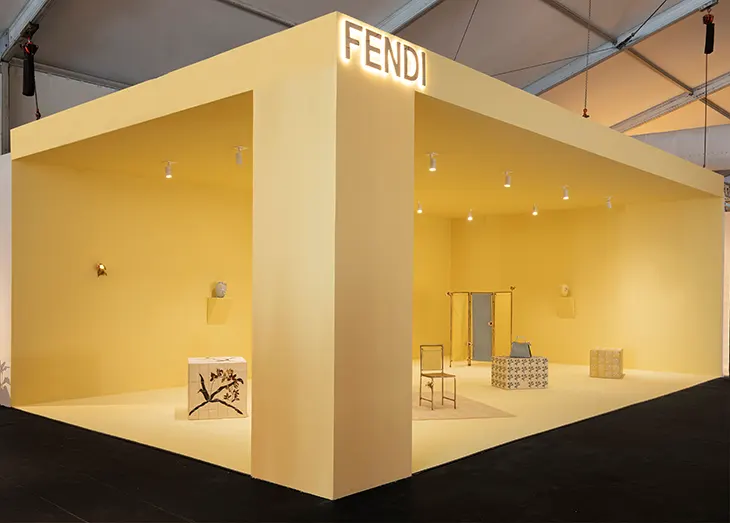
FENDI marks its 100th year with Fonderia Fendi, a design project conceived by Conie Vallese for Design Miami 2025. Vallese shapes the installation as a ‘salotto’ inspired by Italy’s role in the 1925 Decorative and Industrial Modern Arts exhibition in Paris. She works with five Italian ateliers, FENDI’s leather workshops, Fonderia Battaglia, Officine Saffi Lab, CC-Tapis, and Barovier & Toso, to create bronze, ceramic, glass, carpet, and leather pieces that form a unified sculptural language. The project also draws from Karl Lagerfeld’s 1994 illustration Les Cinq Doigts d’une Main, which portrays the five Fendi sisters and informed Vallese’s focus on collective expression.
DESIGN
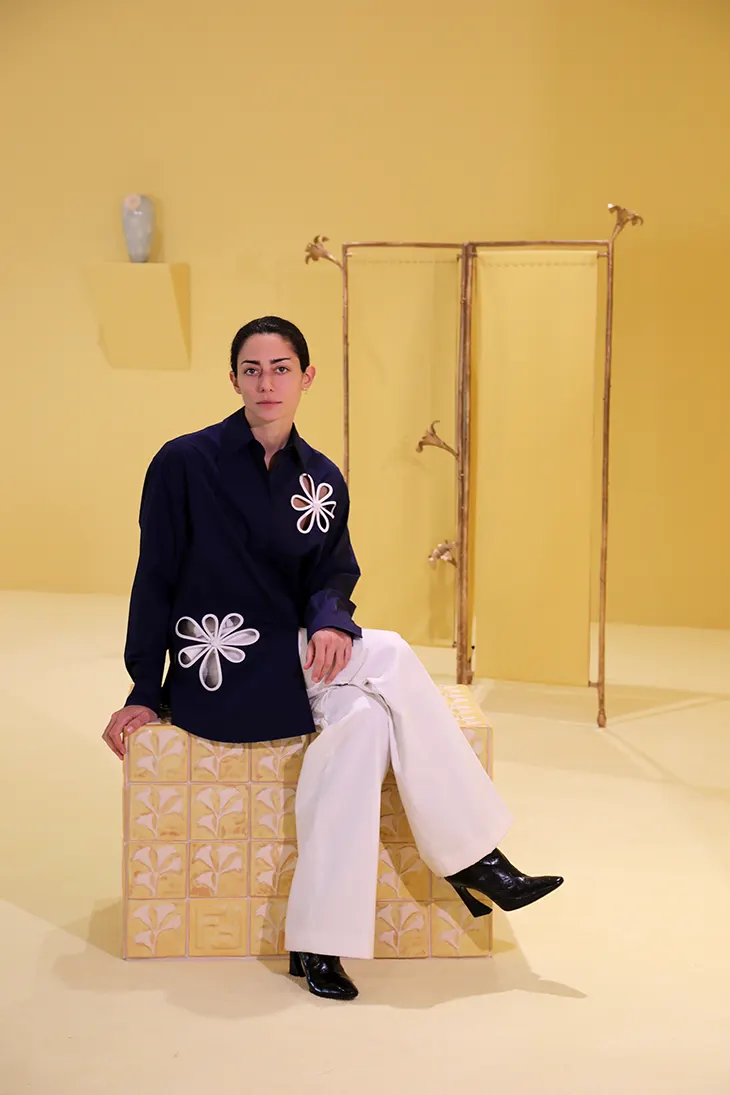
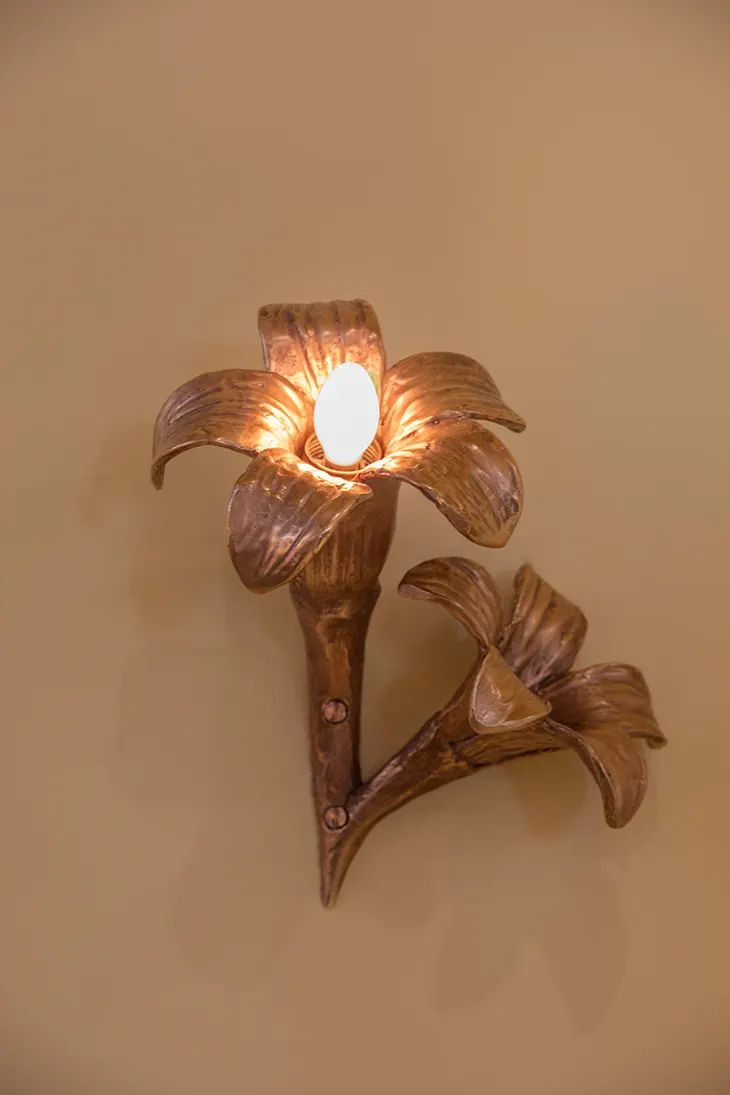
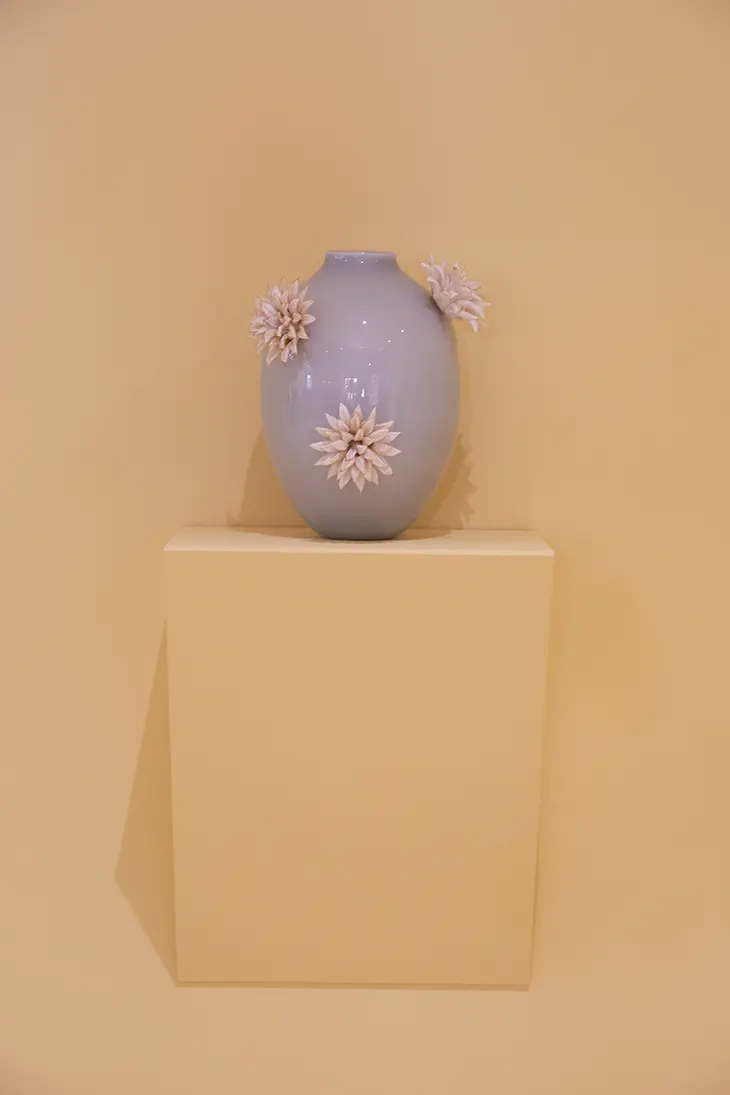
The space unfolds in rosy bronze, sorbetto yellow, and pale anice blue, with soft light emphasizing textures in opaque glass, glazed tiles, tufted surfaces, and hand-shaped lines. Lilies and orchids appear across the installation, including a bronze screen, bench, chair, and sconce cast in Milan. Ceramic pedestals and cubes carry the floral motifs with double F tiles in soft glazes. A wool rug by CC-Tapis interprets the tiled effect through carved detail, while Barovier & Toso create pastel vases with sculpted appliqués.
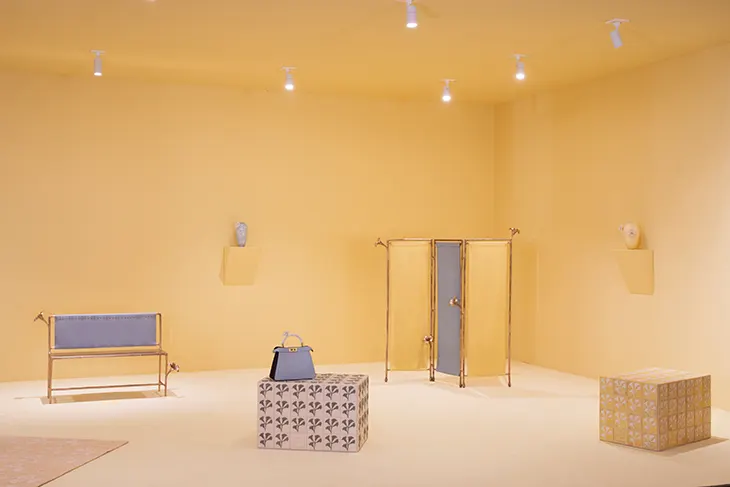
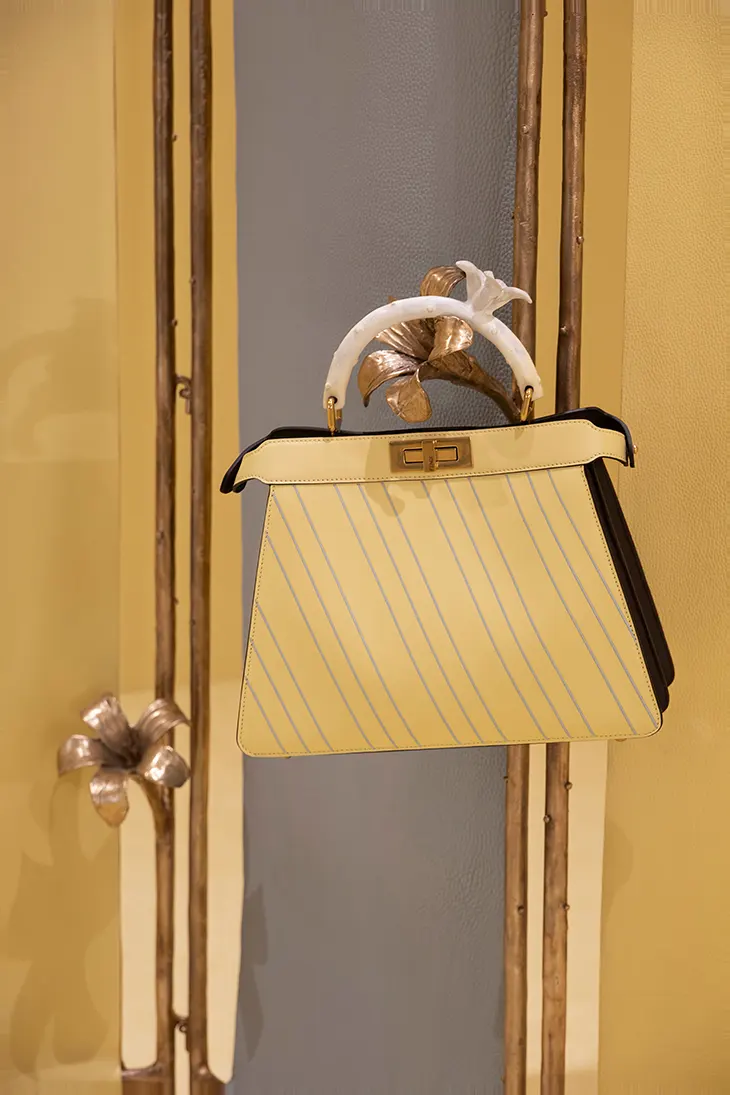
FENDI extends its tradition of inviting guest artists to reinterpret the Peekaboo bag. Vallese designs a reversible model in pale yellow and blue calfskin with ceramic details, produced in an edition of five for the Miami Design District boutique.
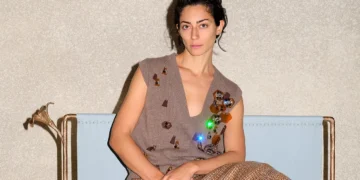
In this interview, editor Katarina Doric talks with Conie Vallese as she reflects on the materials, motifs, and collaborations that shaped Fonderia Fendi. Their conversation moves through her interest in organic forms, the dialogue with Italian ateliers, and the strength she associates with the next chapter of the House.
What guided your choice of materials for each object?
My choice of materials was guided by the dialogue at the heart of the project: to create an intimate space where collaboration is strong and bringing together feminine strength and Italian craft. Glass, bronze, and ceramic are materials I return to throughout my practice because they naturally hold organic forms, embrace imperfect textures, and support my approach to creating one-of-a-kind pieces.
“I hope this project speaks to a future where FENDI continues to embrace the power, complexity, and depth of women, not as a concept, but as a lived and felt reality.”
What drew you to lilies, orchids, and Selleria stitching?
On one side, flowers have been a central subject in my work for some time. Their forms hold an emotional softness and a quiet strength, qualities that translate beautifully into sculptural materials. They carry a certain elegance and tension. At the same time, FENDI has a rich visual language, and while imagining the bronze pieces, their iconic Selleria stitch came to me as meaningful detail to explore. I incorporated the stitch not only as an impression in the bronze, playing with the illusion that something solid could be “hand-stitched”, but also through hand-crafted leather elements. In yellow and pale blue hues.
What surprised you most during the making with the various ateliers?
Even though each atelier has its own techniques and history, the pieces found a shared voice almost instinctively, it all naturally came together and the materials complemented each other, creating a space of beauty and simplicity. Coming together with another opens a space for exchange, where ideas evolve, learning flows in both directions, and something stronger is created through the meeting of different perspectives.
“I want the materials to hold onto those traces of touch, to show that something solid can still feel intimate.”
How do you navigate the tension between industrial process and hand-formed imperfection?
Even when I work with large workshops, the hand is always at the center. The industrial process becomes a framework, a kind of architecture, but the gesture, the softness, is what gives the object its life. I want the materials to hold onto those traces of touch, to show that something solid can still feel intimate. Each atelier brings a mastery of technique, but they also can understand the value of imperfection and that’s for me the beauty I want to hold on. So, I push for that on the process, for a form that holds the spontaneity of its making. In the end, the tension becomes the essence, and I think is also where authenticity arise.
What do you hope this project communicates about the next chapter of FENDI?
I hope this project speaks to a future where FENDI continues to embrace the power, complexity, and depth of women, not as a concept, but as a lived and felt reality. So much of FENDI’s history has been shaped by women so I wanted the installation to honor that lineage. Through the materials, the organic forms, and the tension between softness and solidity, the project for me celebrates the kind of strength that women carry, resilient, and deeply connected to beauty. If this hints at the next chapter of FENDI, I wish it suggests a house that continues to honor women: their hands, their stories, their emotional intelligence. And that the project conveys that femininity is not a style, but a strength, an energy to embrace and celebrate fully.