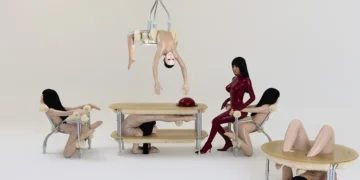



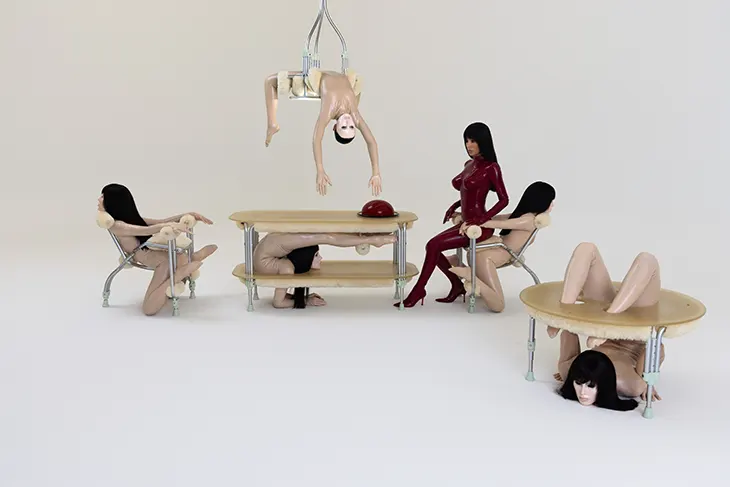
From its opening gesture, BIO POP positions itself as critique. In reality, it functions as rehearsal. Bianca Censori’s debut performance work, presented in Seoul as the first chapter of a seven-part cycle, claims to examine domesticity as the origin point of social control. What it delivers instead is a careful restaging of female submission, rendered clean, symbolic, and disturbingly unchallenged.
ART
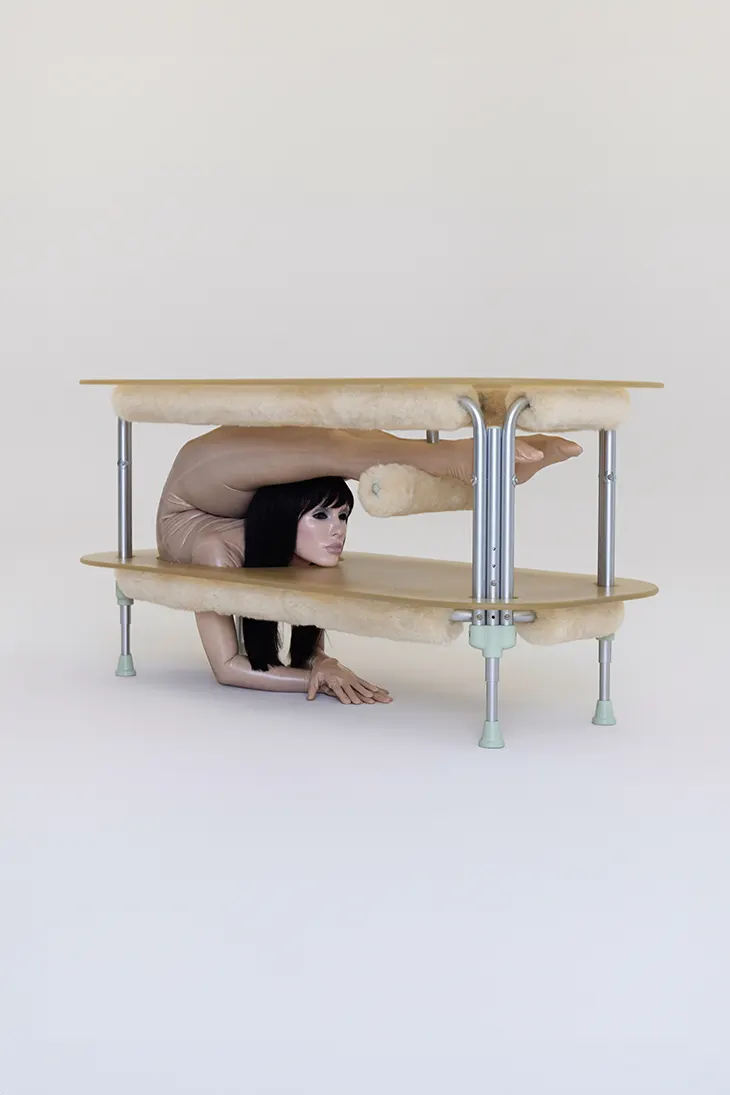
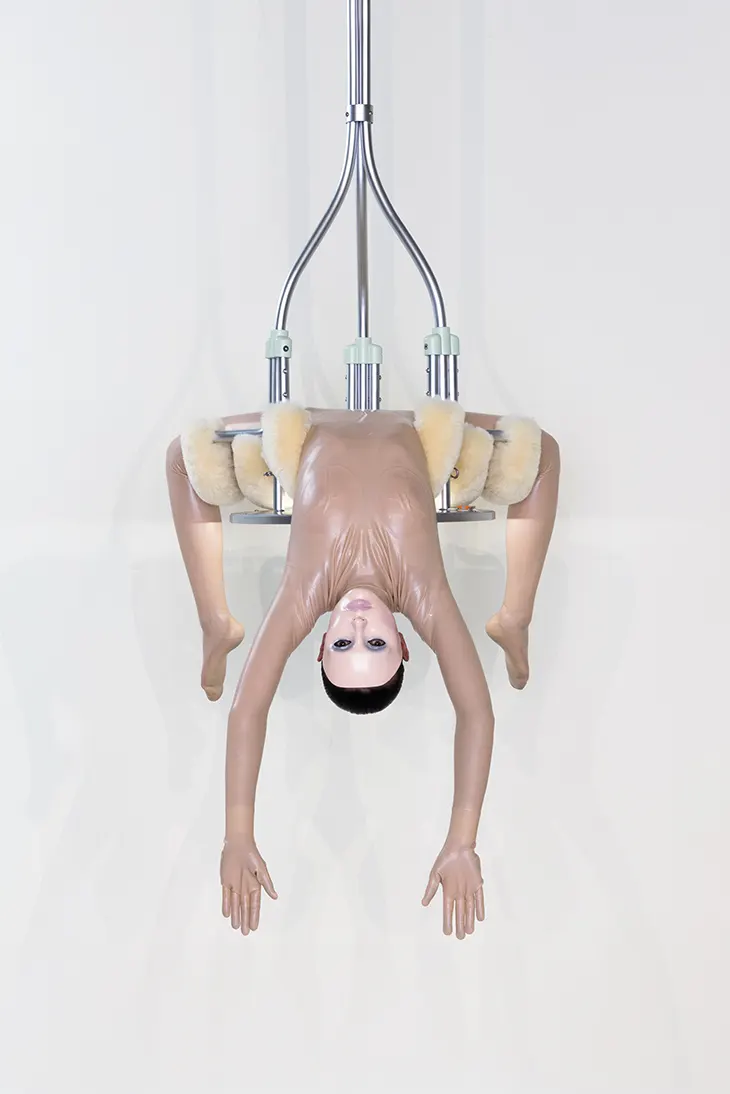
The performance begins in a kitchen. Censori bakes a cake. She then carries it into a dining room where women masked as her doubles sit restrained inside sculptural furniture she designed. The objects resemble medical supports or orthopedic devices, padded and pale, constructed to hold bodies in place. Comfort and restriction collapse into the same gesture. The women disappear into the furniture. The furniture absorbs them. The scene unfolds without interruption, without friction, without resistance.
BIO POP borrows the visual vocabulary of feminist performance without committing to its politics. Doubling, ritual, repetition, and the domestic interior all appear as familiar tools. Yet the work refuses to articulate a position. It stages confinement but never breaks it. It reproduces control while insisting that reproduction alone equals critique. That assumption collapses under scrutiny.
The women in the performance exist as units, not subjects. They remain silent, masked, interchangeable. Their bodies serve the composition rather than disrupt it. Censori stands at the center, visible and authored, while the others dissolve into structure. This hierarchy matters. A work that claims to interrogate how domestic roles imprint identity cannot rely on anonymity and silence without reinforcing the very logic it claims to expose.
The furniture intensifies this problem. Framed as extensions of the body, the pieces function as instruments of posture, correction, and containment. They recall care devices while performing restraint. BIO POP presents this duality as tension. It never resolves it. The work treats coercion as aesthetic material rather than political condition.
This failure of critical distance becomes unavoidable when the exhibition is read alongside the public narrative surrounding Censori herself. In recent years, the phrase “Kanye domination” entered public discourse after Ye claimed he had “dominion” over his wife, a statement that sparked widespread concern about control and authorship within their relationship.
That context cannot be separated from BIO POP, particularly given that Ye is credited as the composer of the performance’s music score. When an exhibition centers restrained female bodies, ritualized service, and silence, while its sonic framework comes from a figure who has publicly asserted authority over the artist’s body and appearance, the imagery no longer reads as abstract. The work inherits that power dynamic without acknowledging it.
The cake serves as a key symbol. The artist statement frames it as offering rather than nourishment. The kitchen becomes altar. Domestic labor becomes ritual. Yet the performance never asks who receives the offering or who benefits from the ritual. Service appears elevated, but elevation without redistribution remains hierarchy by another name.
The project’s long-term structure deepens concern. BIO POP is explicitly framed as the first chapter in a seven-part cycle unfolding through 2032, with subsequent chapters titled CONFESSIONAL, BIANCA IS MY DOLL BABY, STARBABY, BONE OF MY BONE, GENESIS, and BUBBLE. The progression moves with confident certainty toward witness, idolization, sacrifice, rebirth, and ascension. This teleological framing assumes resolution before it is earned. It treats endurance as development and submission as a necessary stage on the way to transcendence. Duration does not substitute for critique.
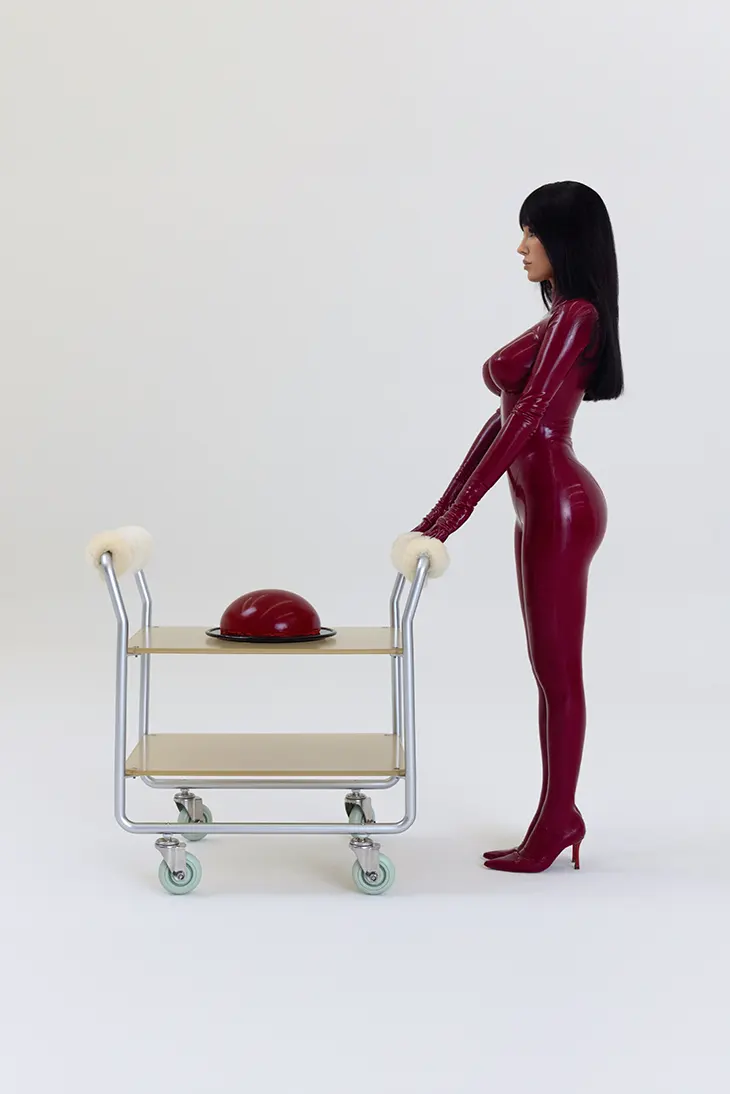
BIO POP insists on reading domesticity as the origin of all systems. That claim carries weight. It also carries responsibility. If the home is where roles are learned, then the work must show how those roles can be unlearned. BIO POP never does. It stages the lesson again, cleanly, beautifully, and without interruption.
As an introduction to the art world, the project arrives polished and coherent. It controls space, image, and narrative with precision. What it refuses to confront is power. The work treats submission as visual language rather than political condition. It assumes repetition alone produces insight. It does not.
BIO POP does not expose domination. It rehearses it.





the banality of this self absorption isn’t worth penetrating