


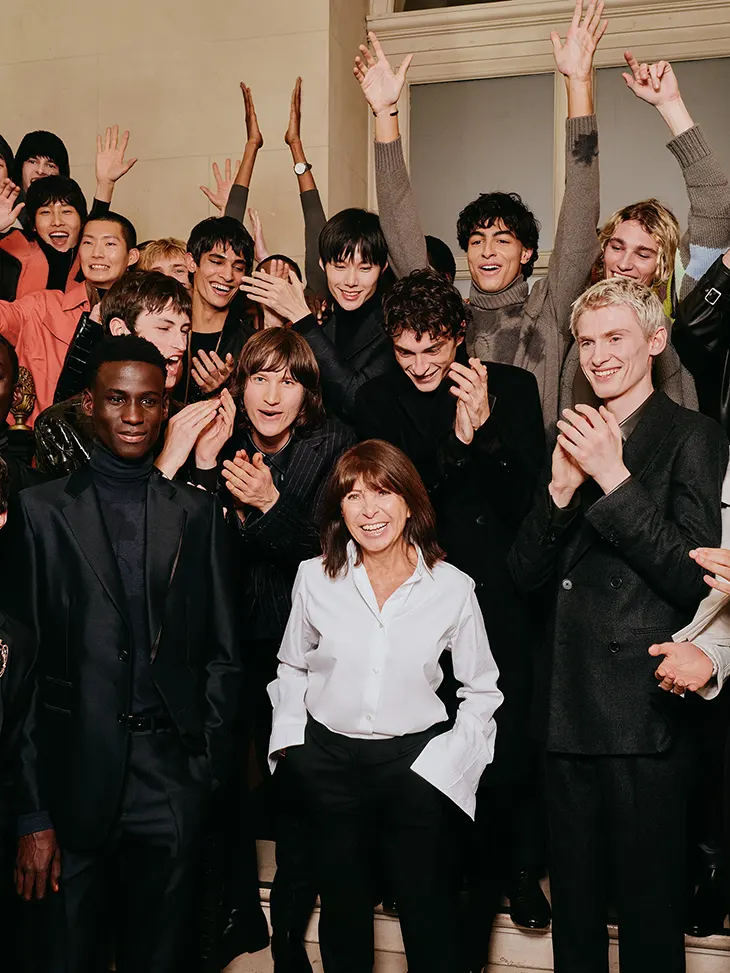
Saturday evening at the Palais Brogniart, Véronique Nichanian did what she has done for nearly four decades at Hermès: she presented menswear of extraordinary intelligence, restraint, and immaculate construction. The difference this time was finality. After 38 years as artistic director of Hermès menswear, Nichanian staged her farewell, a collection that read less as conclusion than as summation, a distillation of everything that has made her tenure one of the most significant in modern fashion history.
PARIS FASHION WEEK COLLECTIONS
The show opened with screens projecting a montage of her bows across the decades, charting the evolution of a body of work that has fundamentally shaped contemporary menswear. In an industry addicted to reinvention, Nichanian has been one of its rare constants, a designer whose name became synonymous with a particular kind of masculine elegance: unflashy, assured, and built to last.
The Collection: Between Refinement and Sensuality
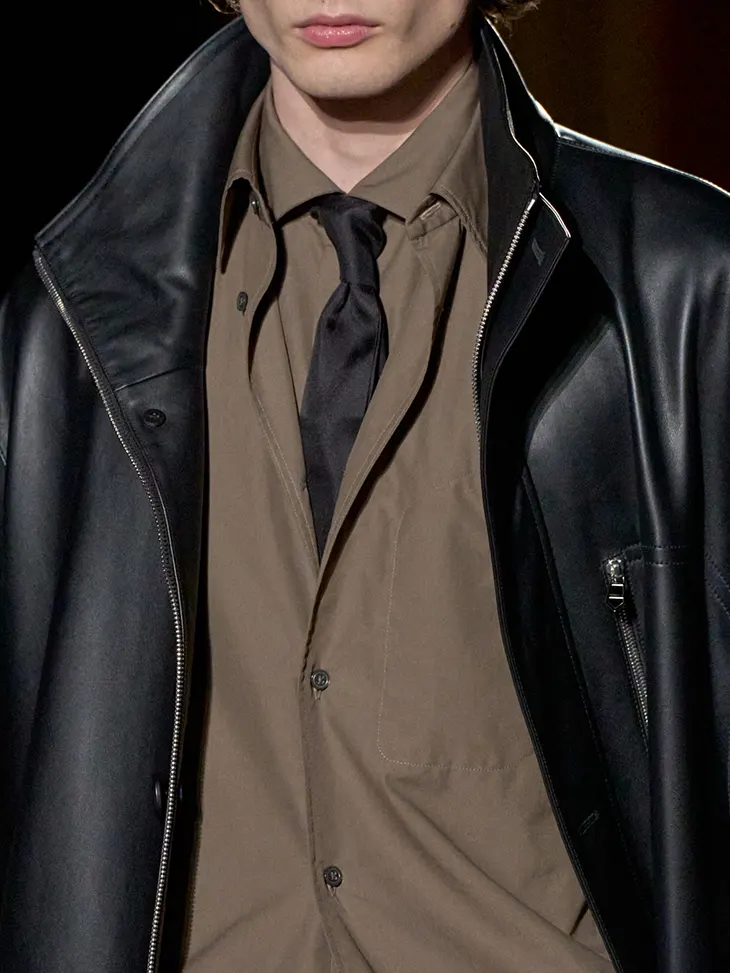
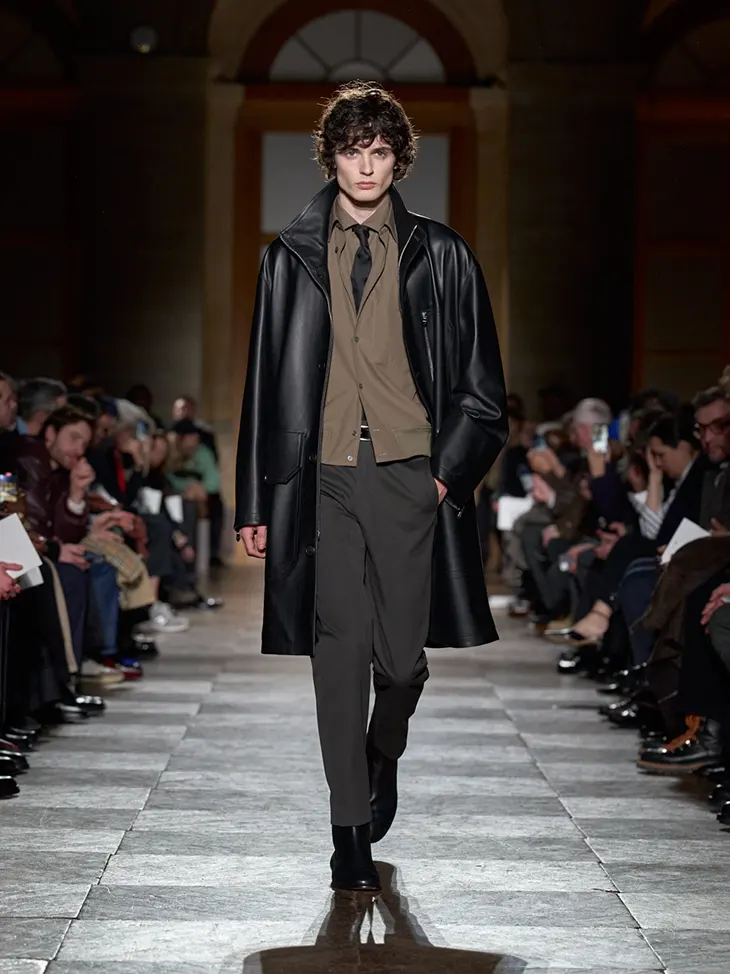
Fifty-nine silhouettes unfolded across the runway, each one a testament to Nichanian’s philosophy that “the line does not exclude comfort but invites it to forge its own way.” The opening look established the tone immediately: a parka in smooth black calfskin paired with a peat compact cotton poplin shirt-blouson, layered over another khaki shirt, finished with impeccably cut cotton-wool gabardine trousers. Pure Nichanian: nothing screaming for attention, everything earning it.
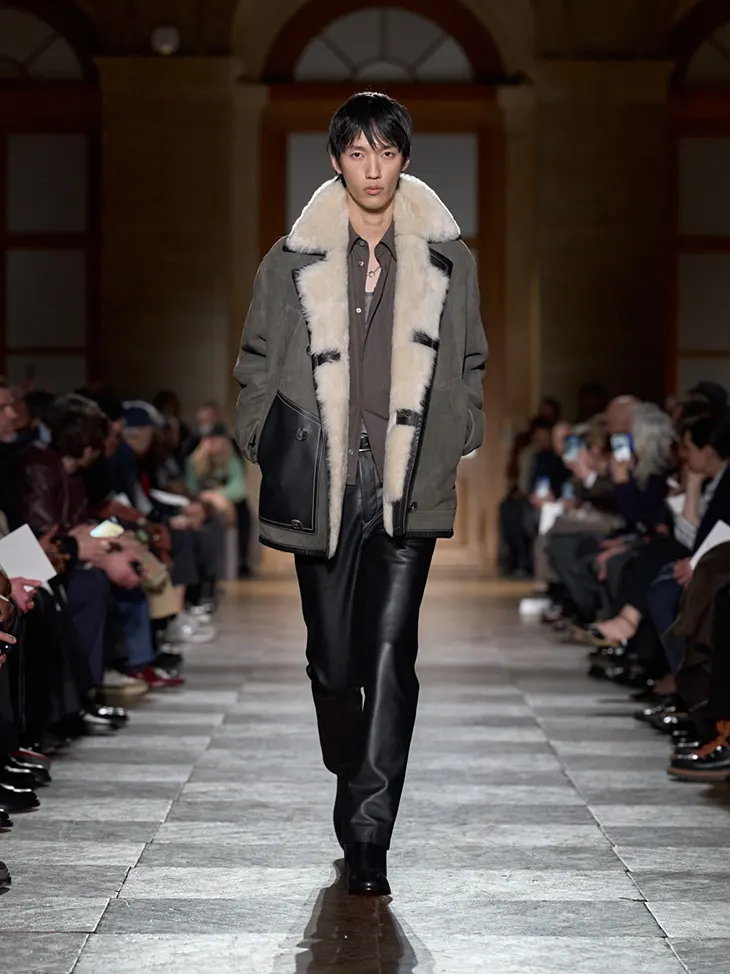
From there, the collection moved through a masterclass in material intelligence and proportion. A full-grain lambskin jacket. A reversible cashmere and wool travel coat. A double-breasted suit in pinstriped leather that somehow managed to feel both radical and timeless. These are clothes that fit together but remain mobile, alive, enduring, as the show notes articulated, “through a season made for a lifetime.”
Material Obsession
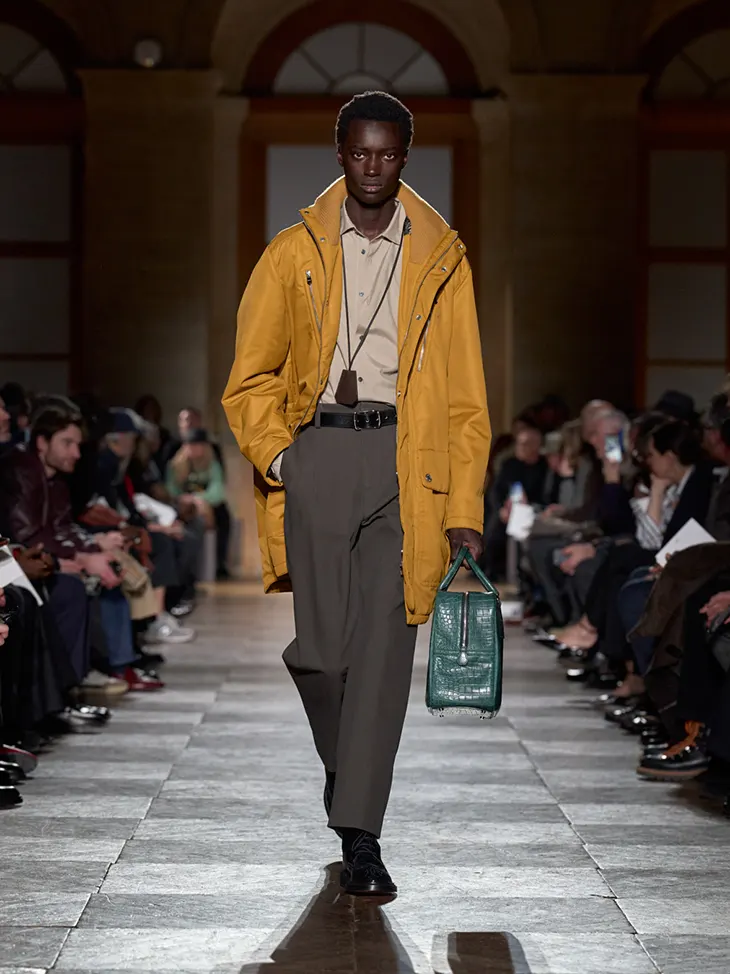
The fabric work throughout demonstrated why Hermès menswear under Nichanian has occupied a category of its own. Shearling lined with Toilovent. Lightweight calfskin. Hybridizations wrought with sensitivity: deer grain oriented inside out, airy interfacing, weightless bouclette, and what the house describes as “modulated envelopments.” Technical fabrics married to the most classic forms, innovating without abandoning the essential relationship between body and garment.
The palette spoke in hushed intensities: tourbe, gris brûlé, kaki, café, taupe, écorce, bleu nuit. Peat tones and burnt greys dominated, punctuated by sudden bursts of orange, sunset, and cumin. One moment captured the collection’s spirit perfectly: an orange lining revealed within a coat, described in the notes as “like a gale of laughter in the night.“
Archival Echoes
Woven through the new work were archival pieces, gentle reminders of how enduring Nichanian’s vision has been. A mocha calfskin jumpsuit from Fall Winter 1991. A blouson with detachable double front from Fall Winter 2004. A cashmere chaîne d’ancre turtleneck from Fall Winter 2011. A mismatched suit with playful chalk stripes from Fall Winter 2002. These weren’t nostalgic gestures but evidence of a design language so consistent that pieces from thirty-five years ago could walk alongside new creations without discord.
The Details That Define
The collection’s selfish details, as Nichanian calls them, accumulated into something greater than decoration: étrivière stitching, double lambskin lapels, off-centre bellows pockets, embroidered tennis stripes on shearling overshirts. The Brides de gala print appeared throughout as interior linings on light calfskin overshirts, a signature touch that rewards the wearer rather than the observer.
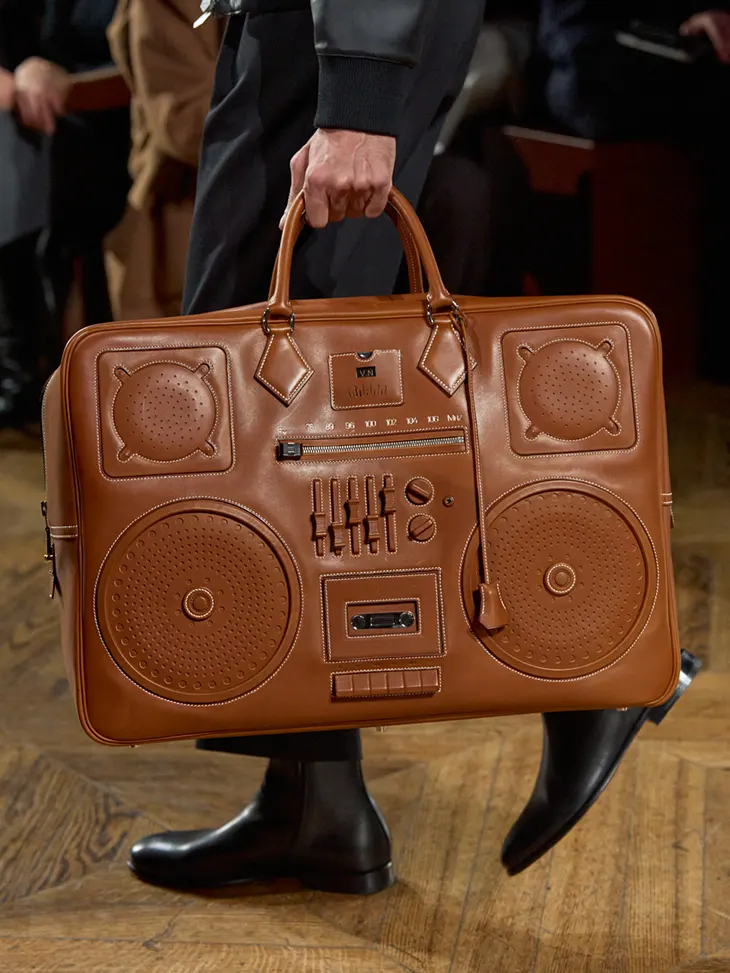
Mix and patch pieces in lambskin and cashmere intarsia demonstrated technical virtuosity without showmanship. Turtleneck pullovers with blurred floral patterns in cashmere and silk achieved the rare balance of being precisely crafted yet airy. A Plume Fourre-Tout On Radio bag punctuated the collection, described as “a manifesto that doesn’t take itself too seriously, nonetheless reiterating a sense of poise.“
Discover details spotlight from the Fall Winter 2026 runway show in our gallery:
The Final Look
The closing silhouette, Nichanian’s final look for the house, was a single-breasted suit in khaki mirror crocodile worn over a black crisp silk turtleneck. Understated and immaculate, it embodied her modus operandi: “striking the note just between refinement and sensuality.”
Legacy and Transition
The guests at Palais Brogniart rose in ovation as giant screens projected images of Nichanian across all seasons, the same yet different, eternal. Afterward, she hosted a goodbye party featuring a live performance by Paul Weller.
Grace Wales Bonner will take the reins for next season, though Nichanian will remain at the house as artistic director of men’s leather and silk. The transition marks the end of one of fashion’s longest and most distinguished tenures, a 38-year demonstration that menswear can be both innovative and enduring, both surprising and reliable.
Nichanian leaves behind not just a body of work but a philosophy: clothes for today and forever, exceptional materials worn with the air of nothing at all, garments that become companions from a life in motion. As the show notes concluded, “Because time, instead of fading, invites them beyond seasons, beyond years.”
Discover all of the runway looks from the Fall Winter 2026 runway show in our gallery:



Super