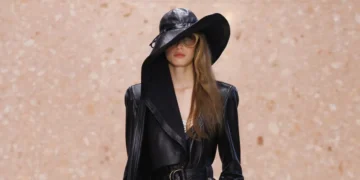




CFCL presented the VOL.12 women’s collection for Fall Winter 2026 during Paris Fashion Week and continued its practice around a central question. The brand asks whether fashion can participate in shaping a better society. Clothing functions as a medium that connects society with the individual wearer.
FALL WINTER 2026
The collection revisits the concept of “social sculpture” introduced by Joseph Beuys. Forty years after his passing, CFCL returns to his idea that artistic practice can influence social structures. Beuys linked activism with creative production and expanded the role of art within society. CFCL interprets this thinking through knitwear and treats clothing as sculptural objects produced in multiples.


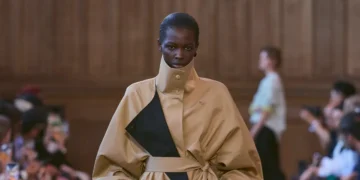
One group draws inspiration from the felt works created by Beuys. His installations often used draped felt arranged with clarity and restraint through a single material. CFCL translates this reference through the TW INLAY series. The fabric combines non-mulesed New Zealand wool with Inner Mongolian cashmere. A triple-layer structure places highly elastic recycled polyester between the outer layers and generates firmness together with warmth. Raw knitted edges and a mélanged surface produce an appearance similar to felt. Generous coats in this group create strong drape across the back through a band that extends across the nape of the neck.
Another part of the collection explores drape through lightweight materials. The MILAN series appears again in recycled polyester and continues as a central component of CFCL knitwear development. Additional variations expand the material vocabulary. AC MILAN incorporates bright acetate yarn while MILAN VELVET introduces rayon chenille yarn. These fabrics produce delicate drape and maintain a light structure suited to everyday wear.


CFCL introduces its first motif pattern since the founding of the brand through a foil print inspired by the bark of oak trees. The motif references Beuys’s project 7000 Oaks, realized in Kassel between 1982 and 1987. That long-term project connected ecological awareness with artistic intervention through the planting of oak trees across the city. CFCL transfers the visual structure of oak bark onto knitwear surfaces through foil printing techniques developed for stretch fabrics.
The SOFT PORTRAIT FOIL dress presents a tight silhouette knitted in a rib structure using cupro polyester yarn. A foil print is applied after the garment is completed. The SOFT MILAN FOIL dress develops a flared silhouette with a hem circumference that reaches six meters. The upper body uses seamless rib knitting with metallic yarn while the skirt forms through a Milan rib structure. The two sections are sewn together to produce controlled drape. Advanced printing technology applies an extremely thin binder layer so the foil surface maintains smooth luster even on elastic knit structures.

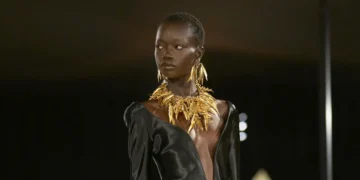
The oak bark motif also appears in three-dimensional evening garments. The FLUFFY FRINGE FOIL dress presents plate-like knitted fringe finished with foil print together with metallic thread fringe in two colors. Each fringe element is inserted by hand through openings programmed into the garment body. The process creates a dense textured surface across the dress. The ENCHANT train dress develops this direction further through the addition of silver and black sequins that emphasize the extended silhouette.
The collection also continues CFCL’s collaboration with VEJA. The partnership began through a shared focus on transparency within the sneaker supply chain. The second edition advances research into functional design and material development. The sneaker integrates CFCL’s knitwear language into footwear and proposes knit structures as practical tools for everyday life.