




I went to see The History of Concrete at Beldocs already compromised. I had followed John Wilson for years, which means I had already accepted his method, his voice, his patience for ugliness, his faith in the accidental image. I had already given him permission to make me care about scaffolding, storage units, risotto, small talk, the kinds of subjects people use to avoid saying what they actually mean. So when his first feature documentary appeared in the Beldocs program, in Belgrade, my city, I felt the peculiar happiness of seeing a private obsession become locally available.
There is always a small humiliation in loving something niche. You feel protective of it, then suspicious when other people arrive. I wondered who would come. Documentary people, probably. Film people. A few people who read festival programs with religious seriousness. Maybe someone who had once watched How To with John Wilson alone during a bad period and now treated him as a minor emotional authority. Maybe a few architects, because the word concrete has a way of finding them.
MOVIES
The cinema was full. This surprised me more than it should have. Belgrade can fill a room for stranger things. Still, there was something funny about sitting in a packed cinema waiting for a documentary about concrete. I saw a few familiar faces. I saw a few architects in the audience, which made perfect sense and also made the whole thing feel slightly more exposed. We were all there for the same absurd promise: John Wilson would explain concrete, or fail to explain concrete, and in failing would explain something else.
The film begins with a premise so stupid it becomes almost pure. After attending a workshop on how to write and sell a Hallmark movie, Wilson tries to use the same formula to make a documentary about concrete. It is the kind of idea that sounds like a joke someone says too quietly at a dinner party, then actually follows for two years because the joke contains a wound. Wilson’s work has always depended on this confusion between bit and breakdown. He chooses a subject that appears empty, then waits until it starts leaking.
View this post on Instagram
Concrete is perfect for him because concrete has no charisma. It has no romance unless someone forces romance onto it. It is the material of sidewalks, public housing, parking garages, unfinished developments, postwar cities, bad plazas, municipal failure, luxury foundations, cracked pavements, and whatever remains after the fantasy of design meets weather, money, and time. It is everywhere, which makes it invisible. Wilson’s entire project is built on making the invisible socially embarrassing.
Watching The History of Concrete in Belgrade made the film stranger, funnier, and more loaded than it may have been in another city. Coming from an ex-socialist country, you do not look at concrete as neutral material. You grow up with it as ideology, shelter, monument, failure, pride, trauma, and urban fact. Belgrade has a peculiar relationship with concrete. It is there in brutalist landmarks, apartment blocks, underpasses, unfinished structures, public institutions, military ruins, and buildings that still carry the visual weight of another political century. Concrete here is never just concrete.
That may be why Belgrade felt like the right audience for Wilson’s film. The room understood the absurdity, but it also understood the material. People laughed hard, yet the laughter had another charge. This was not a crowd discovering that concrete can be funny. This was a crowd that already lives inside the punchline. In Belgrade, concrete is not an aesthetic trend rediscovered by design Instagram. It is a daily condition. It is where childhood, ideology, urban planning, collapse, aspiration, neglect, and real estate speculation all meet without asking permission.
For me, there was another layer. I studied architecture, so I cannot look at concrete innocently. I know the language around it, the utopian claims, the structural promises, the way material can be used to sell permanence even when everything around it is unstable. Architecture teaches you to read concrete as structure, surface, mass, intention, and sometimes as propaganda. Life in Belgrade teaches you to read it as weather, memory, maintenance, failure, and class. Wilson approaches it like an amateur with perfect instincts, which makes the film more interesting. He does not enter through theory. He enters through embarrassment, confusion, curiosity, and jokes. In that sense, he gets closer to the truth than many professionals do.
Wilson has always understood that the city reveals itself through its unwanted details. A blocked sidewalk, a cracked curb, a strange sign in a window, a person doing something private in public because the city has no private space left to offer. His camera has a democratic eye, but never a sentimental one. He films the ugly, the banal, the accidental, and the humiliating with attention so precise that the viewer begins to feel implicated. The laugh arrives first, then the recognition. You laugh at the image, then realize the image has been laughing at you.
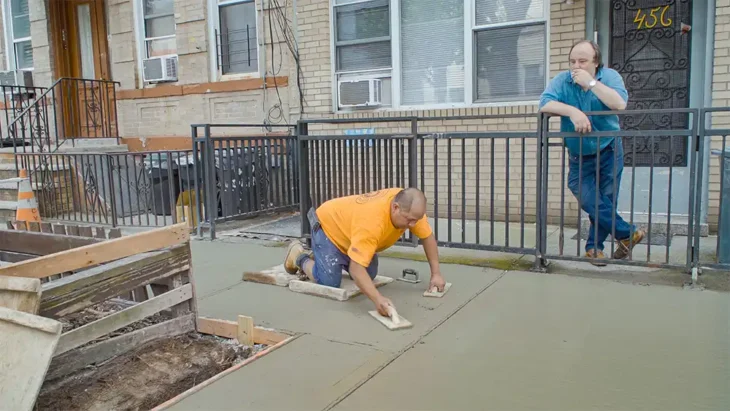
The audience laughed with real force. Not festival laughter, not the careful intellectual kind, but full laughter, the kind that breaks rhythm and makes people around you laugh harder because they feel permitted. Wilson’s humor depends on this permission. He never announces the joke. He simply holds the image long enough for the room to understand that reality has humiliated itself. A sign, a face, a construction detail, an interaction, a corporate phrase, a person trying to explain something impossible with complete confidence. He does not mock them exactly. That would be too easy. He lets them remain themselves until the viewer becomes implicated.
This is why his work can feel kind and cruel at the same time. The camera notices too much. It looks at people the way we all look when we are alone in public and pretending we are not staring. The difference is that Wilson admits the stare and edits it into structure. He turns urban life into evidence. Evidence of what, he rarely says directly. Loneliness, maybe. Decline. Desire. The absurd theatricality of being a person in a city built by interests that do not know your name.
The History of Concrete stretches the How To formula into feature length, and you can feel the stretch. Sometimes that is part of the pleasure. Wilson follows tangents because tangents are where reality keeps its best material. A film about concrete becomes a film about filmmaking after success, about Hallmark narrative rules, about housing, about performance, about the problem of what to do after people begin expecting your weirdness. Fame has made Wilson recognizable enough to become strange to himself, which may be the real subject of the film. Concrete is the alibi.
There is something moving about watching him try to make a next thing. The end of a beloved series creates a practical problem, but also an existential one. The artist who became known for wandering now has to wander with an audience watching for the method. Accident becomes expectation. The gaze becomes a brand. The film understands this, even when it hides behind jokes about infrastructure. It asks what happens when your way of seeing the world becomes the thing people want from you.
That question stayed with me more than some of the film’s larger urban arguments. Wilson touches affordable housing, development, infrastructure, material decay, and the fantasy of permanence. Some of these threads could go further. At times, the film seems to approach politics, then retreat into eccentricity, as though polemic would make the whole thing too stable. But stability has never been Wilson’s gift. His gift is drift with consequences.
He knows that contemporary life rarely arrives as an argument. It arrives as a badly designed object, a strange workshop, a sidewalk stain, a corporate invitation, a person oversharing under fluorescent light. The system appears through fragments. Wilson collects those fragments until they become almost unbearable. The joke accumulates into a diagnosis.
Belgrade sharpened the diagnosis. The film’s New York concrete spoke fluently to Belgrade concrete. Different systems, different histories, same uneasy feeling that cities reveal their values through what they pour, patch, abandon, and sell. In New York, concrete can point to private development, infrastructure decay, housing pressure, and a city constantly selling itself back to its own residents. In Belgrade, it carries another genealogy, one tied to socialist modernism, public ambition, post-socialist transition, war memory, privatization, illegal construction, and the current violence of speculative development. The material changes accent, but the anxiety remains recognizable.
This is why the screening felt like correspondence. Wilson did not make a film about us, but Belgrade answered it anyway. Every city has a concrete unconscious. Ours happens to be very close to the surface. You can see it in New Belgrade blocks, in the Sava Center, in Genex Tower, in underpasses, in staircases, in raw facades, in repairs that never fully repair anything. You can also see it in the new developments that use concrete as a skeleton for glass fantasies, pretending the city can be reborn through square meters and promotional renderings.
Wilson’s film made me think about how concrete holds contradictions better than most materials. It can be public and oppressive, cheap and monumental, practical and ideological, ugly and beautiful, protective and violent. It can house people or erase them. It can promise a future and then trap a city inside that promise long after the future has expired. Architects know this. People who grew up around brutalist landmarks know this. People who live in cities that keep changing without becoming easier to live in know this too.
The History of Concrete is too long, probably. It wanders too much, maybe. Some sections feel like Wilson kept walking because stopping would require a thesis. But I trusted the wandering. I trusted it because the film’s real intelligence lives in its refusal to pretend that meaning arrives cleanly. Meaning arrives cracked, stained, misused, poured over something older. Meaning arrives as a surface that was supposed to hold.
There was something beautiful about hearing Belgrade laugh at John Wilson. Not politely. Not academically. Loudly, fully, almost with relief. A documentary about concrete filled a cinema and made people laugh like they had been waiting all week for permission to find the built environment ridiculous. John Wilson makes the ordinary look guilty. The History of Concrete makes the ground beneath us feel suspicious. After the screening, walking outside in Belgrade, every pavement slab looked like it knew something.