


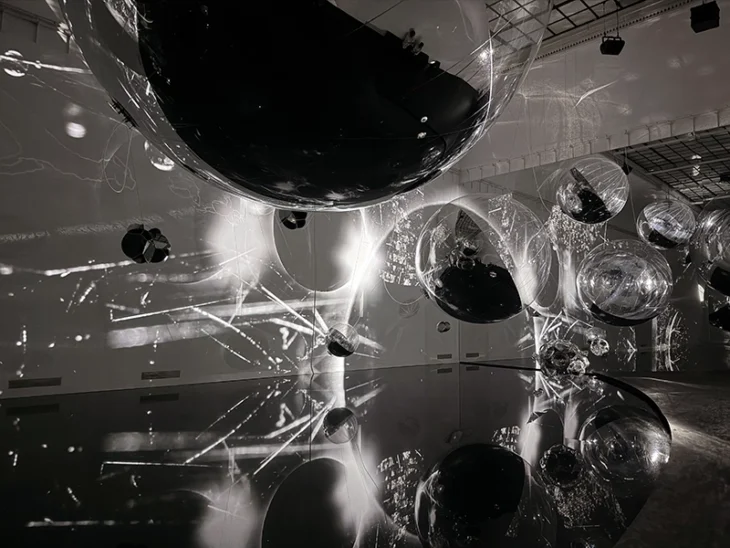
Tomás Saraceno has spent much of his career testing the limits of what an artwork can hold. Air currents, spider webs, solar heat, Indigenous knowledge, political struggle, and architectural speculation all enter his practice without settling into a single discipline. At Haus der Kunst, these strands converge in Ancestral Futures, his most ambitious exhibition to date, running through February 7, 2027.
ART
The scale matters, but not for the usual reason. Saraceno does not use the museum as a container for monumental objects. He turns the building into a field of relations. Air fuelled sculptures, shared habitats, web structures, acoustic systems, and spatial interventions alter the galleries from within, asking visitors to understand space as something produced collectively by bodies, materials, climates, and species.
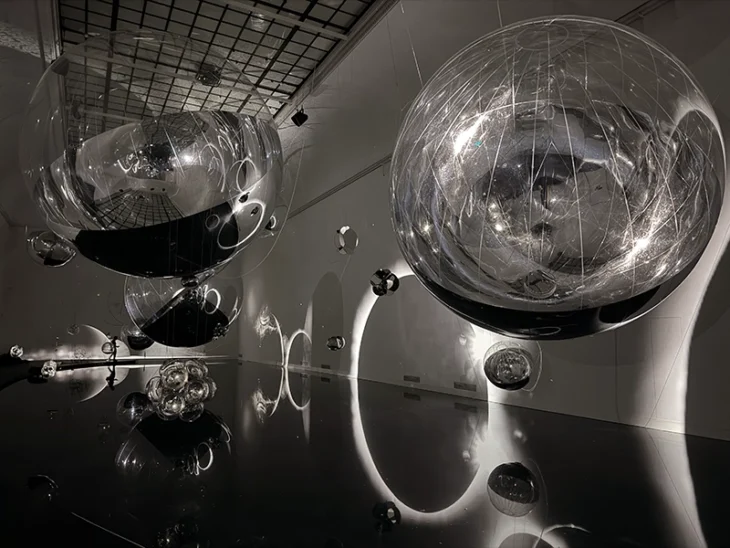
The exhibition brings together two of Saraceno’s central bodies of research, Aerocene and Arachnophilia, while introducing The Sanctuary of Water, a permanent land art project developed with the eleven Indigenous communities of the Red Atacama network in Salinas Grandes, northern Argentina.
That new commission gives the exhibition its political and ethical center. Conceived in close collaboration with communities defending ancestral territories, The Sanctuary of Water places questions of extraction, sovereignty, and ecological survival inside the museum without reducing them to representation. Saraceno’s role here is less that of an author imposing form than that of a participant helping construct a platform through which local knowledge, environmental urgency, and collective resistance can become visible.
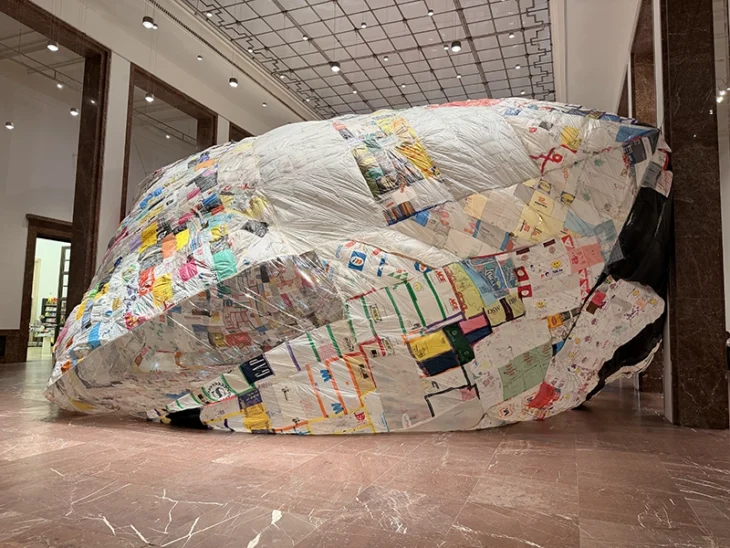
This distinction is crucial. Contemporary art often turns ecological crisis into imagery. Saraceno instead tries to build systems that remain active beyond the exhibition. His work carries a utopian charge, yet it also insists on infrastructure, research, and participation. The speculative dimension never fully separates from the practical one.
That tension has long defined Aerocene, the interdisciplinary community Saraceno initiated in 2015. Its solar powered sculptures imagine forms of movement independent of fossil fuels, using air, heat, and radiation as the basis for flight. The project reached a decisive point in 2020, when Aerocene Pacha completed a record breaking flight in Argentina powered entirely by natural atmospheric forces.
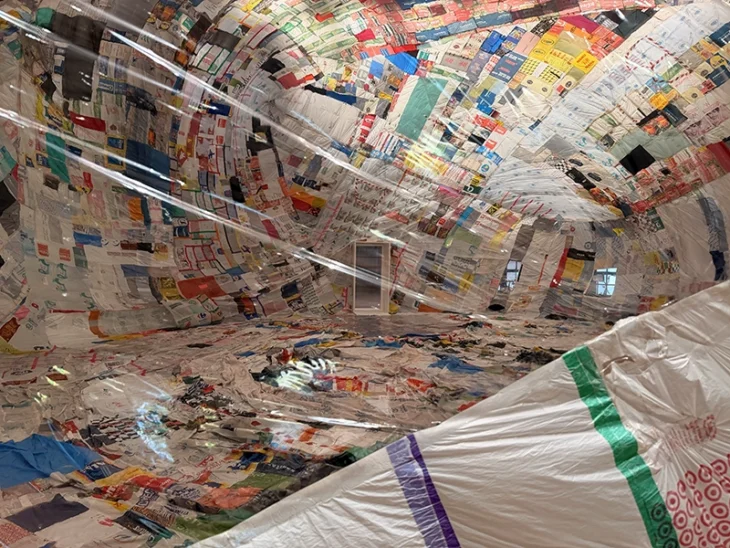
At Haus der Kunst, these works operate as propositions rather than demonstrations of technological mastery. They ask what forms of mobility become possible once speed, extraction, and combustion no longer define progress. Their apparent lightness carries a serious critique of the systems that organize contemporary life.
If Aerocene looks upward, Arachnophilia turns attention toward forms of intelligence that already exist around us. Saraceno’s long engagement with spider webs treats them as architecture, instrument, communication network, and record of movement. In works such as Towards the Sanctuary of Water, these structures become models for thinking about interdependence without hierarchy.
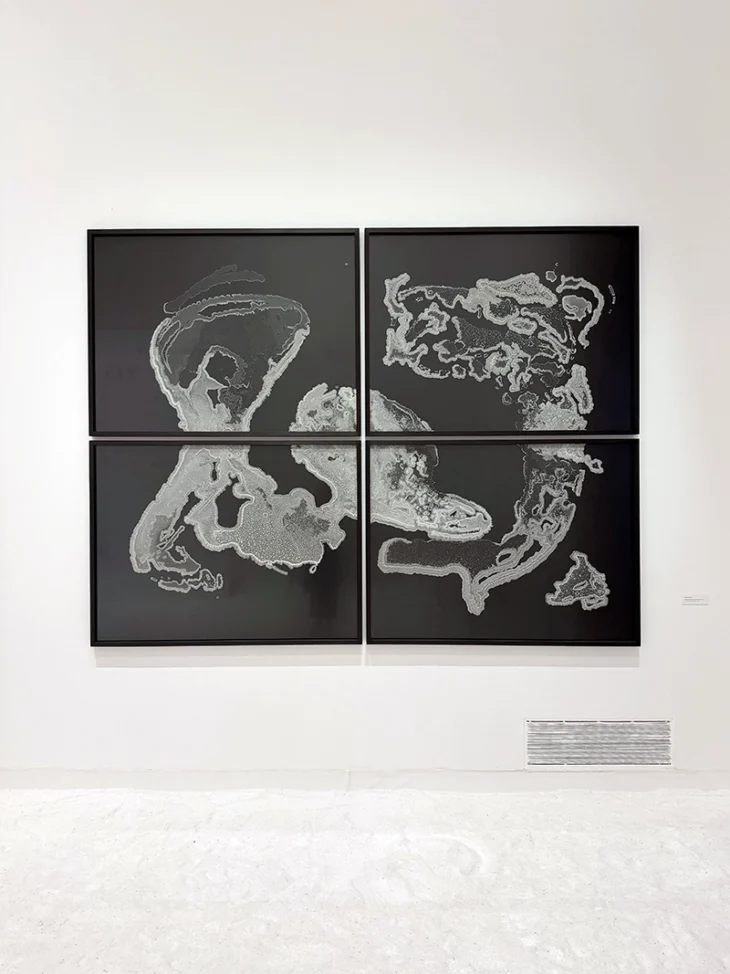
The web is an obvious metaphor for connectivity, but Saraceno’s interest goes further. He studies how webs register vibration, adapt to pressure, and distribute tension. Their intelligence lies in response rather than control. This makes them especially relevant to a practice concerned with ecological systems, where stability depends on constant adjustment.
The exhibition’s title, Ancestral Futures, refuses the familiar opposition between tradition and innovation. Saraceno proposes that the future may depend less on invention than on recovering forms of knowledge that modernity has marginalized. Indigenous stewardship, nonhuman intelligence, atmospheric awareness, and collective action appear here as contemporary resources, not remnants of the past.
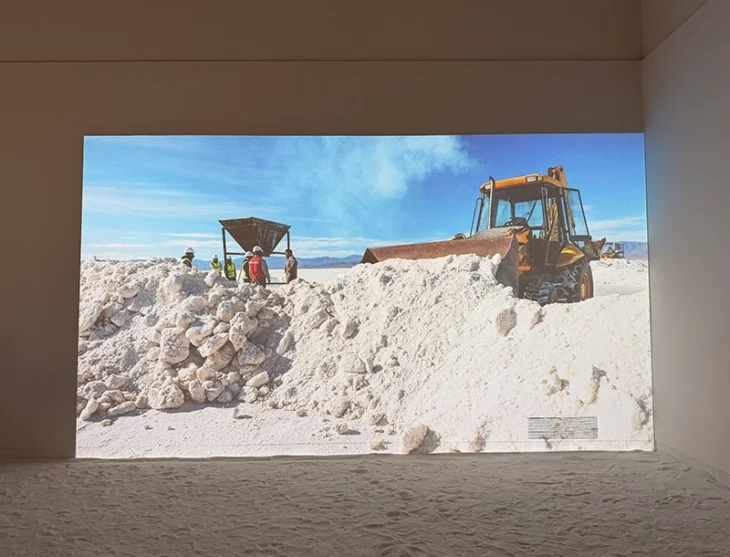
This approach can easily slip into abstraction, and Saraceno’s work has sometimes risked allowing its visual seduction to soften the urgency of its politics. At Haus der Kunst, the challenge lies in whether the immersive environments can sustain the difficult contexts they invoke. The exhibition’s success will depend on how clearly it preserves the agency of the communities, organisms, and systems it brings into view.
Curated by Sarah Johanna Theurer and Andrea Lissoni, the project also extends into learning programs, performances, and public encounters developed with the Aerocene Foundation. This broader structure suits Saraceno’s practice, which has always functioned through networks rather than isolated works.
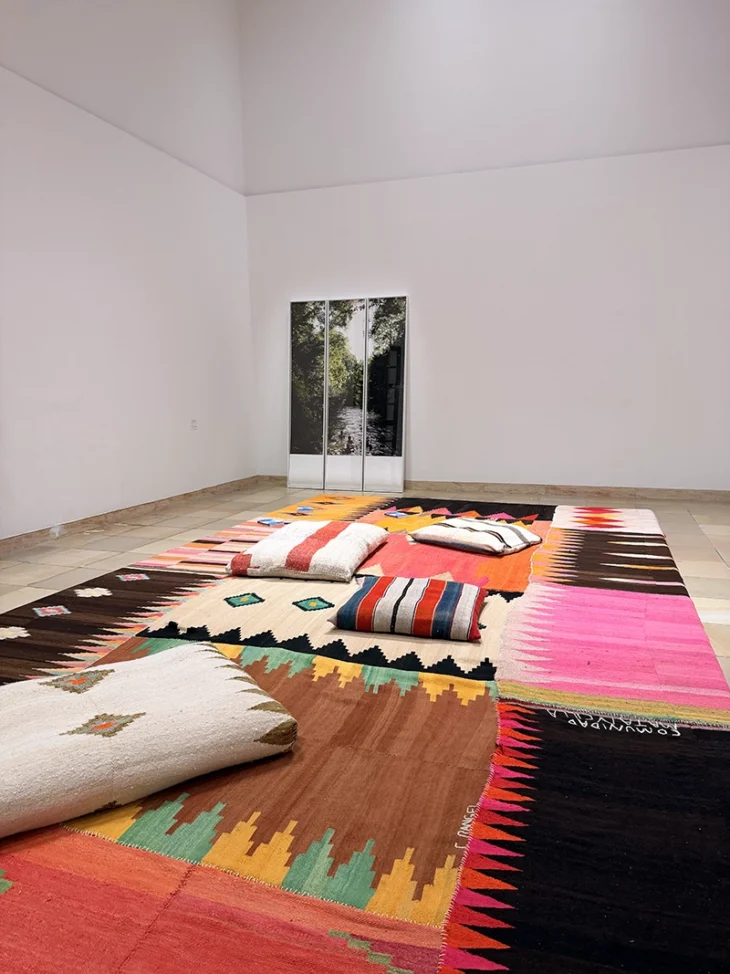
Ancestral Futures ultimately asks the museum to behave differently. Instead of presenting ecology as a subject, it treats the exhibition itself as an ecosystem. Visitors enter a space where air, movement, sound, material, and knowledge remain in constant relation.
Saraceno does not offer a coherent image of the future. He offers conditions for imagining one. That distinction gives the exhibition its force. The future here is neither distant nor purely technological. It is already present in the atmosphere, in the web, in the land, and in the forms of knowledge we continue to overlook.