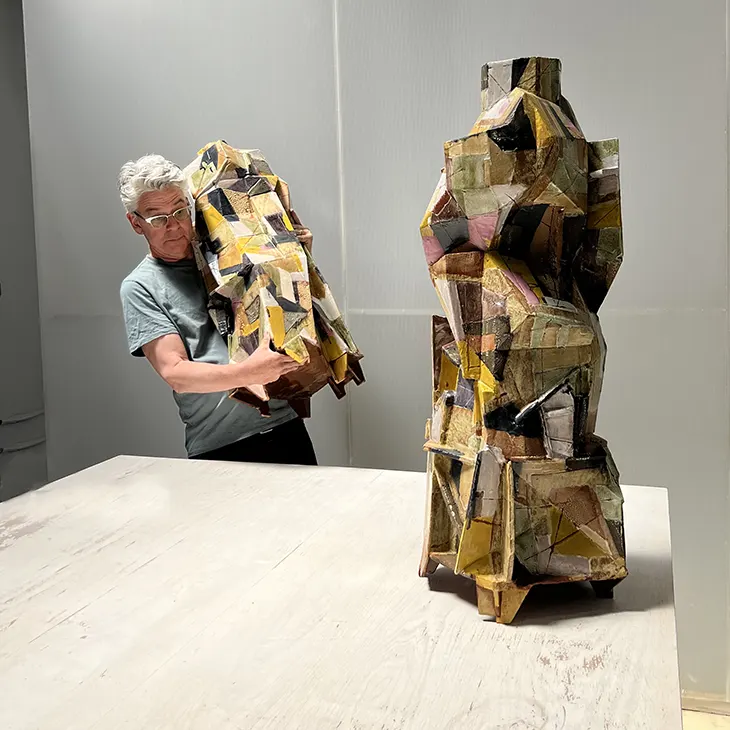
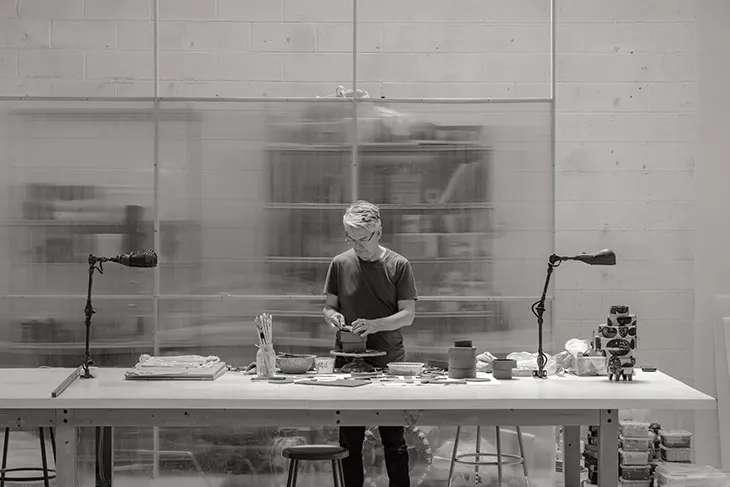
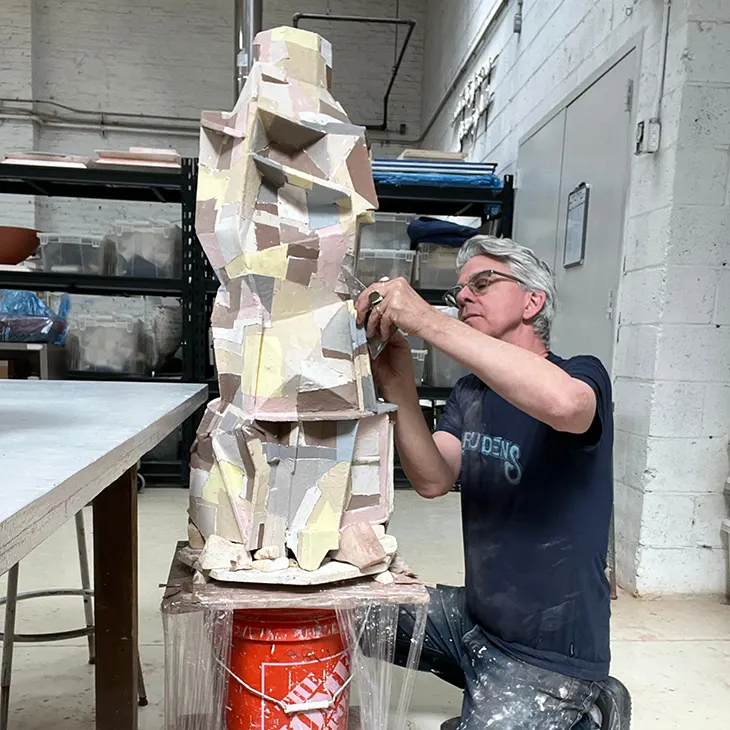
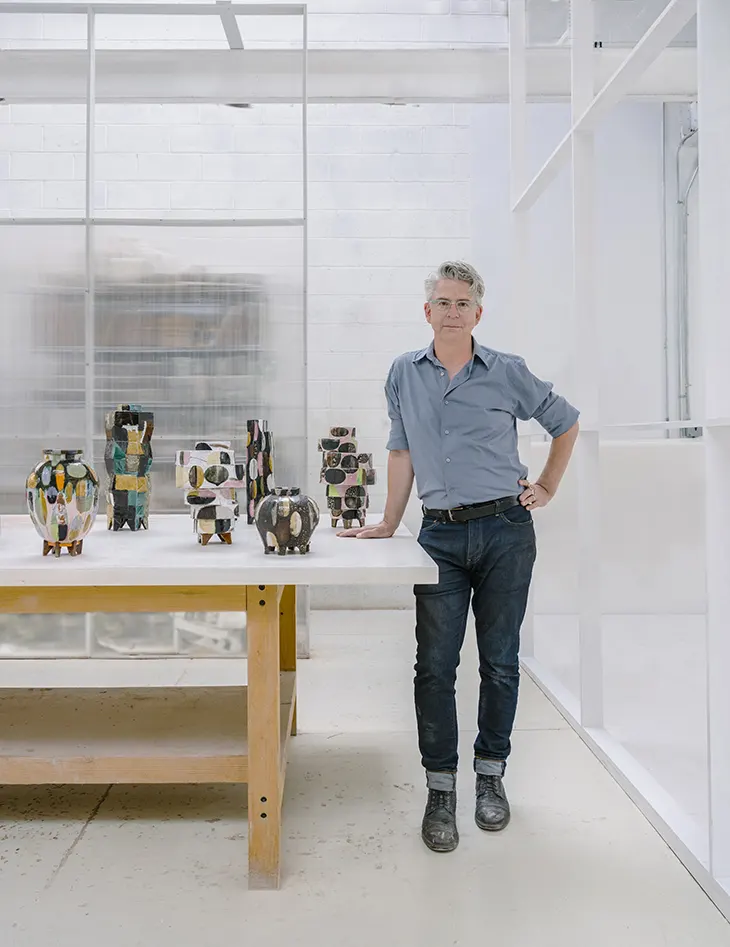
Christopher Russell in his studio – photo courtesy of Todd Merrill Studio
New York does not appear in Christopher Russell’s answers as a badge, it reads as a condition, a daily atmosphere, a kind of permission. He is quick to correct the record, “I’m from New England, I don’t think of myself as a New Yorker,” and then just as quickly admits the deeper truth. He cannot imagine living anywhere else. For him, the city is a “free zone,” a place of acceptance, progress, and democracy, and the word he returns to is gratitude. It is a rare starting point for an artist whose work is so exacting, but it clarifies everything that follows. The discipline, the patience, the insistence on making objects that hold more than one reading, all of it begins with a sense of being lucky to be here, and responsible to that luck.
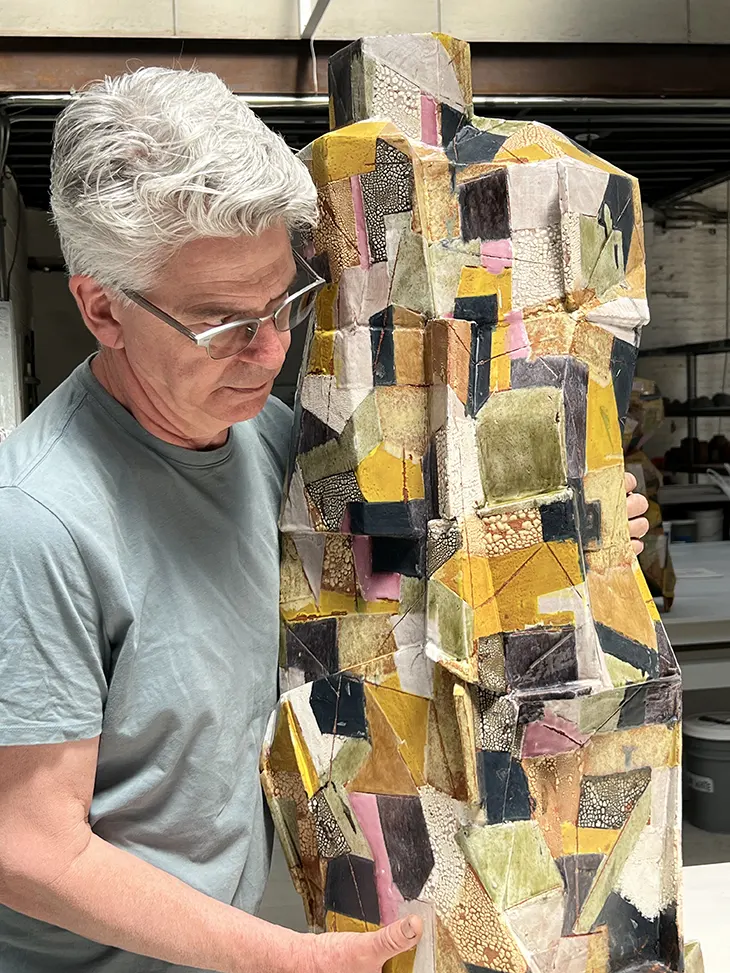
I visited Russell’s studio in Long Island City and watched the rhythm of his practice up close, the way one piece quietly proposes the next. Forms arrive first, often in groups, built from slabs with the logic of construction rather than the romance of the wheel. Weeks of building give way to a pause, the work set on a table and simply looked at, as if the studio itself needs time to catch up. Glazing follows, then the final incision of sgraffito, which he describes as “cracking the seal,” letting the clay breathe again. Throughout, he speaks about his vessels as canvases, paintings on shape, where spontaneity and precision are not opposites but paired energies, each requiring the other.
Photo courtesy of Todd Merrill Studio
That pairing, between control and risk, surface and structure, history and the present tense of making, runs through this conversation. Russell situates his studio days against the long wind of art history, feeling the push of other hands at other tables, and he is candid about the practical realities shaping contemporary ceramics, the shifting availability of materials, the forced reinvention of glazes, the kiln as collaborator that completes what the hand begins. In the context of his work with Todd Merrill Studio, and the design-facing audience that meets his vessels as both objects to live with and objects to contemplate, the familiar debate of art versus design becomes, in his words, “a very deep dark forest.” He does not try to escape it. He walks into it with curiosity, and comes out with a position that feels distinctly his own: make it both, make it hold more than one level, make it rewarding from every distance.
Continue reading for the conversation between Christopher Russell and DSCENE Editor in Chief Zarko Davinic:
You have been a New Yorker for a long time. What has New York City taught you about pace, ambition, and resilience, and how do those lessons show up in the way you work with clay? – I’m from New England, I don’t think of myself as a New Yorker- especially as, on my wife’s side, my son is a sixth generation native New Yorker. But I can’t imagine wanting to live anywhere else. Increasingly, the city feels to me like a free zone, a place of acceptance, progress and democracy. I really do feel grateful every day. I bring that gratitude into the studio, gratitude that I live here, that I’m an artist here, for the positive energy around me.
Photo courtesy of Todd Merrill Studio
When you are in the studio in Long Island City, what is the first decision you make that sets the direction for a piece, is it form, proportion, surface, or color? – One piece leads to the next one. The process of making each piece suggests the subsequent one. Maybe a color combination will catch my eye, or maybe I’ll imagine exaggerating the form I’m working on, but inevitably I see something that piques my interest, and that’s the beginning of the next piece.
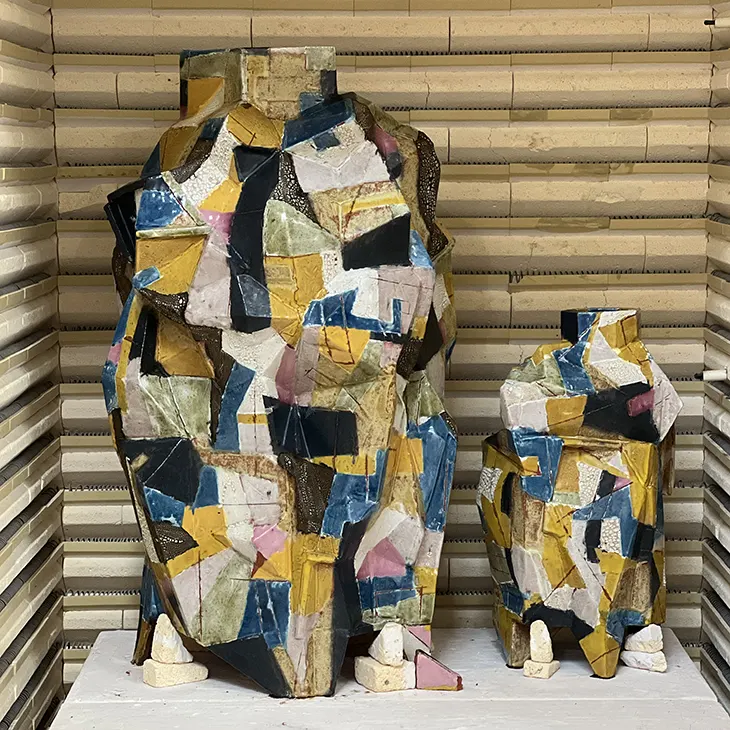
I make the forms first, often in groups, and often with very little idea of how I will glaze them. When they are done – making them can take 2 or 3 weeks, I put away all the building materials and put the forms on the table. Then I just look at them for a while. I might think of them as a group, or as single pieces. Maybe a glazing idea has been rolling around in my head. Then I start glazing, usually it will take a week or two to finish. The last thing is the sgraffito. The sgraffito cracks the seal: it lets the clay out, lets it breathe again.
I think of my forms almost like canvases. I’m making a painting on a shape. I have only the most general plan of what I’m going to do,
Your vessels read as geometrically precise, yet you describe the process as largely spontaneous. What does “spontaneous” actually mean for you in a hand-built practice, and at what point does a piece start telling you what it needs? – Spontaneity and precision go hand in hand. Each piece needs both energies.
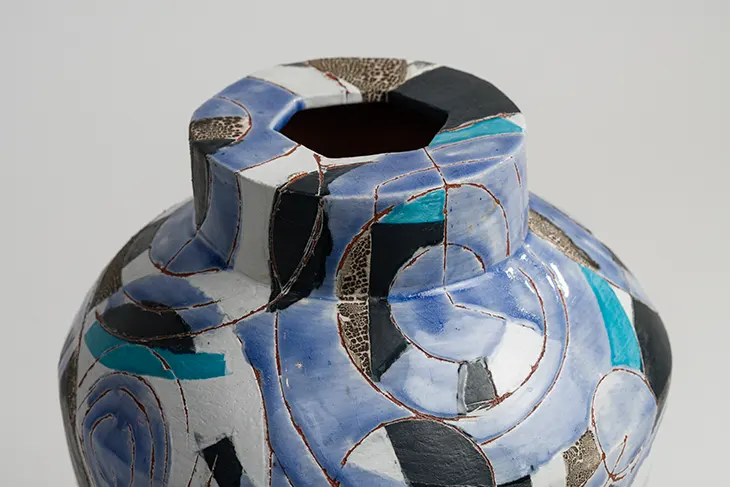
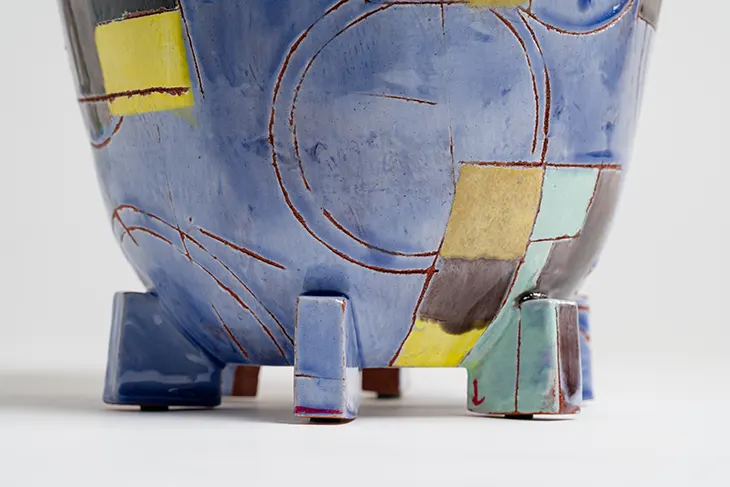
I think of my forms almost like canvases. I’m making a painting on a shape. I have only the most general plan of what I’m going to do, maybe “rounded shapes on a solid background.” At first, I’ll place shapes almost randomly, then place more in response to those. Patterns emerge almost immediately: sometimes I break them down, sometimes I exaggerate them. One shape wraps around a corner, another butts against it. As the piece tightens up, it can begin to ask for more of one color, more round shapes less points. Different faces of the piece develop attitudes. And while I’m doing all this, I know that the glazes will flow and drip and mottle, and that that will add a whole other layer to the final piece.
I have made a lot of different shaped vessels, some simple and structured, others loose and improvised. Only very rarely do I have a preconceived plan for how I will paint them.
Photo courtesy of Todd Merrill Studio
When working on your pieces, what does hand-building allow you to do, conceptually and physically, that the wheel never could, especially when you are chasing harmony, balance, and symmetry? – I never think about wheel throwing, it’s not something that interests me at all. I don’t think of myself in any way as a potter, and I have great respect for people who can make good pots. Even the messy wetness of wheel throwing puts me off. Almost everything I do begins with clay slabs. I use them to build, like you would with sheets of wood, paper or metal. It’s very structural. My father was an architect, he designed and built our house. Maybe that’s why building is so natural to me. A slab of clay can become anything.
When I look at art and architecture, I am conscious of the person who made it, who they were, what their life was like, and how they got to the place to make the work. I feel connected to that person as a peer, another person making artwork
Your career began in painting and drawing, then moved into decorative graphic tiles, sculpture, and now vessels. Looking back, what stayed consistent across those shifts, and what had to be unlearned each time you changed direction? – Art history is always the background against which I do my work. When I look at art and architecture, I am conscious of the person who made it, who they were, what their life was like, and how they got to the place to make the work. I feel connected to that person as a peer, another person making artwork. My work is in conversation with theirs. On a good day in the studio, I am aware of all the other artists who have been in their studio, at their work table, making things, things that I know and love, and that inspire me to be at my table. It’s great to feel that wind of history pushing me forward.
Photo courtesy of Todd Merrill Studio
As far as unlearning, everything you have done prepares you for the next step. If you are shifting from 2D to 3D, you take everything you have learned about color, surface, marks, everything, and you bring it with you. It’s all valuable.
How do you decide which technique leads a piece, and how do you keep the surface from overpowering the form, or vice versa? – I don’t think about one thing overpowering another. A piece develops, and it is what it is. It’s not done until it seems done, and when it seems done, I stop. I’m not looking for stasis, sometimes it seems right when something does overpower something else.
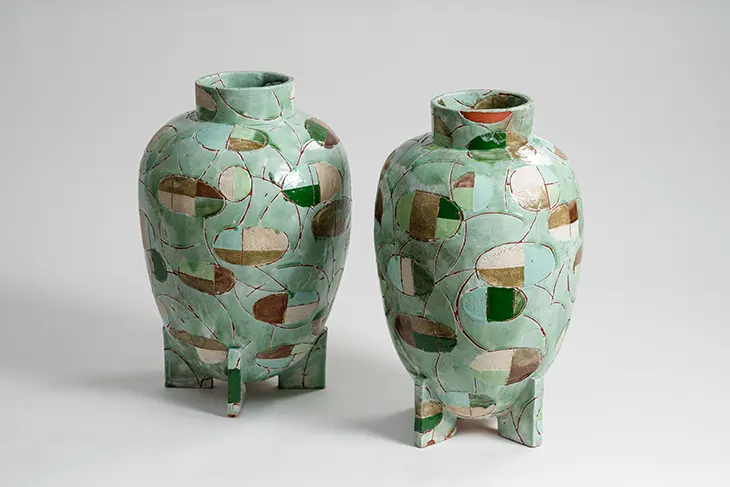
You mentioned treating the large surfaces and simple oval pattern as a “canvas” for silvery grays, blues, and greens. What is your relationship to color in clay, and how do you know when a palette is finished? – During the last 10 years, the availability of materials has changed dramatically. Largely economic forces, but environmental ones too, have stopped the mining and production of a number of essential materials, and some of the old companies have shut down, so we can no longer get materials that we depended on. So I have been recreating glazes, making new ones, substituting commercial glazes. It’s been a huge headache, and I am still mastering all the new materials. In the process, my glazes have changed a lot, which has forced me to try new things. It has forced me to discover new things.
Photo courtesy of Todd Merrill Studio
My glazing process demands a lot of imagination, as the glazes when applied look nothing like the glazes after they have been fired. I know from experience which glazes look good together, which mix well, which flow and drip, which don’t. I start with a general direction, something like “yellow”, “squares with curves,” “blobs”. I start laying the foundation of the design with paper stencils. I put all of one color down at one time, followed by the next, like with screen printing. I’m not into “the hand”, I’m not painterly. It’s the same reason I like the stencils, it’s mechanical. When I feel like it’s got the colors it needs, I do the sgraffito and fire it. The kiln does the painterly part.
You often create your sculptures in pairs. – Pairs are very interesting. There’s a real psychological power in a pair. When they are in a room, either symmetrically or more randomly, there is a connection between the two pieces, a thread of energy. It is very fun to orchestrate their interaction, with shape and color. I’m thinking about doing some pairs that are not so much twins as have a family resemblance. Pairs that aren’t the same shape or color or design, but that are a pair. How close do two vessels need to be to be a pair?
When you start going down the art vs design road, you inevitably end up in a very deep dark forest. Can a sweater be an artwork?
Working with Todd Merrill Studio places your work in a design-forward context that often attracts both collectors and people who live with objects daily. – When you start going down the art vs design road, you inevitably end up in a very deep dark forest. Can a sweater be an artwork? What is the function of a Matisse? What is the function of The Pieta? Is Falling Water a better sculpture or a better building, considering it started falling apart before it was finished but is a masterpiece of 3D form.
Photo courtesy of Todd Merrill Studio
How do you want viewers to understand the line you walk between functional design and purely aesthetic sculpture, and has that line shifted over the last few years? – I am aware that sometimes I am making a piece that intentionally goes further out from a traditional functional vessel than another I might make. Maybe pushing the traditional is the art part. But sometimes too making a wonderful version of something very traditional can feel like art too. Unless a piece is too big to handle, I always make sure my vessels are water tight, though when I am making them I never imagine them as holding water. Over the years the most functional pieces I have made are probably the tiles, which I came to as they seemed like a logical step from drawing and painting.
When I build the form, many times the last thing I do is cut out the mouth. I can feel the piece take a deep breath.
I do know that at this point in my career I love making vessels. When I build the form, many times the last thing I do is cut out the mouth. I can feel the piece take a deep breath. The open piece is completely different to the closed one. And the form is just constantly interesting to me. It’s a form that is so comfortable in the world. That makes it a perfect space to create something new.
When someone encounters your work for the first time, what do you hope they feel immediately, and what do you hope they notice only after spending time with it? – One big failure I find in so much art work is that it has just one level to look at. A piece will have a front, but not a back. It will look good from far away, but have no interest up close. It will have an important message, but a boring material presence.
I want a viewer to be confronted by a form, a surface, an inside, an outside, big marks, small marks, meanings, no meanings, precision and blur. I want someone to look at one thing and think “That’s so big” and at another thing and think “That’s so small.” And the issue of art vs design: make it both. More is more.
Zarko Davinic is an architect by education, Founder and Editor-in-Chief at DSCENE Publishing, having studied at the Faculty of Civil Engineering and Architecture in Niš, Serbia. In 2007, he founded DSCENE, which grew into an international publishing network with MMSCENE, ARCHISCENE, and DSCENE Beauty. Today, the platform features two globally distributed print editions, combining a vision for design, fashion, and culture.