


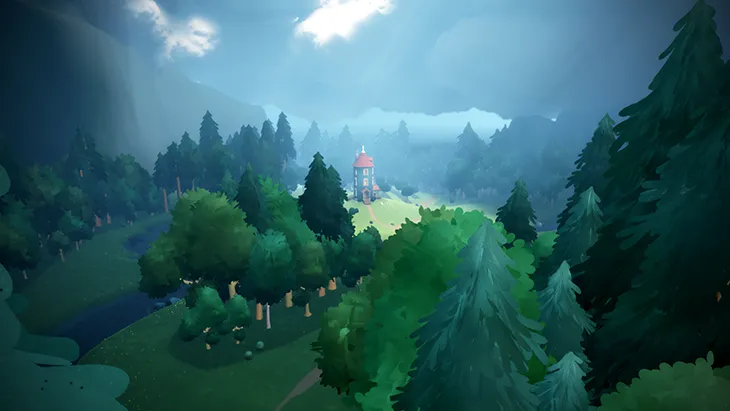
For Flora Yu, environment design begins before style. Before objects, lighting, or surface detail, she asks what a space should awaken in the person entering it. As a 3D artist working across games, interactive media, and stylized digital production, Yu approaches environment design as a way to translate a game’s emotional, narrative, or educational purpose into space.
DESIGN
Yu has contributed to projects including RoboCo, Filament Games’ STEM-focused educational title, and Ink, Mountains and Mystery, NetEase Games’ collaboration with the Palace Museum, where classical Chinese aesthetics were translated into interactive digital environments. At thatgamecompany’s Sky: Children of the Light, her understanding of emotional space entered a larger and more socially resonant world.
Sky: Building Spaces for Memory and Connection
thatgamecompany, the award-winning studio behind flOw, Flower, Journey, and Sky: Children of the Light, has long explored games as emotional experiences rather than competitive systems alone. Since its 2019 launch, Sky has carried that philosophy onto a global stage, surpassing 300 million downloads and reaching players across mobile, console, and PC platforms. Its community spans cultures, regions, and generations, making its environments shared spaces for a worldwide player base rather than scenes designed for a single market. The game has received major recognition including Apple’s 2019 iPhone Game of the Year and two Gamescom Awards in 2023, including Games for Impact and Best Mobile Game. Its AURORA concert experience also set a Guinness World Record by bringing 10,061 players together in a concert-themed virtual world.
Within this global social world, Yu’s role has often been that of a lead environment contributor, guiding environment development from early visual direction through asset creation, layout, integration, and optimization. Her contribution centers on translating emotional and narrative goals into playable spaces that are not simply viewed as images, but experienced, revisited, and shared by a global player community.
In Sky, environment art is not simply scenery. It becomes the atmosphere through which social memory forms. A garden, ruin, path, or small corner of a map may become the place where players meet friends, celebrate a season, take a commemorative image, or return years later with recognition. Yu’s work belongs to a broader shift in contemporary game environment design, where digital spaces are increasingly understood as systems that shape emotion, social behavior, and long-term attachment.
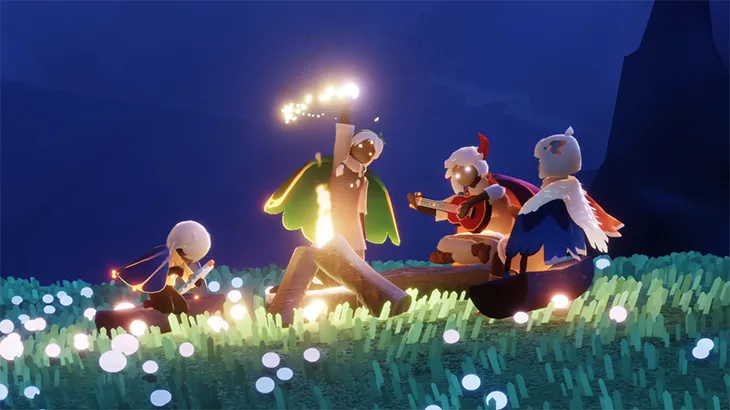
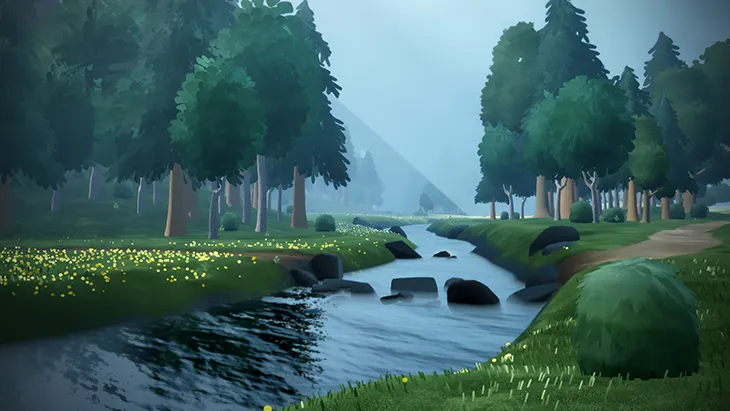
During Season of Moomin, Yu played a key creative role in introducing foliage as a major storytelling element within Sky’s world. Her responsibilities included asset creation, layout, integration, and optimization, but the larger task was more delicate: to make Moomin Valley feel grounded, organic, and newly alive without separating it from Sky’s soft emotional identity.
Through trees, grasses, flowers, and layered plant forms, Yu helped create a landscape that felt both unfamiliar and emotionally native to Sky. The work demonstrated that foliage could become more than environmental texture: a repeatable environmental language capable of shaping mood, guiding perception, and renewing familiar spaces without breaking the identity of the world. For a live game like Sky, this mattered because it showed how plant life, color density, and spatial placement could continue beyond a single seasonal collaboration and become part of the game’s evolving aesthetic vocabulary.
In a later Bloom event centered on roses and springtime renewal, Yu extended this language across multiple classic Sky maps. Rather than confining the event to a single location, she developed a rose-based environmental system that moved through familiar places players had known for years. Seven rose variations and color palettes appeared across the world, bringing a new seasonal rhythm to old paths, gathering spaces, and vistas.
The roses changed familiar environments without erasing their identity. They did not overwrite memory; they illuminated it. Places players had passed through countless times became newly intimate, inviting them to slow down, photograph, and gather.
The response was visible across community spaces, from official Discord conversations and Reddit posts to X and RedNote screenshots. Players shared rose-filled images, revisited older maps with friends, and treated the floral areas as social gathering points. The development team also recognized the rose forest as one of Bloom 2025’s standout visual moments, noting how strongly players gravitated toward it as a place to photograph, gather, and share. The response showed that the environment did more than look memorable; it changed how players used familiar spaces, turning old maps into places of connection, remembrance, and communal feeling.
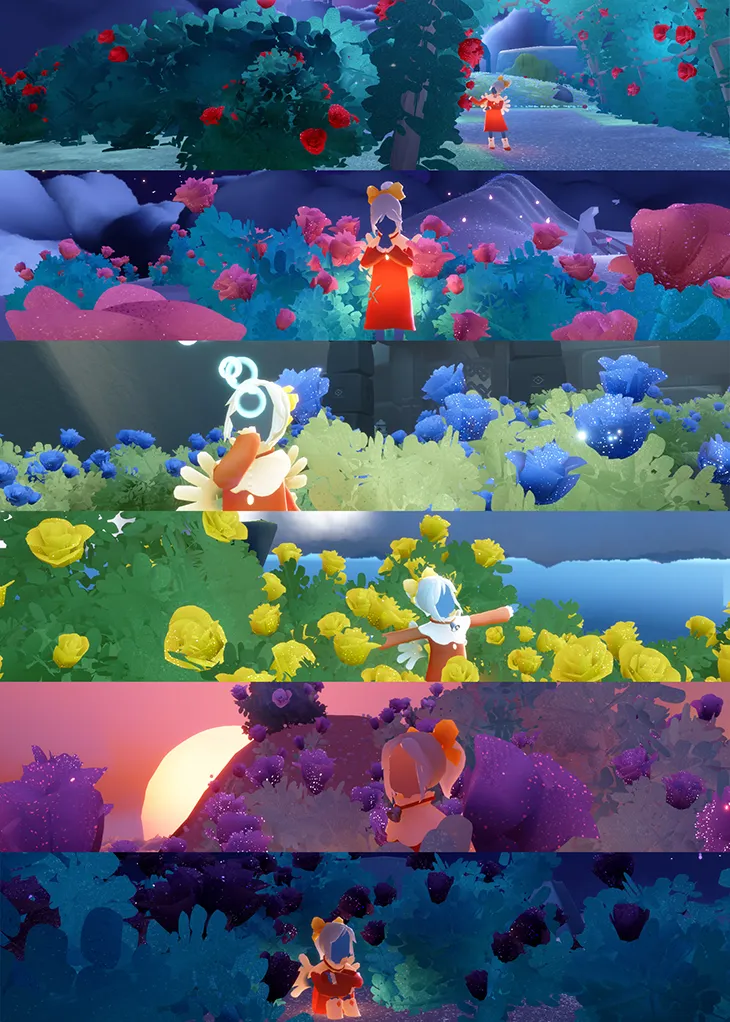
For Yu, this is where foliage becomes meaningful: not as ornament, but as a language that can change how players return to a world. From Moomin Valley to Bloom, plant life became a continuing method for reshaping familiar maps into renewed social and emotional destinations. A seasonal update becomes more than a visual refresh. It becomes a social invitation.
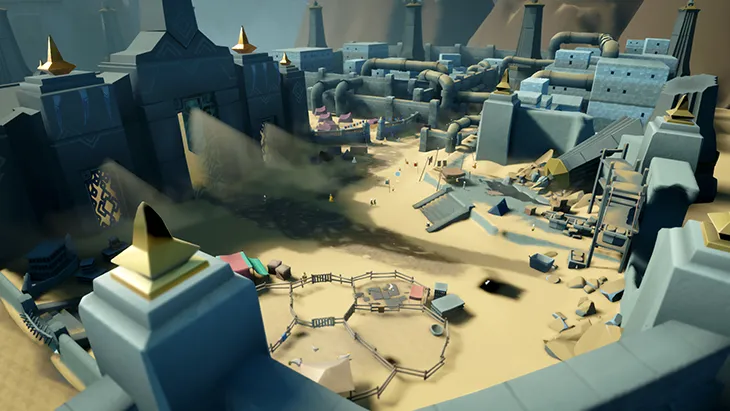
If Moomin Valley and Bloom explored the emotional force of nature, Two Embers asked how a denser and more complex environment could remain legible, poetic, and emotionally clear. The city introduced in Two Embers stands among the largest and most structurally ambitious spaces created for Sky to date. Unlike a garden, it could not rely on softness or seasonal warmth alone. It needed to carry loss, history, collapse, resilience, and traces of life in a post-apocalyptic setting.
Yu contributed to look development and environment production for the residential living areas and the spaces outside the Sanctuary. The work required balancing damaged architectural surfaces, lived-in detail, lighting atmosphere, and spatial clarity, allowing the city to feel inhabited and broken without becoming visually overwhelming. In Sky, the story is often carried without words. Damaged architecture, preserved objects, distant silhouettes, and the rhythm between openness and density all help players sense what a place once was, what it has endured, and what still survives.
Optimization in real-time games is not just about removing things. It’s about protecting the experience. Good optimization doesn’t make the world smaller. It leaves what truly matters.
In this context, optimization became both a creative judgment and a form of storytelling. Yu had to decide which details helped players understand its history and atmosphere, which could fall away, and how the world could remain dense without losing readability or performance.
The Two Embers city demonstrated that Sky’s visual identity could move beyond airy minimalism into denser, more architecturally layered territory while preserving clarity and cross-platform stability. For a game built around shared experience, the point is not simplicity, but composition: complexity can also become poetic.
RoboCo: Environments That Teach Through Play
Yu’s attention to how environments shape behavior appears differently in RoboCo. Developed by Filament Games, an educational game studio with hundreds of projects for major cultural, educational, and technology clients, RoboCo extends playful learning into robotics. Through educational and robotics-learning contexts, including Filament’s later collaboration with FIRST, an internationally recognized youth robotics and STEM education organization, the project connected sandbox play with real-world STEM education, offering students, educators, and robotics communities a more accessible way to approach engineering through experimentation.
On RoboCo, Yu was responsible for 3D environment development, from look development and asset creation to layout, integration, and optimization. The work required a different kind of design sensitivity. Instead of inviting players to linger, reflect, or remember, each space had to lower the friction of learning: making engineering problems approachable, readable, and immediately testable.
Environments were built around design prompts, giving players clear cues about what their robots needed to do, where interaction could happen, and how the results of each attempt could be understood. Props, materials, surfaces, and small interactive details became part of the learning loop. They translated robotics concepts such as force, precision, balance, and iteration into visible responses, allowing players to revise their designs through play rather than instruction. For Yu, environment design became a quiet teacher: it did not explain the solution, but made experimentation clear and engaging enough for players to keep trying.
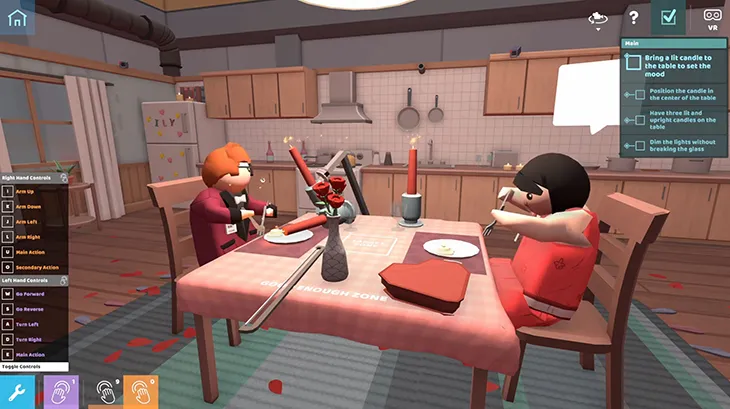
Seen beside Sky, RoboCo clarifies the range of Yu’s method. She treats environment design not as decoration around gameplay, but as a way for a game to speak through space. In Sky, that language invites emotion, memory, and connection; in RoboCo, it makes experimentation readable and learning feel alive. Across both, her work reflects a broader evolution in real-time environment art: from building beautiful scenes to designing systems that shape how players feel, act, gather, learn, and understand a world. This is the center of Yu’s practice: using environment design as a tool to advance the purpose of the game itself.
Beyond her game production work, Yu’s real-time animated short You Shell Be Happy was named a Draft Selection and received the Excellence Award at the Rookie Awards 2020, with further finalist and official selection honors from international animation and film festivals including DYTIATKO International Children’s Media Festival 2021 and Palm Springs International Animation Festival 2020.
A broader selection of Yu’s environment art, stylized 3D production, and interactive world-building work is available through her portfolio.
Words by DSCENE Editor Maya Lane.