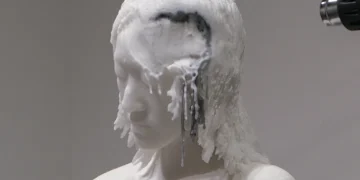



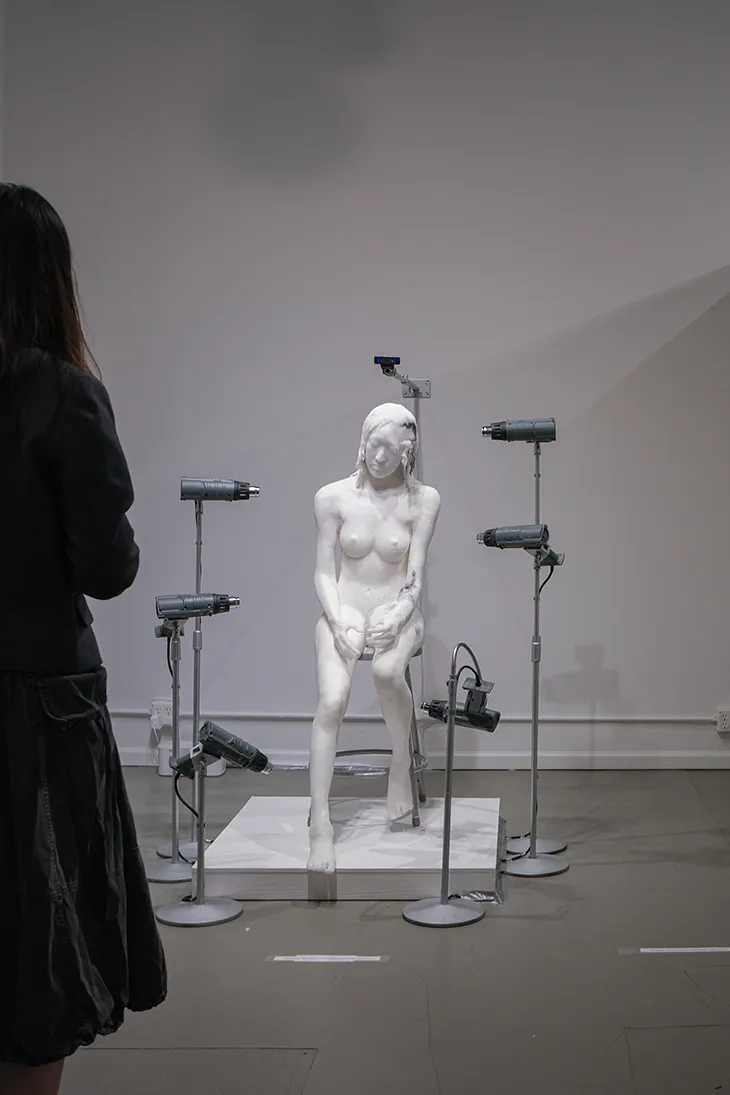
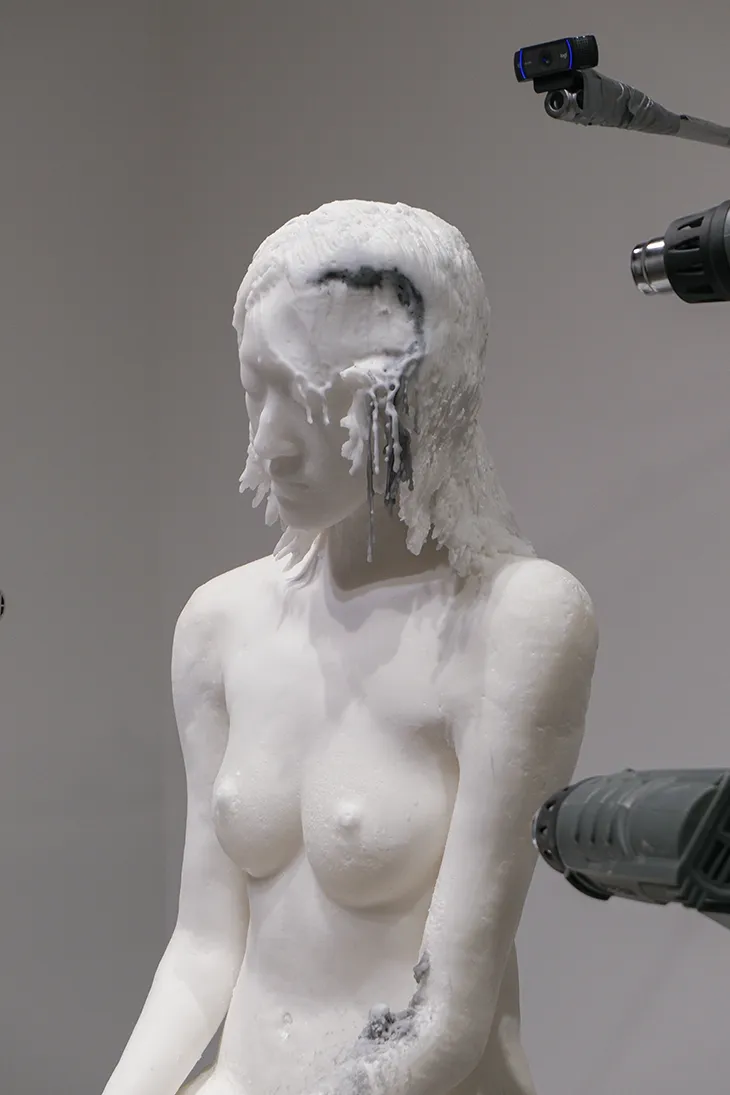
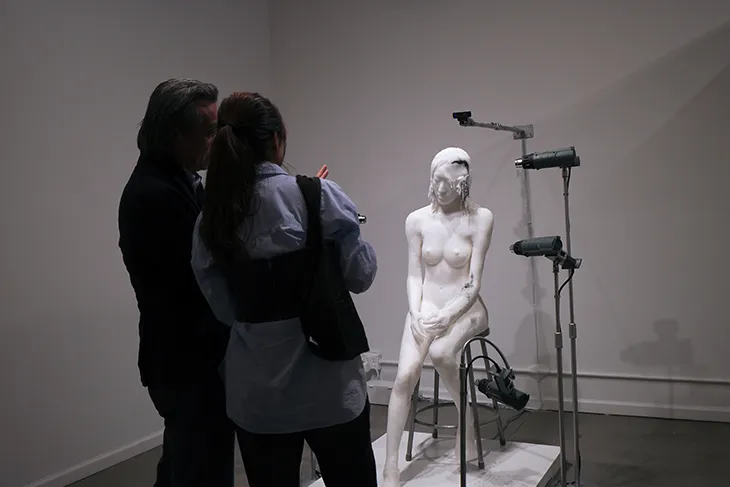
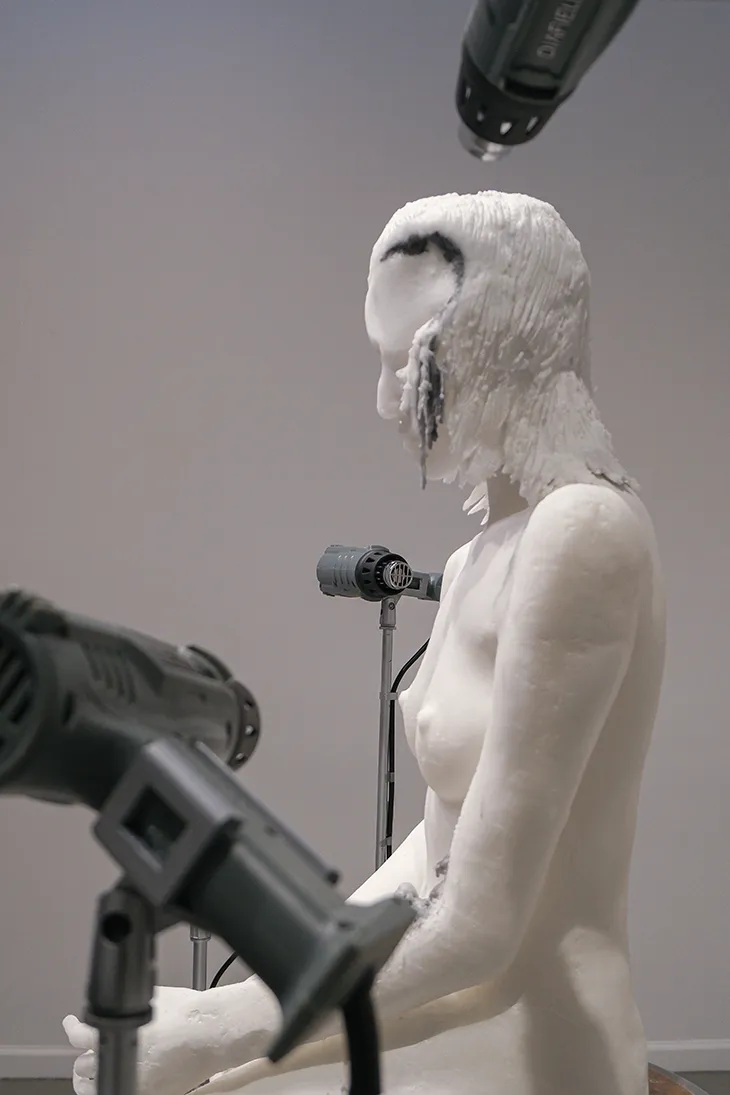
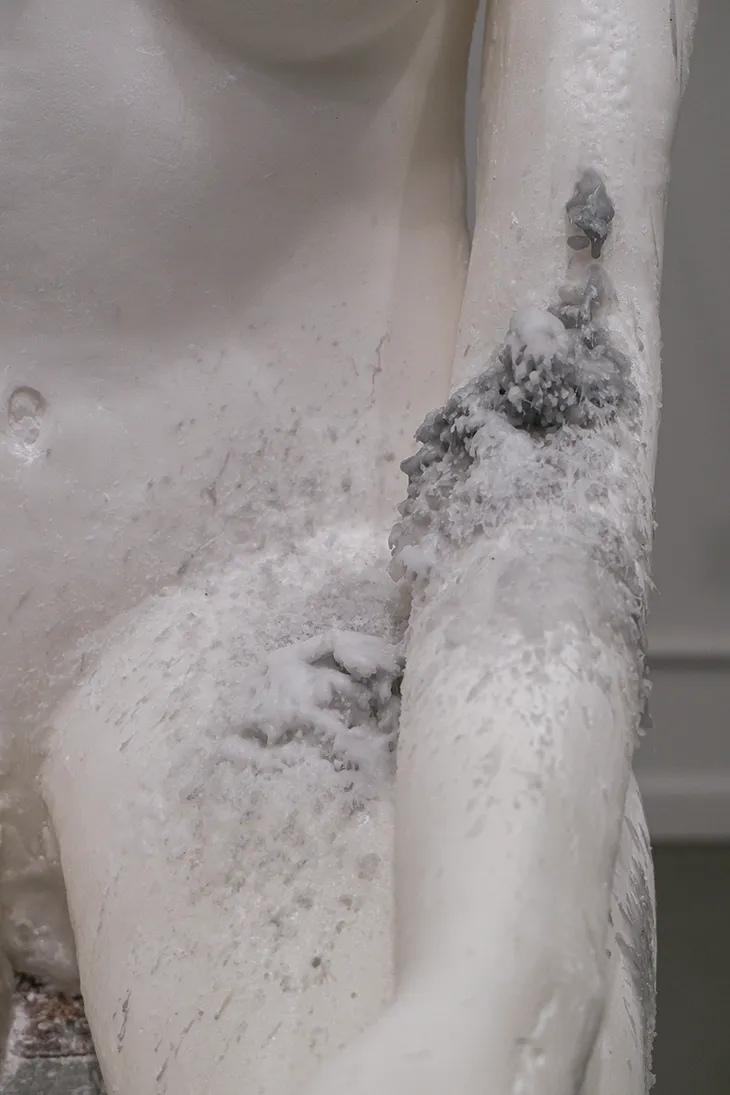
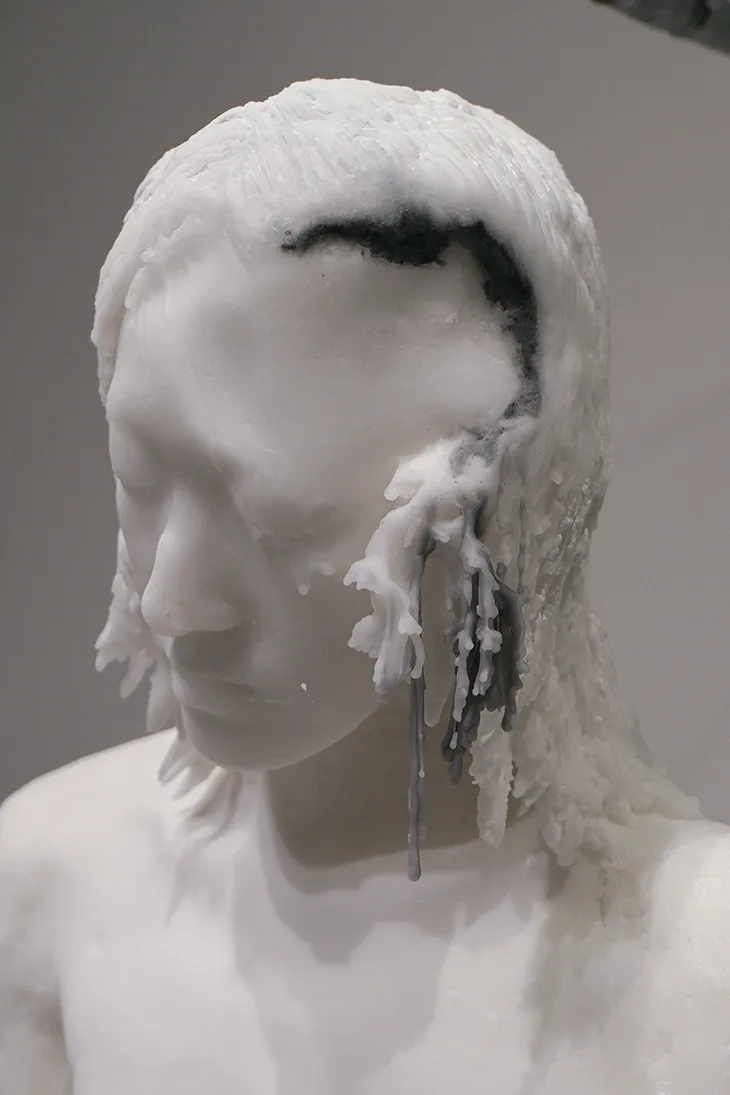
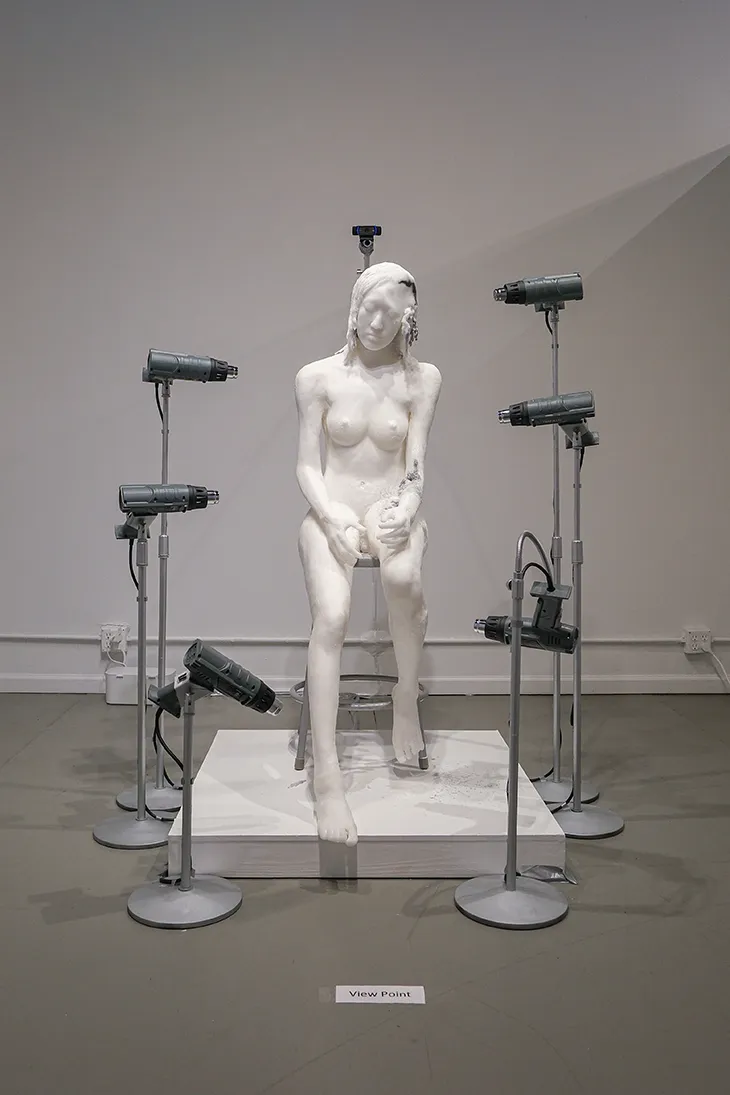
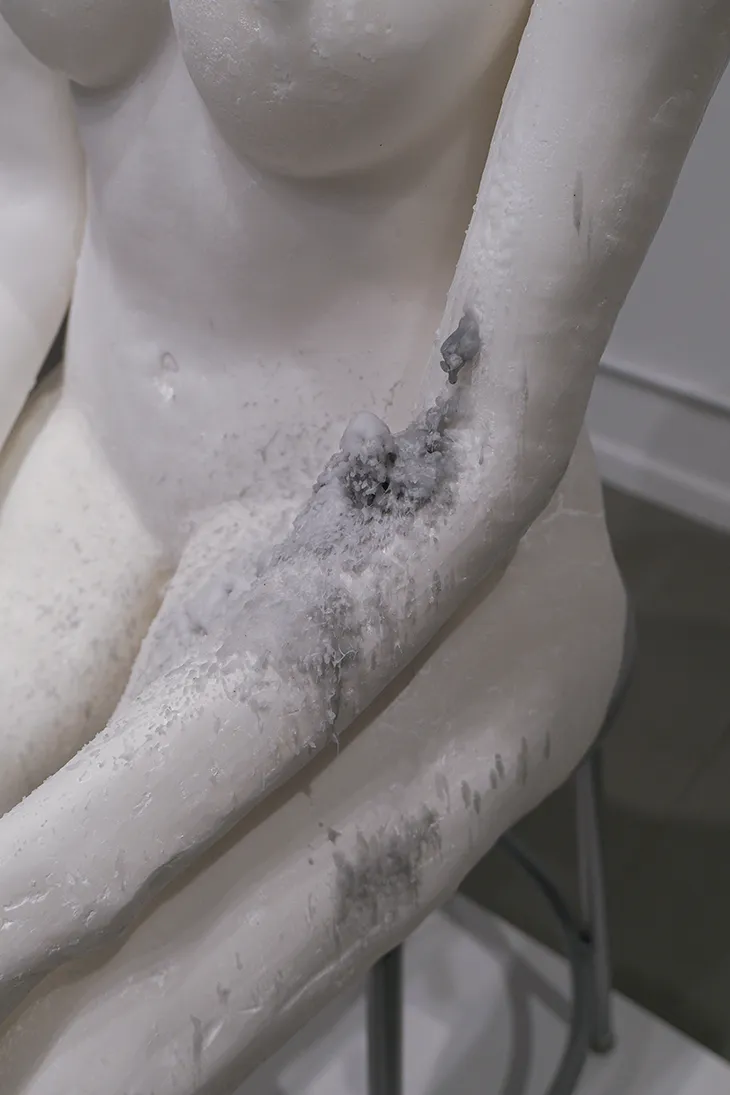
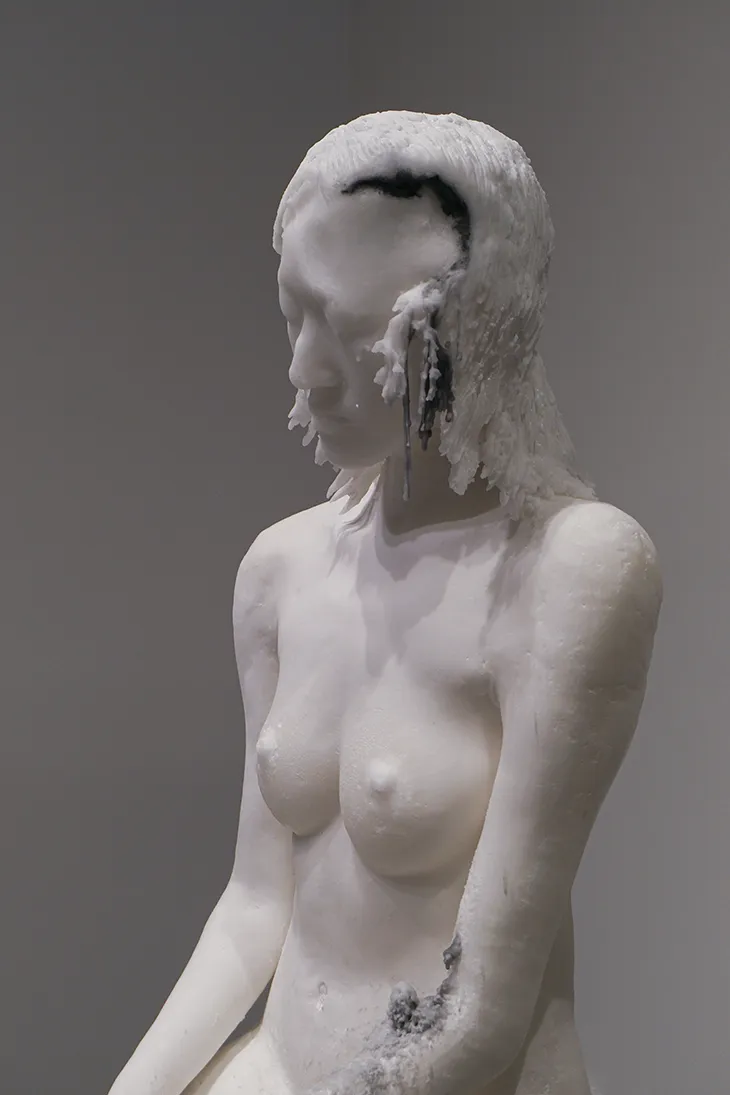
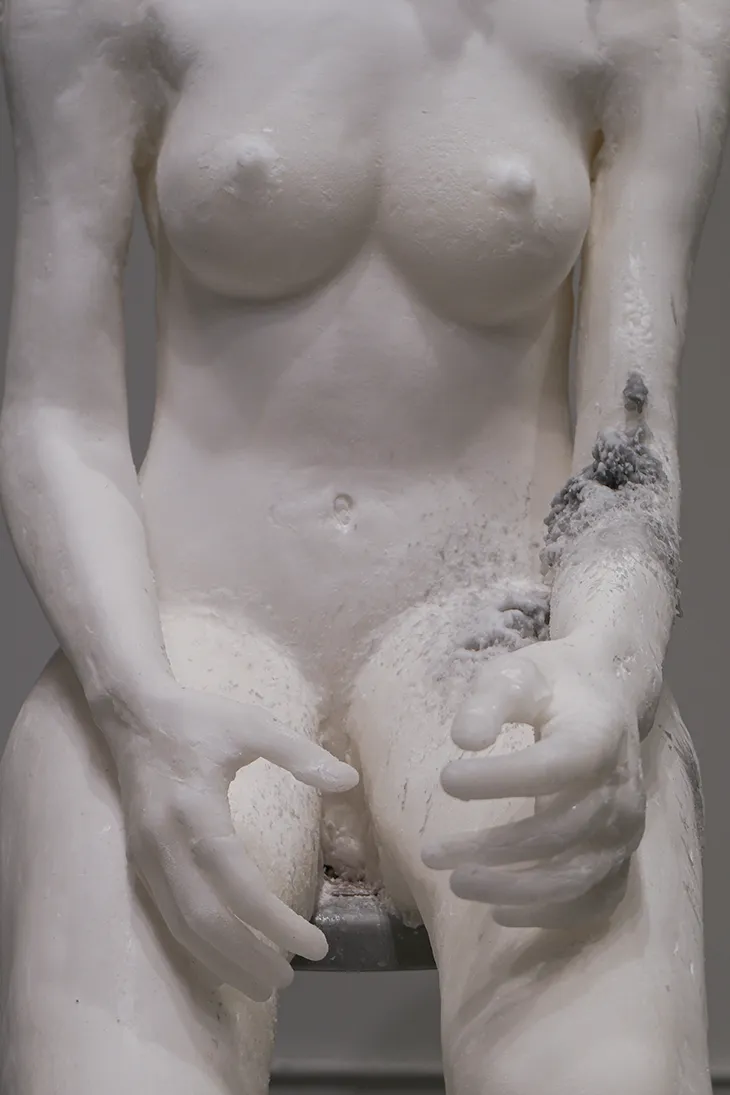
At ARC Gallery, a life-cast wax figure stands at the center of a room. Cameras track every visitor’s gaze, converting points of attention into heat, and wherever eyes linger, the wax softens and melts away. By the end of its run, the figure will have recorded the cumulative weight of every look it received, not as photographs or data, but as material loss. The work is called Don’t Look At Me, and it was made by two artists, Vivian Lu and Rose Qi, who share a conviction: that the most powerful forces shaping our lives are the ones we have already stopped noticing.
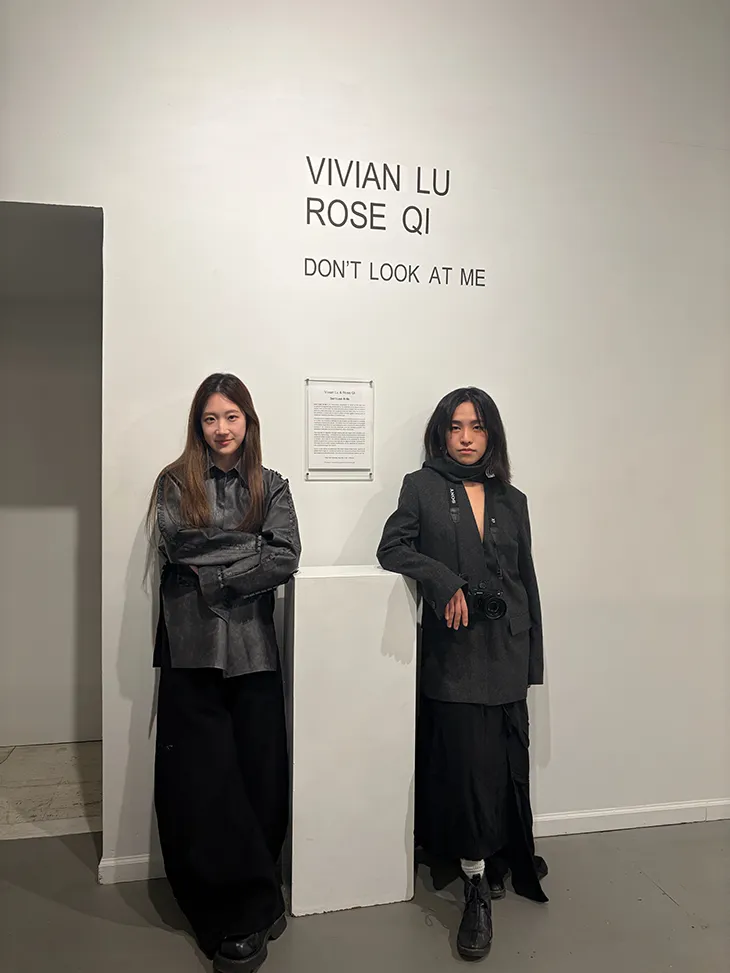
Vivian Lu is an artist working with interactive installations. Trained in philosophy and drawn from theatre, film, and writing, she builds work that invites audiences to co-create meaning in real time, turning memory and feeling into shared physical experience. Her installations stage the space where perception unfolds through the body, where we encounter ourselves and others beyond any fixed self.
Rose Qi is a designer and emerging artist working across interactive installation, wearable design, and fashion. Her practice investigates how technology mediates the relationship between the body, perception, and social behavior, translating invisible psychological and social dynamics into responsive physical systems.
Presented as part of ARC Gallery’s Athena Fund Solo Exhibition, a program dedicated to supporting women artists and underrepresented voices, Don’t Look At Me has drawn attention for transforming perception itself into a physical force. We spoke with Lu and Qi about surveillance, vulnerability, and why passive participation is the point.
Making the Invisible Felt
Don’t Look At Me transforms ordinary acts of looking into a responsive physical system. What interested you in translating invisible social behavior into material consequence?
Vivian Lu: Most of my earlier work has circled the same question: when the frameworks that define what counts as “human” begin to loosen, what is actually left of the person? With Don’t Look At Me I wanted to step back inside that question rather than past it, not to ask what happens after those frameworks come apart, but to look at what the frameworks themselves are doing to us while they still hold.
The gaze is one of those frameworks. To be looked at is to be assessed, sorted, reduced, a quiet, systemic dehumanization we rarely register because it never announces itself. But there is a tension: the gaze, and the power that travels through it, is as old as social life itself. It is not a malfunction of civilization but one of its conditions. So the work isn’t an argument that looking is simply harmful. It sits with the contradiction that the gaze is at once what diminishes us and what constitutes us as social beings.
Making that consequence material is how I try to hand the choice back to the viewer. The piece reveals something you were already doing: you walked in, you looked, and the system was already running. The only difference is that now you know, and that awareness is where choice begins. The melting body is the cost of looking, it is also, I hope, an invitation into a fragile intimacy.
Rose Qi: I’ve long been interested in how the act of looking affects both ourselves and others. A lot of social pressure is not created through direct violence, but through ordinary behaviors like observing, paying attention, and being watched. These dynamics exist constantly within social relationships, yet they often remain invisible.
I wanted to make that invisible structure visible by translating it into a physical system that could be experienced through the body. The important thing was not simply to represent the gaze, but to allow the gaze itself to produce real consequence. When viewers are only looking at a body, yet that body gradually deforms and disappears because of their attention, looking no longer remains neutral. No individual explicitly intends to destroy the body, but collective attention still leaves irreversible traces over time.
A Space That Understands the Work
You chose to show Don’t Look At Me at A.R.C., a women-run gallery. What makes this a meaningful space for the work?
Vivian Lu: Showing the work at A.R.C. mattered to me for a reason that’s continuous with everything I’ve said about vulnerability. The fragile intimacy I’m describing, the willingness to be unguarded, to be seen, to build a relationship from that exposed place, is something I associate closely with women’s experience. But I want to be careful about how I say that. I don’t think of it as something women inherently are; it’s something we’ve learned from living under the gaze. When you already know what it is to be stripped down and assessed, you also learn how to meet other people in that stripped-down place. It’s a capacity cultivated through experience, not a trait we were born with.
That’s where my interest in the piece finally lands. It begins as a work about surveillance, but what I care about underneath that is whether shared vulnerability can become a way of being together.
Rose Qi: Although Don’t Look At Me is not specifically about female experience, the experiences of being watched, evaluated, and regulated through visibility were the important starting points for the project. Exhibiting at A.R.C. – a gallery with a long history of supporting women artists and underrepresented voices, provided a meaningful context for these conversations.
At the same time, our interest extends beyond gender itself. Women are often more aware of these dynamics because they encounter them more frequently, but the system ultimately affects everyone. We are all observing others while being observed ourselves, gradually learning how to shape our behavior, appearance, and identity through the expectations embedded in those gazes.
Already Inside the System
The installation requires nothing from viewers except what they already do naturally: look at a body. Why was this passive participation important to the conceptual structure of the work?
Vivian Lu: I started my practice in drawing, but it let the audience keep a comfortable distance. Acting gave me a solution: I believe that one can feel a narrative most vividly and deeply when they become the protagonist and immersively experience it. This is why all my works are interactive installations.
In Don’t Look At Me, what I wanted the audience to do is what they always do – look – and only afterward realize the system was already running through them. That refusal to ask permission is the concept, not the interface. It reproduces how the systems I’m interested in actually work: they don’t recruit you, they just include you. The melting isn’t something you observe but something you cause. That shift, from watching to being implicated, is the only way I’ve found to make an invisible force felt rather than just understood.
Rose Qi: Surveillance is often imagined as something imposed from above, a clear distinction between observer and observed. But many of the forces shaping our lives operate differently. They become embedded in ordinary behavior. They no longer require direct enforcement because people begin to internalize them and reproduce them themselves.
If viewers had to consciously activate the work, the installation would become a demonstration. Instead, I wanted the work to function more like the systems it points to. As an artist, I am less interested in illustrating ideas than in constructing situations where people can experience them directly.
Technology as Mirror, Not Spectacle
The technology aspect of the work is drawn directly from the vocabulary of contemporary surveillance. How do you think about the relationship between the technology you deploy and the systems of power it ultimately points to?
Vivian Lu: The apparatus, computer vision, facial-orientation tracking, automated physical response, belongs to the same operational vocabulary deployed across contemporary surveillance, from CCTV networks to biometric borders. But the impulse predates the camera. The regulation of bodies through looking is older than any technology, encoded in law, dress, and social ritual. What automation adds is scale and indifference: a structure that no longer needs a warden because it runs on the ordinary behavior of everyone who passes through it. No one issues an order; no one feels like an agent of power. And yet the damage accumulates, quietly, at the expense of every body in the room.
By externalizing an otherwise invisible process, the conversion of gaze into consequence, I wanted to refuse to treat the technology as spectacle. The robotic gesture simply makes legible what is usually felt and never seen. The wax cannot be restored. Neither can we.
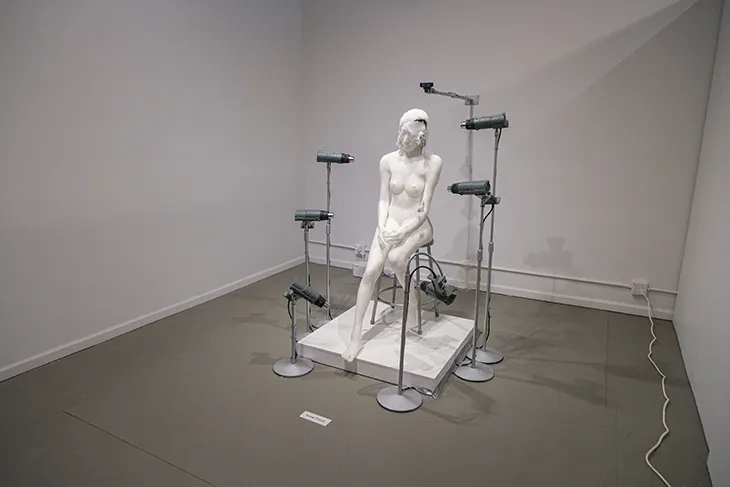
Rose Qi: Technology itself is rarely the source of power. Technologies change constantly, but the social structures behind them often persist. Cameras and tracking systems are simply contemporary manifestations of a much older impulse, the desire to regulate behavior through visibility.
Technologies become embedded within everyday life and eventually disappear into the background. The most powerful systems are often not the ones we notice, but the ones we stop noticing. The technology makes the process visible, but the mechanism it points to is fundamentally human.