



When Stefon Diggs steps off the football field, he enters a different kind of arena, one he’s constructed entirely on his own terms. At Tuleste Factory through the end of July, the NFL superstar and design visionary presents If You Want Peace, a solo exhibition by SI VIS PACEM that reimagines what it means to create spaces that feel both elevated and deeply human.
The collection emerges from a fundamental belief: home should serve as a sanctuary. After years of discipline, movement, and the relentless intensity of professional sports, Diggs discovered that his peace came not from performance, but from presence. The exhibition manifests this philosophy through sculptural furnishings, functional objects, and carefully considered interventions that blur the line between nostalgia, fantasy, and everyday living.
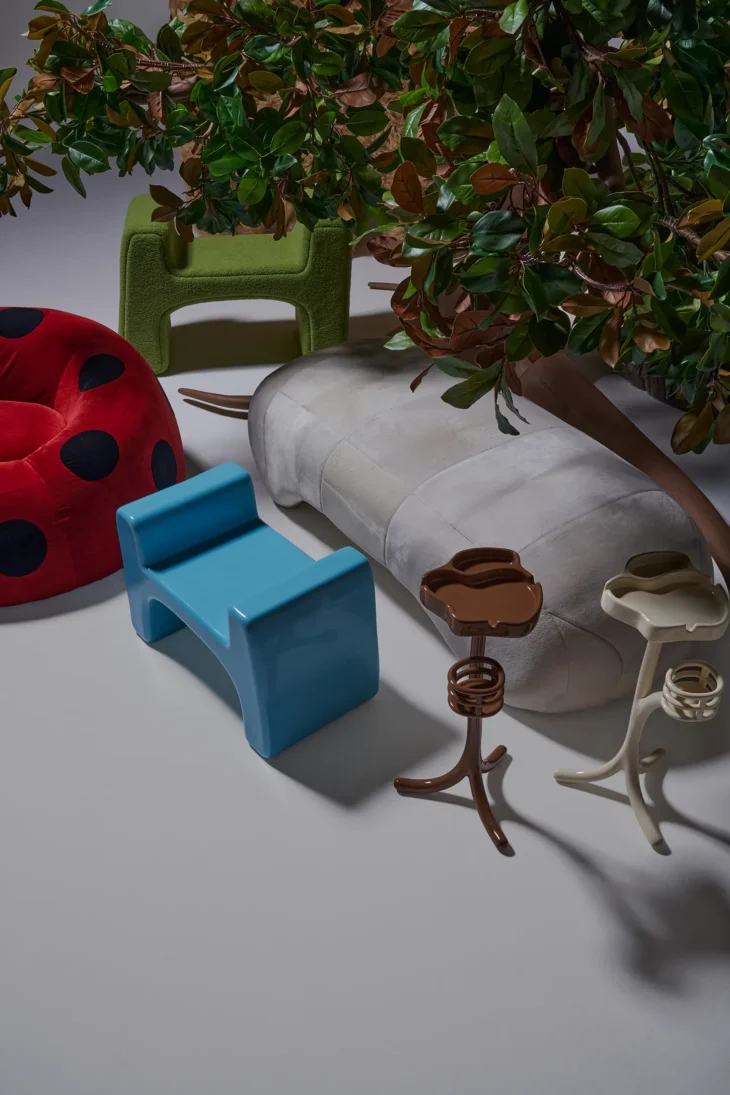
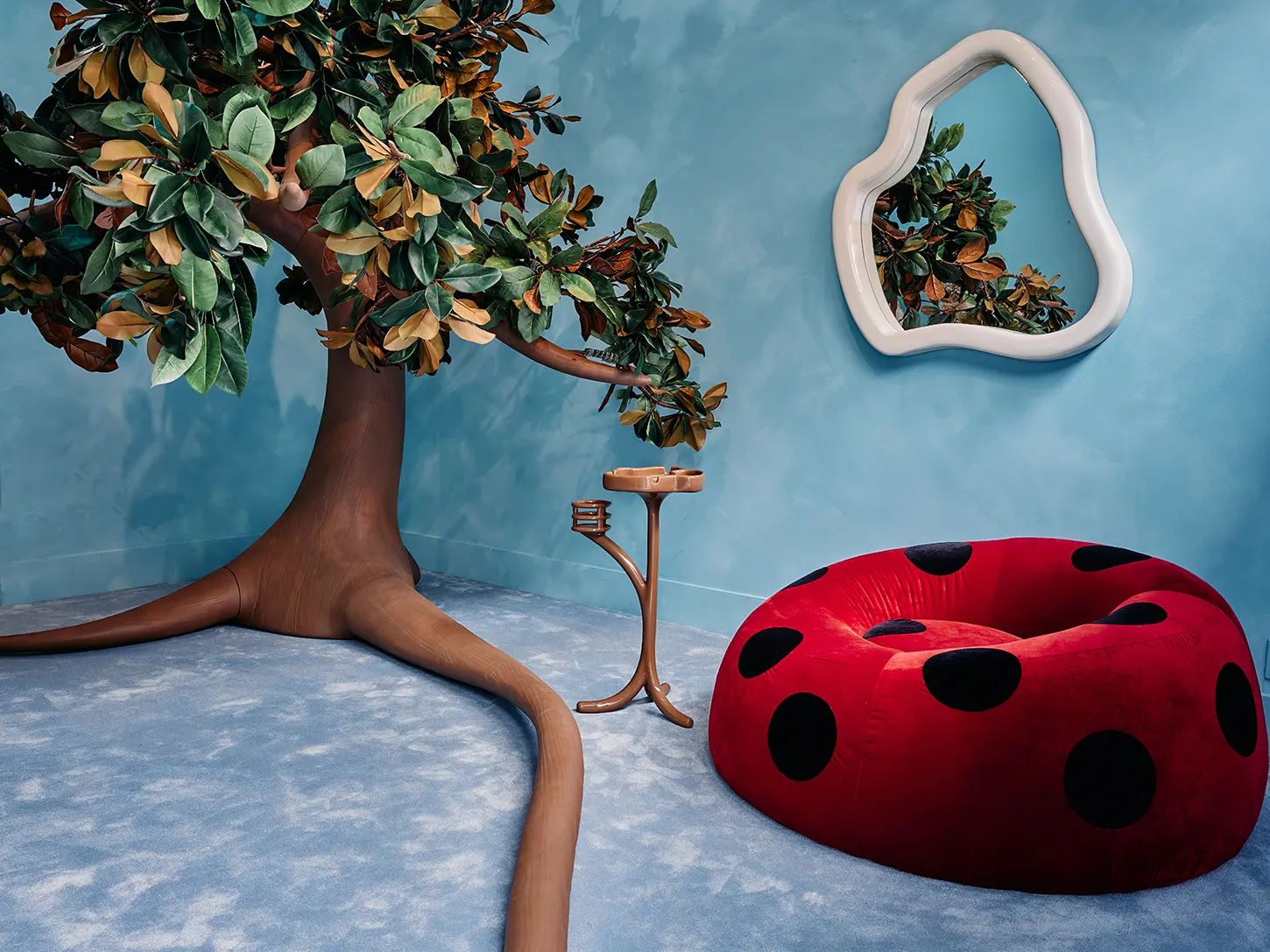
What distinguishes SI VIS PACEM from conventional furniture design is Diggs’ hands-on creative process and his willingness to imagine beyond traditional boundaries. Working with collaborators and manufacturers in Vietnam, alongside upholsterers in New York, he’s developed a collection grounded in softness and organic forms. The signature pieces tell individual stories: a tree mirror inspired by meditative time spent outdoors in Maryland; ashtrays that double as sculptural objects, designed for the smokers and cigar enthusiasts he surrounds himself with; ladybug chairs rooted in personal symbolism and good luck; and a monumental H bench that functions as both functional art and conversational anchor.
The exhibition transforms Tuleste Factory into an immersive environment rather than a traditional gallery display. Visitors are encouraged to touch everything, to sit, to inhabit the space, a radical departure from the “do not touch” etiquette of most galleries. This tactile approach reflects Diggs’ belief that design should be experienced physically, not merely observed. Every piece carries intention: no harsh edges, considered proportions, materials that invite interaction.
Running parallel to the furniture is work by surrealist painter Lindsay Dawn, Diggs’ SI VIS PACEM co-founder, whose pieces further explore the tension between vulnerability and strength that runs through the collection. Together, they’ve created a world that honors both the intensity of Diggs’ professional life and the quietude he seeks within it.
Stefon Diggs’ background in fashion and design, he’s worn the pieces he creates, informs every decision. Yet his lack of formal training in furniture design becomes an asset rather than a limitation. Unburdened by industry conventions, he asks questions others might not: Can we make a tree out of fiberglass? Can we create functional sculptures that feel like art? His collaborators answer consistently: yes, we can figure it out.
If You Want Peace opens to the public by appointment, with walk-ins accommodated based on capacity. The exhibition runs through July 31st at 342 W 14th Street. Stefon sits down for an interview with DSCENE Magazine’s Editor in Chief Zarko Davinic.
Where did the concept of SI VIS PACEM originate? -I feel like I go to war every day between my career, my passions, and everyday life. When I come home, I want to feel peace. A place where I can reset, reflect, and recharge. SI VIS PACEM is really my way of creating that feeling within my own space. The moments I feel most at peace are in the spaces I create.
FURNITURE STORIES ON DSCENE
The collection draws heavily from nature. Tell us about the tree piece. – I love being outside. I’m a homebody, so I spend a lot of time at home, but when I do go out, I’m training, working out, or just being still. I became a lover of trees. I was in Maryland for a bit, spending more time outside, and when I came back, I was like, what if we made a tree? At first, I wasn’t sure if it was even possible.
We had conversations about the process, what materials we’d use. The manufacturers in Vietnam are incredible, they’re architects and engineers too. They took the render we sent and built it with foam first, then made a mold from an actual tree branch. The leaves are a mix of leather and synthetic material. It’s fiberglass resin with an automotive finish, so it looks ceramic but can actually live outside. When I saw it coming together, I was like, this is insane.
The challenge of getting it into the gallery must have been real. – Exactly. We have a gate that comes down, but we can’t open the doors wide enough. So we had to make it modular. They literally took the render we sent them, built a foam version, cut it out, and figured out how the tree could come apart and reassemble. They made branches, created molds from real tree branches. It’s crazy how they executed it. We’re sharing progress photos on Saturday, it’s insane how they do it.
Creating an environment where people feel like they can just be. The whole point is peace. It’s not about performance or showing off. It’s about creating a space where someone walks in and feels like they can reset.
The ashtray seems to function as something more. – I have a lot of smokers around me, cigars, cigarettes, whatever. I wanted something functional and comfortable for them. My agent and some close father figures of mine smoke a lot of cigars, and they usually have cognac or whiskey with them. I wanted to create something where they could rest their drink and enjoy themselves. It’s big enough to hold a tall glass, something personal. But if you don’t smoke, you can drop your keys in it, put it by the door, use it however you need.
The version we have feels less cold. It’s got good weight. I made it big enough so you could put a very tall glass in there, or something a little more personal. The whole point was making it multipurpose. It can be an ashtray, a catchall, a side table with a plant. Whatever you need it to be.
There’s a ladybug motif throughout the collection, the ladybug chair is probably my favorite piece. – A good friend of mine reminds me of a ladybug. There’s a belief that when a ladybug lands on you, you’re not supposed to brush it off, it brings good luck. I kept seeing them for a period of time, and I thought, that’s a sign. We made it in different materials and fabrics. It had to be cozy, so we adjusted the construction so you can sit deeper into it. You can really sink into it. The shearling version, it feels like you were made for that chair.

You have these sculptural figures throughout the space, these friendly little forms. What are they? – These are my friends. I don’t have many friends, obviously [laughs], but I wanted to create little figures that feel peaceful and helpful. They started as a conversation about making functional sculptures. I was like, what if we make little figures? And they said, we can do anything. I wanted a little army. They’re cool because they’re functional too, you can put your keys here, your phone, whatever you want. They’re peaceful. They’re like, “Let me hold stuff.” You can put them inside or outside. The fiberglass isn’t too heavy, so you can actually pick them up and move them around.
The mirrors come in different iterations. – Yeah, we have the signature lake mirrors, and we’ve evolved them. The black and white one is my favorite. That was actually inspired by Lenny Kravitz. I saw a picture of him in his house with a black and white floor next to a Basquiat painting, shoes off. I was like, I wonder if I can make something to fit a vibe like this. It’s very Dr. Seuss in a way. I love it. You can also match mirrors with different fabrics and finishes. The chrome is just beautiful, especially for people who have black, white, grey spaces. The chrome fits perfectly. We can make them in different finishes too, so there’s a lot of room to build on that.
I like to keep things lighter, fun, usable. My childlike self and my lack of experience bring up more creativity, because I’m not stuck in a box. We only can do what we ask for.
How did you land on these specific design influences, the 70s and 80s references? – I was a consumer. Over the past five or six years, I’ve been buying a lot of furniture. When I build a space and want to create it peacefully or energetically, or however I want it, I just go off things that came before me or things I’m drawn to. I love furniture and design. I like to keep things lighter, fun, usable. My childlike self and my lack of experience bring up more creativity, because I’m not stuck in a box. We only can do what we ask for. When I ask them, “Can we make something?” I just want to see if it can happen. They say, “We’ll figure it out.” That non-traditional route spurs curiosity. You don’t feel limited to thinking one way.
You mentioned working with Lindsay Dawn. Tell us about that collaboration. – She’s incredible. She’s so freely creative. She’s just endless with ideas. I’ll be like, “Let’s do this, let’s do this,” and she’ll be like, “What about this?” . The ideas are literally endless. She has great ideas too. Sometimes they sprinkle in and I’m like, that wasn’t bad. Her surrealist paintings are in the show alongside the furniture. They explore that same tension between vulnerability and strength that runs through everything we’re doing.

With your brand LIEM Homme you also have a fashion background. How does that inform the furniture work? – I started with my clothing brand, and I was going to make furniture off of that. It developed into something else. Originally, I wanted to make all the letters, write them all out and have them scattered around my house. That’s how the E and H started. The letters can work as different things. The E works as an E, the H works as an H, an M. It’s definitely versatile for an entryway or as juxtaposition pieces throughout a space.
The scale of some pieces is surprising. – I like to have a lot of fun in my house. I like to stand on different pieces. When I’m on the phone talking to somebody, you have those long conversations and you end up just moving around. I want a furniture piece where multiple people can be on the phone, chatting. We made this massive H piece, like twelve feet tall, that’s modular. It’s a party piece. You can sit on it, stand on it, multiple people can be involved.
When you go into most galleries, they say, “Don’t touch anything.” I’m the opposite. You’re going to live with this. When you touch something like this, it’s motivating.
You’re showing all these pieces with the intention that people touch them. – Exactly. I want people to touch everything. When you go into most galleries, they say, “Don’t touch anything.” I’m the opposite. You’re going to live with this. When you touch something like this, it’s motivating. You feel the fabric, you feel the quality. The sense of real experience of touch is intoxicating. I don’t want people to just look. I want them to interact. Get your feel of it. See if you like it. Because ultimately, you’re going to bring this into your home.
You attended Fashion Week for years, you know the circuit. How does that experience shape your approach to design? – I was going to Paris and Milan for women’s and men’s shows in the summertime. I got a little overwhelmed after going three years in a row, maybe four. You’re going from place to place, show to show.
But that taught me something important. You learn by seeing how your work lands in different environments, how different cities respond to design and creativity. That’s why I want to take SI VIS PACEM to different places, Miami in December, and beyond. I want to see how people receive the work in various cities.
What excites you most about this exhibition? – Creating an environment where people feel like they can just be. The whole point is peace. It’s not about performance or showing off. It’s about creating a space where someone walks in and feels like they can reset. That’s what this exhibition is. It’s an invitation into a world built around that feeling. That’s the goal.
Discover more of the exhibition and the furniture collection by Stefon Diggs in our gallery:
For more of Stefon Diggs’ Work visit his Instagram @stefondiggs and @sivispacem.home.