


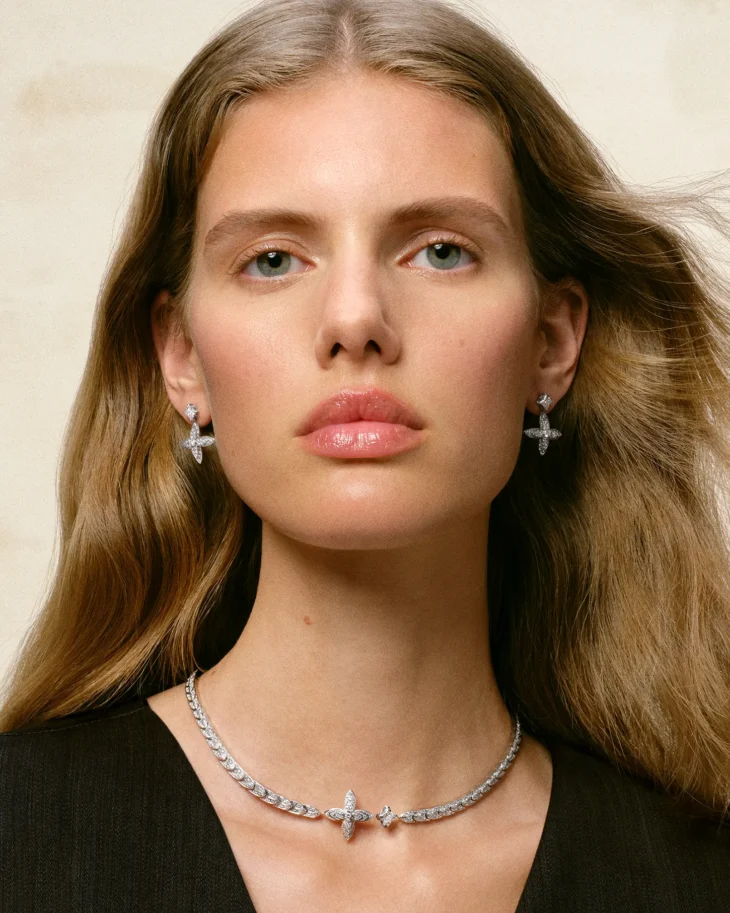
Louis Vuitton’s high jewelry division has quietly established itself as one of fashion’s most unexpected players in the luxury diamond market. With the expansion of its Idylle Blossom collection, the maison is making a clearer statement: high jewelry is no longer ancillary to the ready-to-wear narrative. It’s a distinct and growing pillar of the brand.
The Idylle Blossom collection, introduced in 2012, rests on a deceptively simple foundation. Georges Vuitton designed the Monogram Flower in 1896 (a motif so integral to the house that it’s become shorthand for LV design itself). For the high jewelry expansion, the house has taken this graphic symbol and translated it into two distinct registers: accessible fine jewelry and exclusive high jewelry pieces, both executed in white gold and diamonds.
Two Languages of Luxury
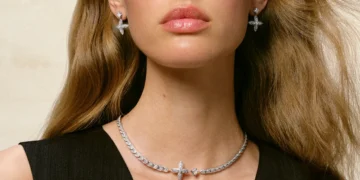
The fine jewelry set speaks the language of daily wear. Three new pieces (a ring with pavé band, delicate earrings, and a diamond-set pendant) are engineered for rotation, for stacking, for the kind of familiar intimacy that defines modern luxury. They’re precious without demanding ceremony.
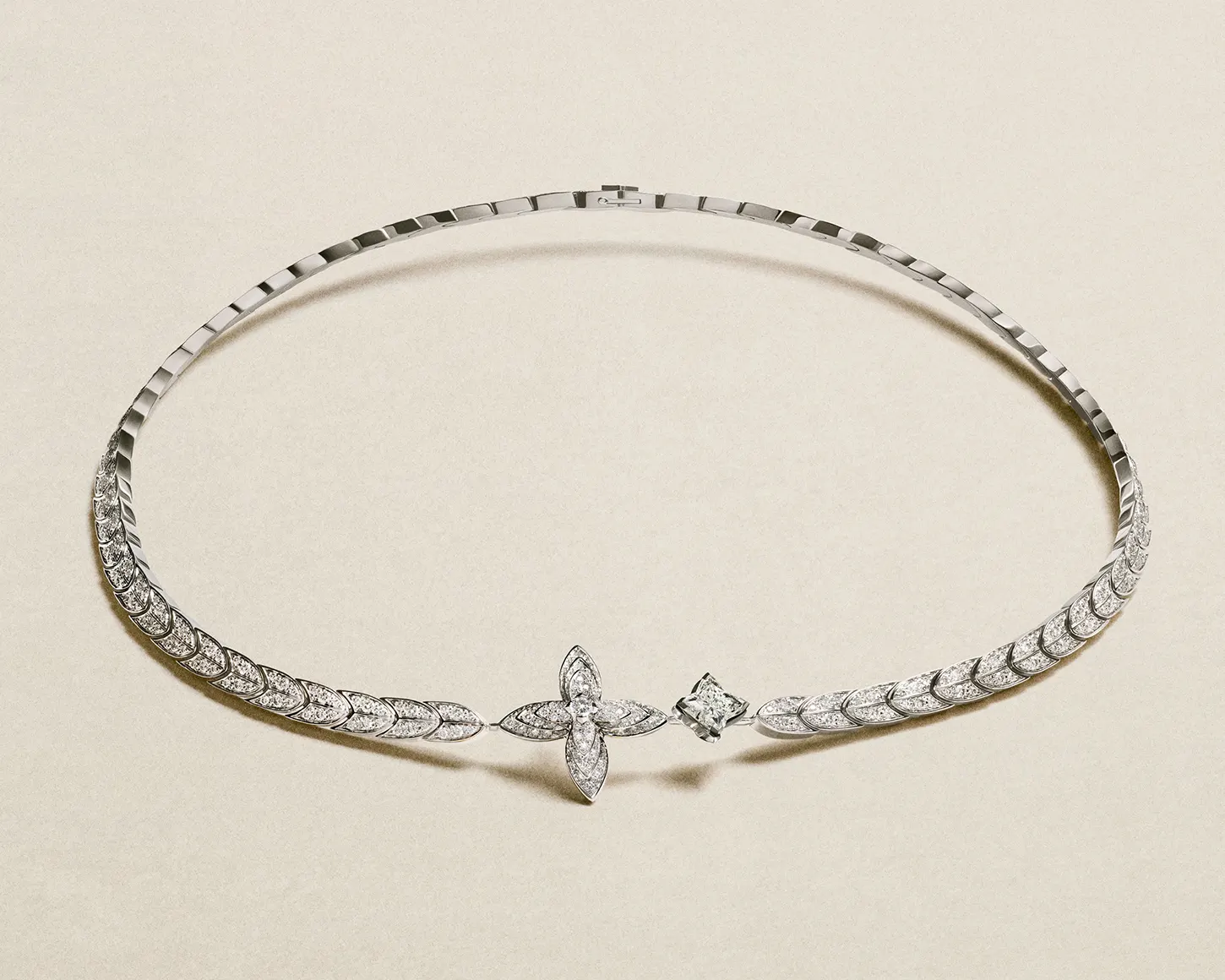
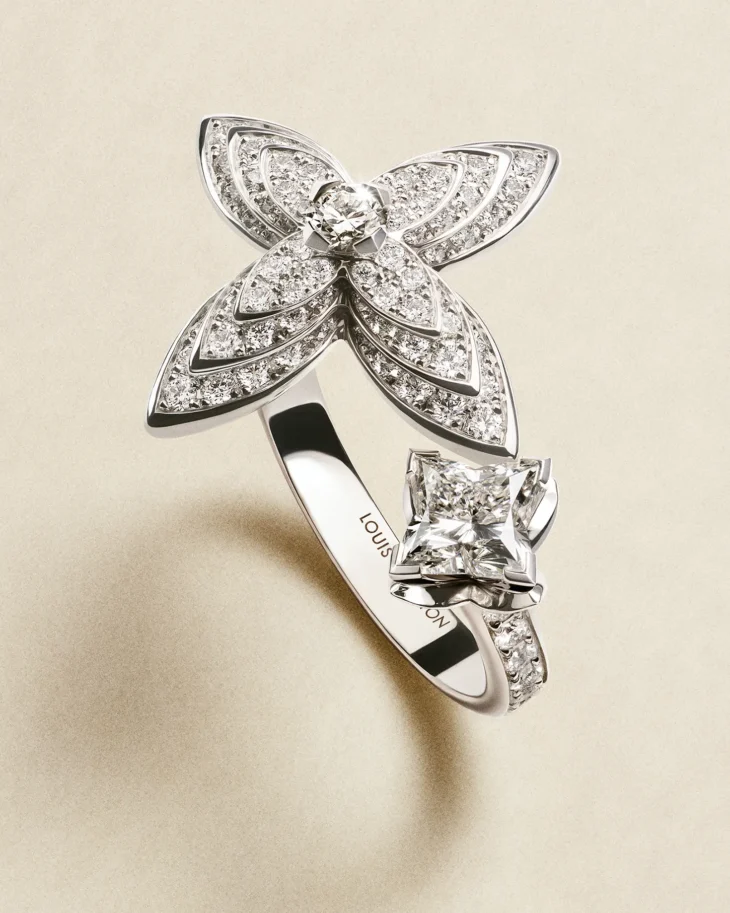
The high jewelry set, by contrast, enters a different conversation entirely. Here, the house introduces its proprietary LV Monogram Star cut (a diamond cut exclusive to Louis Vuitton). The geometry of this stone is deliberate: faceted to echo the symmetrical petals of the Monogram Flower itself. When paired with the pavé Monogram Flower motif in white gold, the result is a kind of dialogue between two interpretations of the same symbol. A necklace hugs the neck with what the house describes as “sensual precision.” Matching earrings and a reinterpreted Toi & Moi ring complete the parure.
This isn’t subtlety. It’s architectural, a design approach that distinguishes Louis Vuitton high jewelry positioning from the more conventionally ornamental luxury jewelry landscape.
Why This Matters
Designer-led high jewelry collections are a complicated proposition. Cartier and Van Cleef & Arpels built empires on jewelry first; for them, ready-to-wear never existed. But Louis Vuitton high jewelry enters a market where the house is primarily known for leather goods and fashion. The category requires a different kind of credibility, a more rigorous commitment to the craft. The expansion of Idylle Blossom signals that commitment. Rather than treating high jewelry as a novelty sidebar (which many fashion houses do), the maison is investing in a signature collection. It’s repeatable. It’s recognizable. It’s building toward something systematic within the luxury diamond jewelry category.
This is strategic brand building at a rarefied level. The LV Monogram Star cut, in particular, is the kind of distinctive detail that transforms a jewelry piece into a collectible. It’s a marker, a signature that says: this diamond belongs to Louis Vuitton. That level of proprietary design language is rare among fashion houses.
Design Philosophy
The new pieces share a unifying aesthetic. The three-dimensional layering of the Monogram Flower motif, with its tapered and chased petals topped by a central diamond, creates depth and movement in white gold. It’s a departure from flat pavé work, which can read as literal. These flowers are sculptural, almost botanical in their specificity.
The necklace, in particular, deserves attention. Short and curved, it sits close to the skin with a clasp invisibly integrated into the design (a detail that betrays genuine jewelry-making expertise). There’s nothing loose or decorative about it. The structure is taut, disciplined. This is jewelry as architecture.
Likewise, the reframed Toi & Moi ring (historically a two-stone design) pairs the slender Monogram Flower with a LV Monogram Star cut diamond in a configuration that’s simultaneously traditional and entirely fresh. It’s a restrained composition for a ring, which tends toward maximalism in the high jewelry space.
Broader Context
Louis Vuitton jewelry has grown steadily since the house formalized the category. But this particular expansion of Idylle Blossom marks a threshold. The brand is no longer experimenting with high jewelry. It’s committing to it, developing house signatures (the Star cut, the Monogram Flower motif, proprietary proportions) that will be recognizable across future collections.
This approach mirrors what Cartier and other legacy jewelry houses have done for decades: anchor a brand identity in specific, repeatable design languages. For a fashion house to do this successfully requires resisting the temptation toward novelty. It requires discipline.
The timing, too, is notable. The expansion arrives during a period when luxury consumers are increasingly skeptical of trend-chasing and more drawn to investment pieces with clear provenance and enduring design. Luxury diamond jewelry that traces its heritage to a specific motif (one that’s been part of the brand’s DNA for over a century) has a narrative advantage over generic luxury offerings.
RELATED: Louis Vuitton and Alex Israel Collaboration is BackThe new Idylle Blossom high jewelry collection is significant precisely because it refuses to be decorative drama. It’s deliberate, restrained, and architecturally rigorous. Each piece feels like it’s been thought through from multiple angles, from the intimate (the clasp that disappears into the necklace) to the monumental (the LV Monogram Star cut, a diamond cut that belongs nowhere but here).
This is how fashion houses build credibility in high jewelry: not through novelty, but through design coherence and the patient accumulation of signature details. The Idylle Blossom expansion suggests Louis Vuitton understands that principle.