


Genre Sun is a Minneapolis-based illustrator and visual communication designer whose work focuses on how images can support everyday understanding. Born in Beijing and trained in visual communication, Sun builds self-authored illustration projects around family relationships, emotional conflict, children’s habits, and the small misunderstandings that shape daily life. Her projects have been recognized by the World Illustration Awards, the Art Directors Club, Communication Arts, the Society of Illustrators, and Illustration West, earning her international recognition within the illustration industry.
DESIGN
Award-winning illustrators often become visible through applied work: editorial images that explain articles, product illustrations that support packaging, or animated scenes that bring a story to life. Sun’s path is more personal and method-driven. She has built a practice around illustration’s ability to help people communicate. Her work does not simply decorate a message. It creates visual systems that allow viewers to enter a problem, explore it, and understand it from more than one point of view.
Sun often begins with familiar conflicts. Couples argue over who is right. Parents remind children not to lose their belongings. A family problem becomes repetitive because words alone no longer work. Instead of giving a direct answer, Sun turns these situations into detailed visual worlds filled with clues, symbolic objects, and small narrative jokes. Her contribution lies in transforming emotional or behavioral problems into images that viewers can actively explore.
At first glance, Sun’s scenes feel playful. But the longer viewers look, the more they notice the structure underneath: what each character values, why certain objects matter, and how the same situation can appear different depending on whose world the viewer enters. This design-led approach makes her illustration distinctive. She uses composition, repetition, hidden details, and visual pacing not only to tell a story, but to guide attention and create empathy.
When Difference Becomes a Map
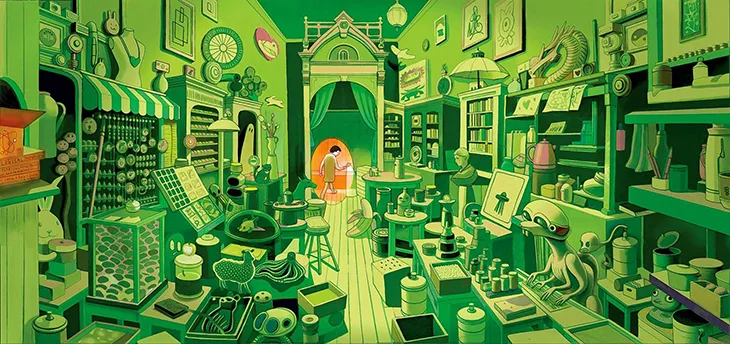
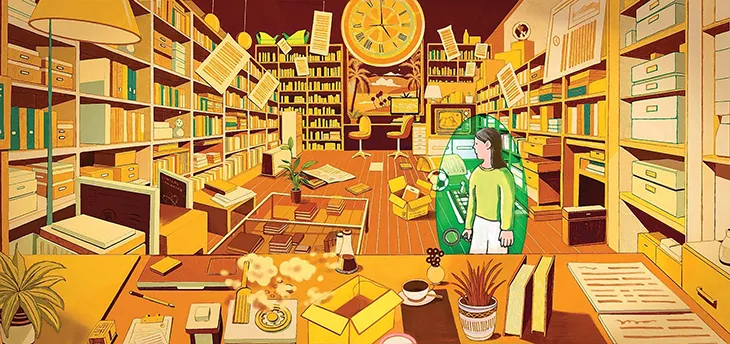
In Bridging Two Worlds, Sun turns an intimate relationship into two explorable inner worlds. The project begins with her own marriage: as an INFP designer, she is drawn to emotion, symbols, memory, and imagination, while her ISTP husband, with a mathematics background, tends to understand the world through logic, tools, action, and systems. Sun uses this personal contrast to address a broader issue in contemporary relationships: people often misunderstand each other not because one side is wrong, but because they are living by different inner maps.
Sun’s contribution lies in turning emotional disagreement into a visual system that viewers can navigate, rather than a fixed message they are asked to accept. She constructs two rooms with very different internal logics. The yellow ISTP world is filled with tools, machines, papers, and Ultraman monsters. The green INFP world moves through outer space, ghosts, traditional cultural references, emotional symbols, and carefully arranged small objects. Both rooms may look chaotic at first, but Sun makes clear that neither world is random. Each has its own order.
By asking viewers to search through these spaces, Sun changes the act of looking into an exercise in perspective-taking. The viewer is not told simply to “be more understanding.” Instead, Sun lets them experience how another person’s world can make sense from within. Small exchanges between the two rooms deepen this idea. A figure from one world appears inside the other. Books about logic are placed in the green emotional room. A green paper crane, a symbol of peace, is left inside the yellow mechanical world. Through these details, Sun suggests that difference does not have to become separation. Two people do not need to become the same in order to understand one another.
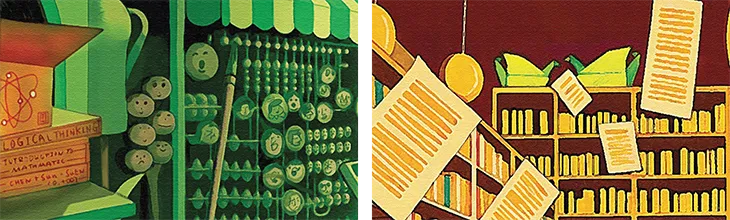
Bridging Two Worlds was recognized by the World Illustration Awards in the Professional Exploration category and selected for public exhibition in London. That recognition brought Sun’s self-authored project to an international professional audience. It also reflects the strength of her method: she uses detailed, interactive imagery to translate psychology, intimacy, and cultural memory into a visual language that many viewers can recognize in their own relationships.
Turning a Reminder Into Participation
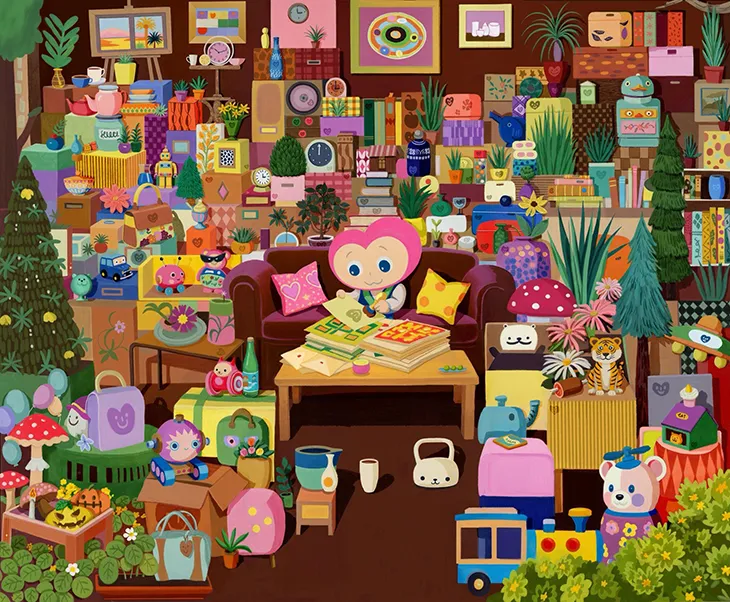
Sun brings a similar approach to Who Still Owes Mr. Heart His Things?, a seek-and-find project about children’s habits and family routines. The subject is simple: children often forget where they put small belongings, and adults often respond by scolding them or asking them to be more careful next time. Sun approaches the issue differently. Rather than turning responsibility into a direct lesson, she turns it into a visual experience.
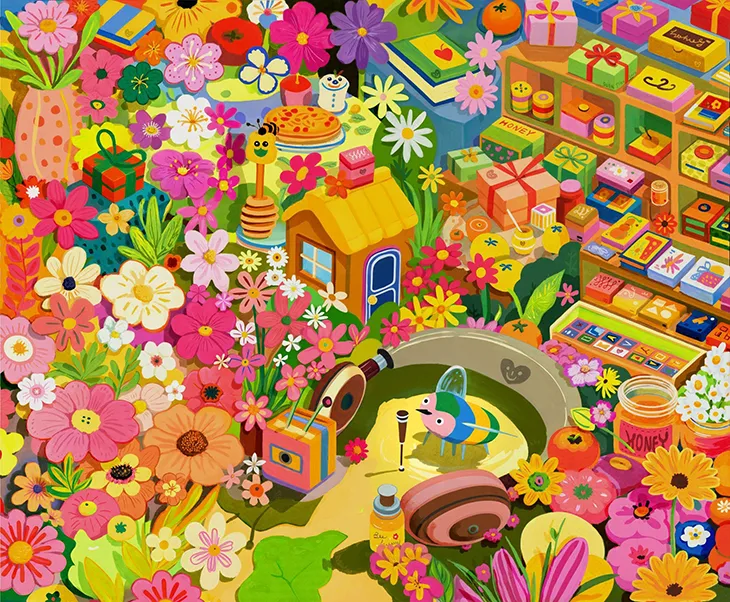
In the story, Mr. Heart cannot remember who borrowed his things. The borrowers have also forgotten what they borrowed and where they placed it. Sun invites the young reader to help solve the problem. A bee who sells honey gift sets lives among flowers and boxes. A rabbit who loves exercise hides among plants. A fox reads in a field of blossoms. A bear’s home is packed with syrup. Each space is crowded, colorful, and full of distractions, but Mr. Heart has marked his belongings with a heart symbol.
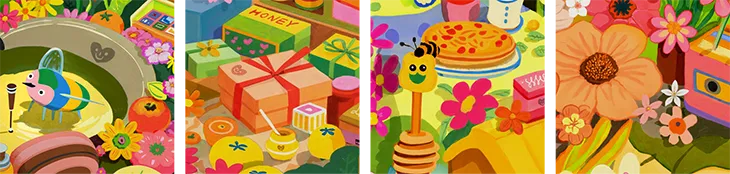
Sun’s visual strategy makes the child participate in the consequence of carelessness. The search is fun, but it also becomes tiring. After looking through one crowded home after another, the reader begins to understand the trouble caused when people do not return or take care of things. The lesson does not arrive as a lecture. It arrives through the child’s own effort.
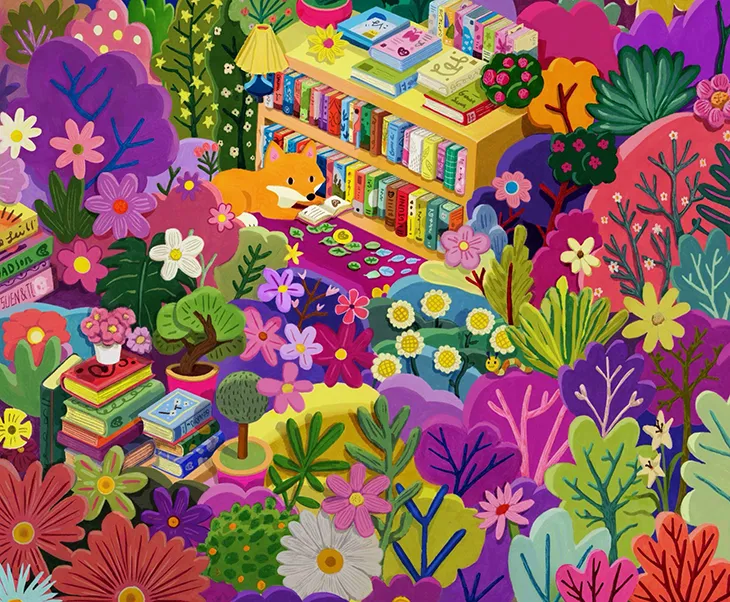
This is where Sun’s work becomes more than children’s entertainment. She uses illustration as behavioral communication. Instead of telling children to be responsible, she lets them feel why responsibility matters. Parents can explore the images with the child, search for the objects together, and discuss the problem through the story instead of repeating the same reminder again and again. Sun turns a family instruction into shared participation.
Visual Logic as a Way to Communicate
Across her work, Sun’s hidden objects, repeated figures, symbolic details, and crowded compositions are not decoration. They are part of a visual logic designed to guide attention. A child follows a clue and begins to understand responsibility. A couple begins to understand how another person experiences the same situation. A private conflict becomes something viewers can search through, discuss, and reframe.
Sun’s practice shows how illustration can function as a communication tool. Her images do not only represent stories; they create spaces where viewers can practice understanding. By combining visual communication design, narrative illustration, symbolic detail, and seek-and-find structures, Sun has developed a distinctive approach to contemporary illustration. Her work suggests that images can help people approach everyday problems with more curiosity, patience, and empathy.
Discover more of Genre Sun’s work at genresun.com and follow @genresun for updates.
Words by DSCENE Editor Maya Lane.