



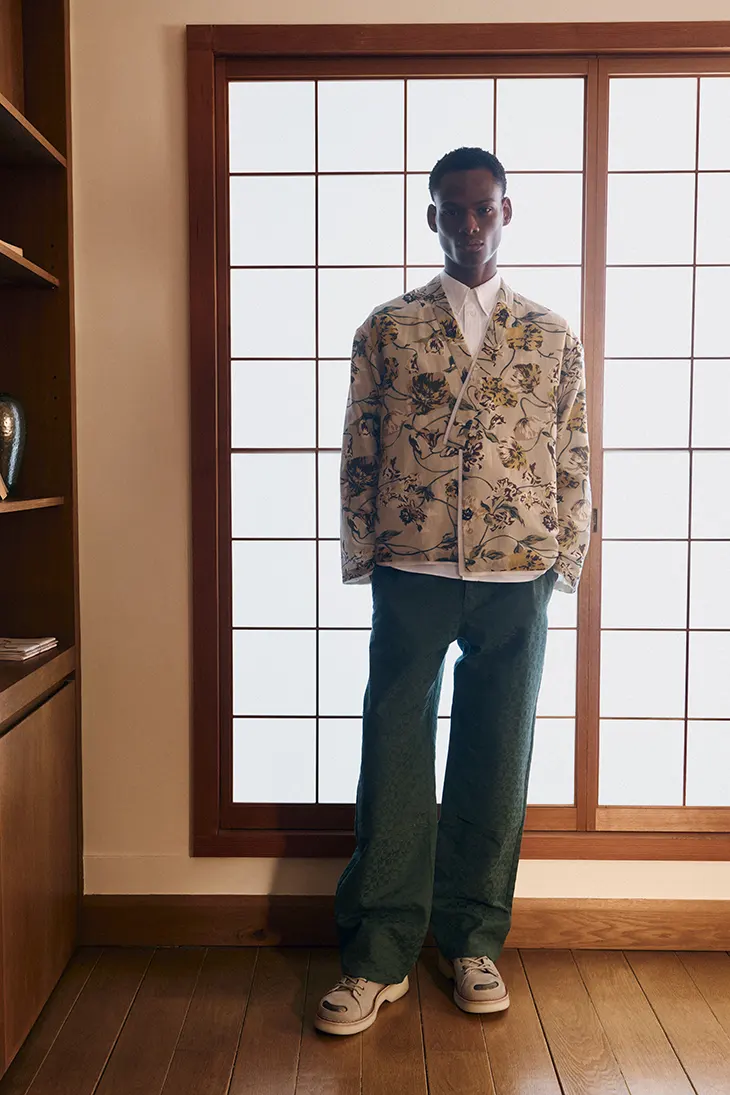
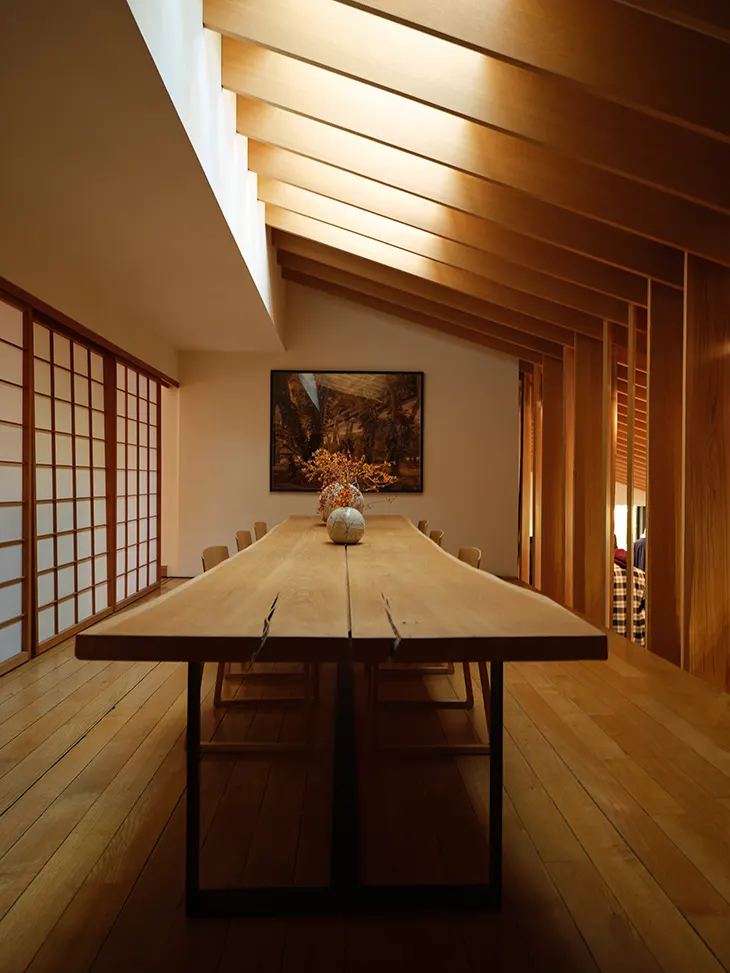
For Fall-Winter 2026, Nigo returned to where it all began. Not metaphorically, but literally. The creative director staged his latest KENZO collection inside Kenzo Takada’s former residence, a wooden sanctuary hidden in Paris’s Bastille neighborhood, surrounded by bamboo, juniper, cherry trees, and a koi carp pond. Built between 1988 and 1993, the house was conceived as an “oasis home,” partially inspired by Takada’s father’s tea house in Himeji, Hyōgo Province, Japan. It was here that the founder would meditate, rest, and host the legendary gatherings that became part of fashion folklore.
“Kenzo represents freedom, color, and joy,” Nigo stated in the collection notes. “I want people to feel the same way when wearing these clothes. It’s my homage to our founder, Kenzo Takada. With Fall 2026 we are going back home, back to the beginning.”
A Dialogue Between Cultures
The collection operates as an essential conversation between French and Japanese aesthetics, a founding principle that Takada himself established when he arrived in Paris in 1965. Nigo, like his predecessor, revels in the mixing of cultures, codes, and archetypes. Americana surfaces through varsity graphics and cowboy shirts. Italian tailoring provides structural backbone. Chinese ‘pankou’ detailing adds unexpected texture. Home, in this context, is not a fixed geographical point but a wearable worldview that invites everyone to feel at ease.
LATEST FROM PARIS FASHION WEEK
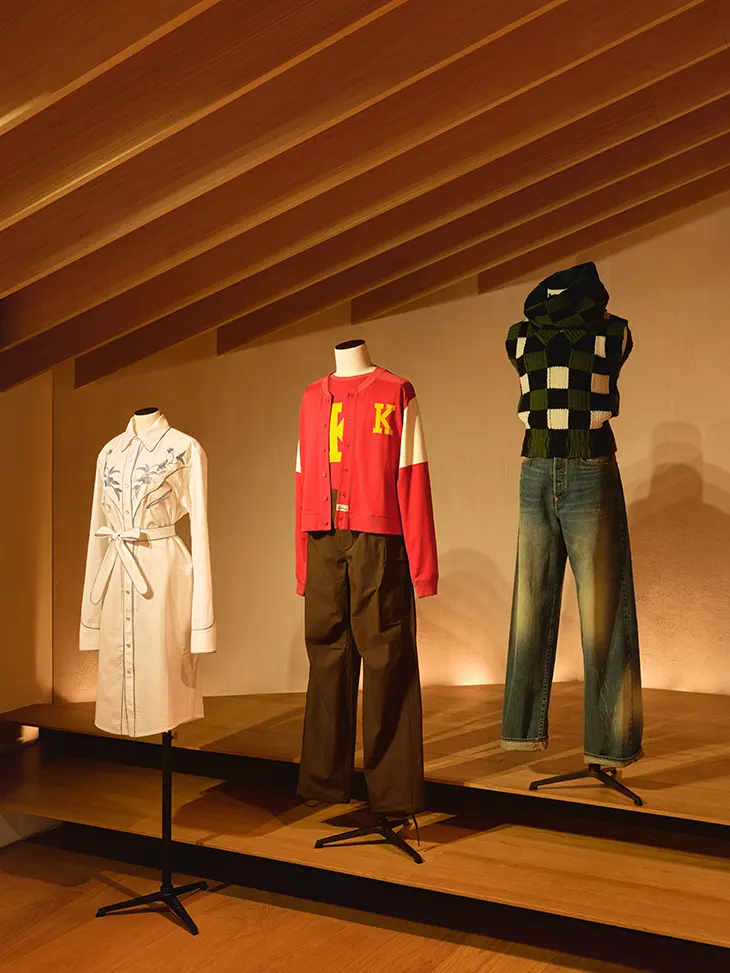
This cultural layering manifests most clearly in the collection’s approach to silhouette. Kimono tailoring evolves through elevated constructions, with kimono and peak lapels appearing on suits that balance Eastern fluidity with Western precision. Cowboy shirts receive floral embroidery and contrasted piping, transforming American workwear into something more delicate, more considered.
Archive as Living Document
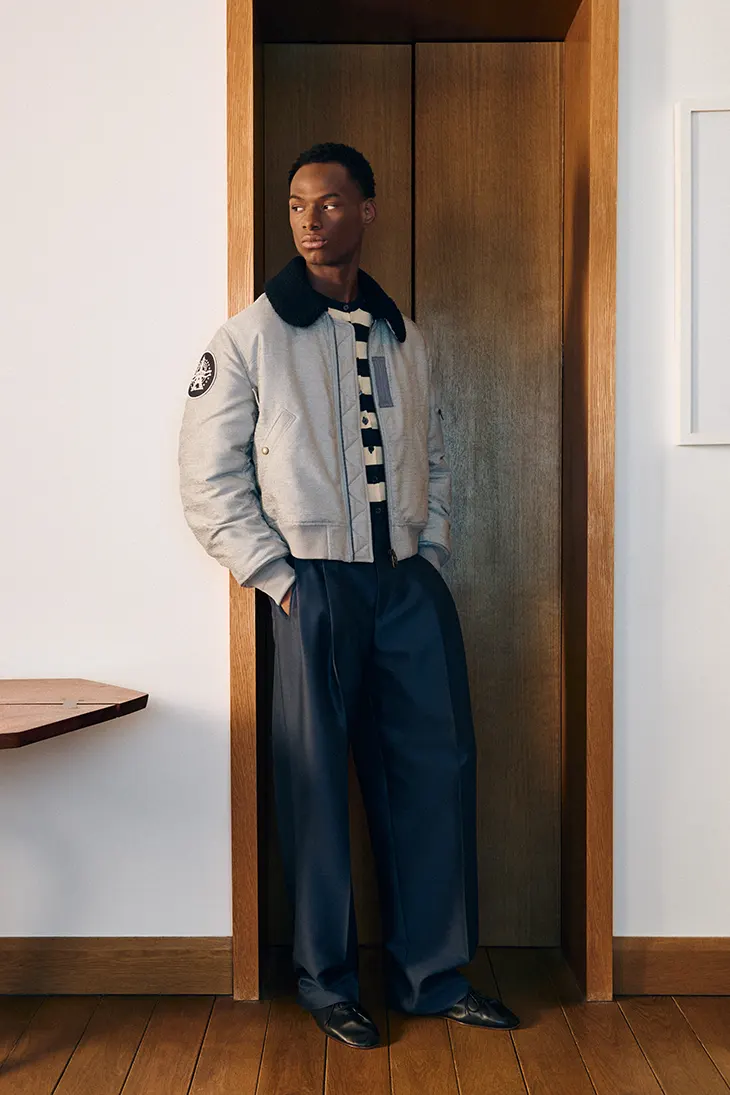
As an avid collector and archivist, Nigo approaches design with simultaneous precision and playfulness. Original KENZO labels, silhouettes, and patterns are reintroduced and reimagined through his practice of sampling visual references. The tiger, that iconic motif from 1980s Kenzo Jungle, springs back onto button-down shirts. The letter ‘K,’ drawn directly from the archives, appears across t-shirts, jackets, and cardigans with varsity spirit.
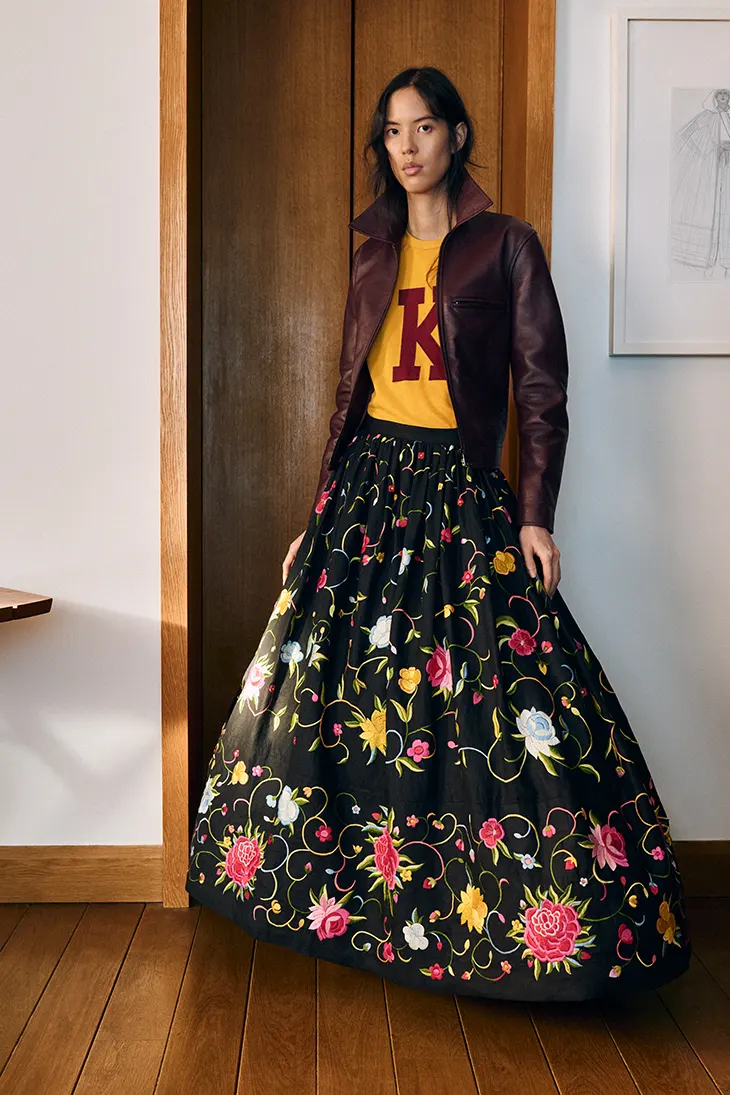
Perhaps most striking is the resurrection of embroidered organza skirts from Spring Summer 1994. These archive pieces are revisited and extrapolated, their floral patterns carried across jackets and shoes. In Look 46, this manifests as a floor-length black skirt dense with multicolored floral embroidery, paired unexpectedly with a burgundy leather jacket and a yellow varsity ‘K’ sweater. The combination is pure Nigo: irreverent, referential, and entirely wearable.
Color and Visual Play
Two-tone neo tailoring makes a return, revisiting 1990s archival silhouettes last seen in Nigo’s Fall-Winter 2022 debut. Deep navy contrasts with Prince of Wales wool. Bi-color and tri-color stripes sit alongside bold checkerboard knits. The palette draws from soft 1970s shades, inspired by images taken during Kenzo’s early years in Paris, while incorporating strong blues, sartorial grays, vivid yellow, and a bold red that punctuates the collection with energy.
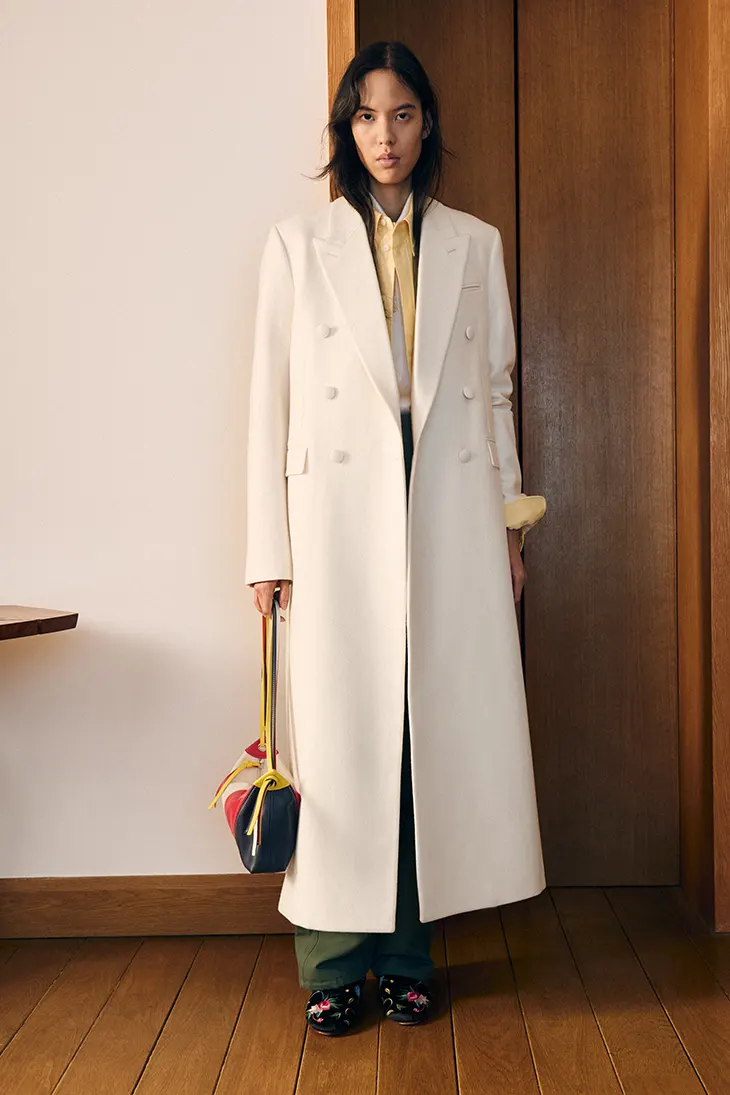
Look 9 exemplifies this chromatic sophistication: an ivory double-breasted coat with covered buttons falls to ankle length, worn over a pale yellow shirt and forest green trousers. The model carries a colorblock leather bag in navy, red, and yellow, while embroidered floral ballet flats complete the look. It’s a study in how to layer neutrals with strategic color intervention.
Functional Interventions
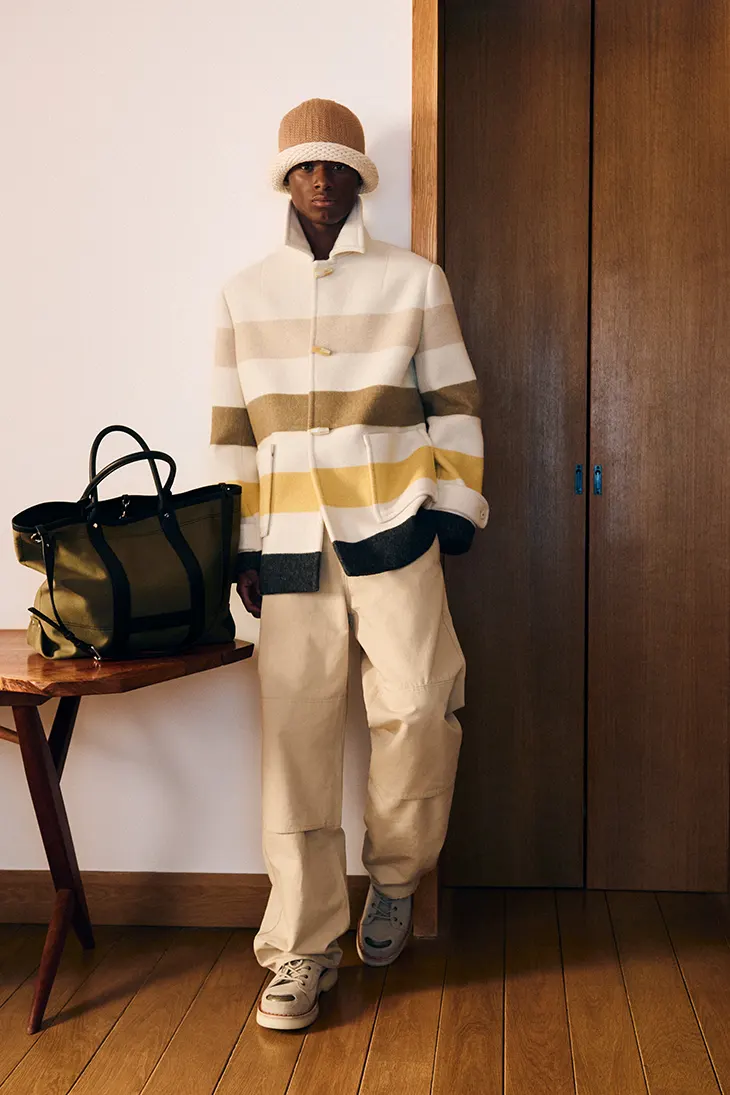
Archetypes are adapted through functional interventions and careful detailing. Military silhouettes soften through delicate button work. Japanese selvedge denim appears throughout, at turns carefully sunbleached to give a weathered, lived-in feel. A new house signature, the Kenzogram, is interpreted across denim, nylon, jersey, knit, and belts, establishing a pattern language that will likely define future seasons.
Look 5 presents a striped wool poncho with fringe detailing, worn over a simple black miniskirt with cream knee socks and lace-up flats. The poncho’s horizontal stripes in cream, tan, olive, yellow, and charcoal reference both Southwestern American blanket traditions and Japanese textile craft. It’s the kind of piece that photographs beautifully but also functions as genuine outerwear.
Accessories and Extensions
Shoes and accessories extend the collection’s narratives of florals and varsity spirit. Lace-up work boots with steel toe cap detailing sit alongside embroidered ballet flats, classic loafers, and a new flat lace-up that combines elements of the ballerina and derby loafer in an ultra-light slipper-like canvas construction. The footwear program alone demonstrates Nigo’s range, moving from utilitarian to decorative without losing coherence.
The 1986 Kite bag returns in an exact replica, then morphs into new expressions in contrasted colorblock leather: a compact shoulder bag, a versatile tote, and a whimsical coinpurse charm. A statement canvas tote and its bucket counterpart are fully reversible, finished with rich leather trims that elevate the everyday.
The Significance of Place
Staging the presentation at Kenzo Takada’s former home was more than a venue choice. It was a statement of intent. For Nigo, now entering his fifth year at the house, this collection represents both a return to his own beginnings at KENZO and a deeper engagement with the founder’s legacy. The Spring-Summer 2022 codes and silhouettes that distinguished his debut are elaborated here, matured, given room to breathe.
The house itself, with its warm wood interiors and carefully curated objects, provided the perfect backdrop for clothing designed to be inhabited. These are garments made for the body to move, dance, run, and play in. The lookbook images, shot by Linus Morales with styling by Marq Rise, capture this sense of ease against the domestic architecture.
A Conversation Continues
Home, then, becomes an elastic, layered, living idea. KENZO’s defining dialogue with French and Japanese cultural aesthetics opens onto a wider playbook, where the personal experiences and influences gathered across both designers’ journeys add texture, humor, and warmth to an unfolding conversation between founder and successor.
What Nigo has achieved with Fall-Winter 2026 is something increasingly rare in contemporary fashion: a collection that honors heritage without becoming a museum piece, that references archives without losing forward momentum. The clothes feel simultaneously nostalgic and urgent, rooted and restless. They invite you in, much like Kenzo Takada’s hidden Parisian home, and make you feel like you belong.
Discover more of the collection in our gallery:
KENZO Fall-Winter 2026 was presented on Wednesday, January 21st, 2026, during Paris Fashion Week. Photography by Linus Morales. Video by Pablo Tapia Plá. Styling by Marq Rise. Makeup by Anthony Preel. Hair by Ramona Eschbach. Music by Ryuichi Sakamoto. Models: Celine Vivod, Godwin Okereuku, Nicola Macchi, Seng Khan