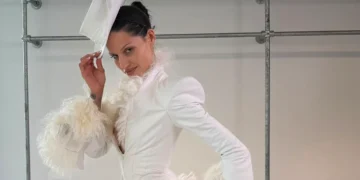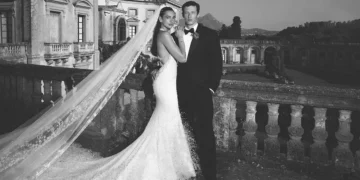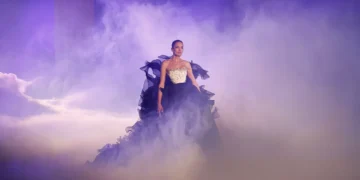



Andrew Kwon’s Bridal Couture 2027 collection, Arabesque, arrived with a kind of quiet insistence, not on fantasy, but on discipline. Shown at St. Bartholomew’s Church on Park Avenue, the presentation leaned into restraint rather than spectacle, which in 2026 feels less like an aesthetic choice and more like a statement of values. In a season when the international crisis continues to hit the fashion industry hard, the most meaningful luxury is often not excess, but proof of work: hours, hands, and technique. Bridal ateliers, for all the category’s commercial baggage, remain among the last places where that level of craft is still protected, funded, and practiced daily. Kwon’s collection made that reality visible.
The venue did not need to be “used” in the theatrical sense. The church’s scale and stillness simply slowed the room down, and Kwon’s clothes benefit from that pace. They are not designed to shout. They are designed to be read, seam by seam, layer by layer, with the kind of attention couture requires and increasingly struggles to receive. The guest list, including Nicole Ari Parker, Sofia Franklyn, Alina Frolova, Vivian Li, Olivia McDowell, and Adrienne Reau, signaled the designer’s growing cultural reach, but the clothes themselves stayed focused on the fundamentals: line, proportion, and construction.
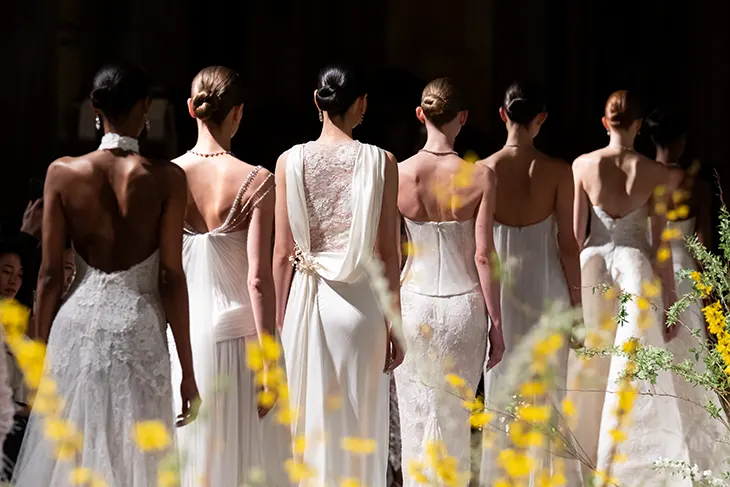
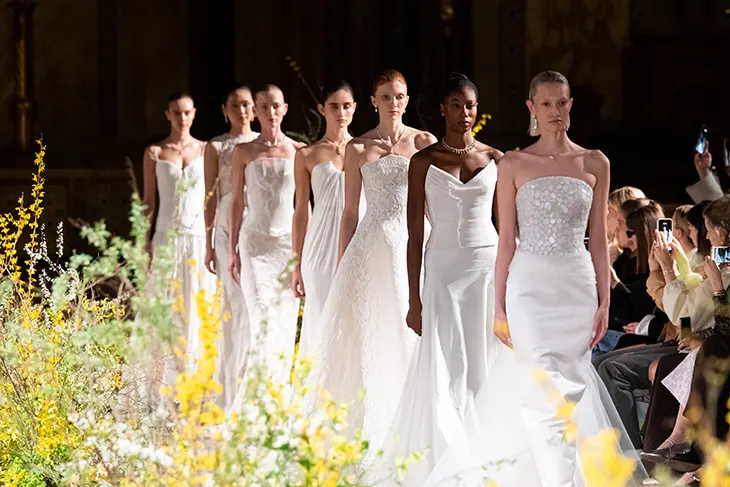
What stood out first was the silhouette language. Kwon worked in elongated, continuous lines that felt contemporary in their clarity, then interrupted that clarity with controlled softness. Bodices held the torso with precision and armour like statement, then released into skirts that appeared to hover, as if the fabric had been taught to move slowly. Volume was present, but it was calibrated, introduced in stages rather than delivered as a single dramatic flourish. This is where the collection’s “bridal” identity became interesting. Kwon did not abandon the traditional codes, he refined them, and he placed them in dialogue with a more modern, editorial sensibility.
Kwon did not abandon the traditional codes, he refined them, and he placed them in dialogue with a more modern, editorial sensibility.
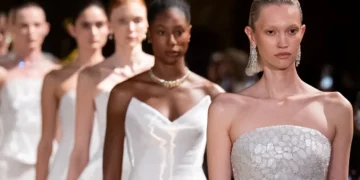
The palette stayed within the bridal spectrum of luminous white and soft ivory, but the effect was not simply “pretty.” The tonal shifts came from layering and transparency, from the way light hit sheer surfaces and then disappeared into denser ones. The collection’s most persuasive moments were often the ones that looked simplest at first glance, because they forced the eye to notice the work underneath. Sheer layers were not used as a decorative veil effect alone, they were used as structure, creating depth without heaviness and allowing the body to appear and recede in measured intervals. That push and pull between exposure and control felt like the real narrative of the show.
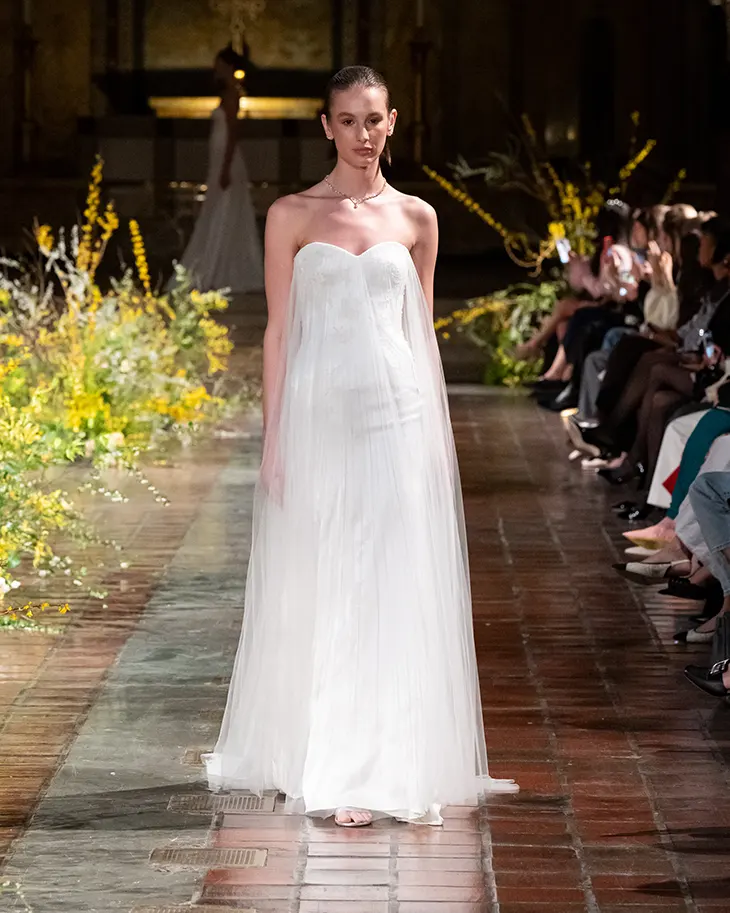
Embellishment, when it arrived, did not behave like bridal embellishment usually does. Instead of symmetrical, all-over sparkle, details appeared in contemporary placements. It gave the collection a sense of movement without relying on literal motion, and it kept the gowns from feeling locked into a single bridal mood. Kwon’s handwork reads as handwork, not as a shortcut to “luxury.” You could feel the time in it, and in the current climate that matters. When fashion is squeezed by economics, logistics, and attention spans, craft is often the first thing to be compromised. Bridal, paradoxically, is one of the few remaining spaces where the economics can still justify the labor, and where the client still expects that labor to be visible. Arabesque made a case for why that ecosystem should be protected.
Bridal, paradoxically, is one of the few remaining spaces where the economics can still justify the labor, and where the client still expects that labor to be visible. Arabesque made a case for why that ecosystem should be protected.
This is also where the collection’s reach beyond bridal came into focus. Kwon’s strongest proposition is not that a bride should look like an idea of a bride, but that she should look like herself, elevated through technique. Several looks carried an eveningwear authority in their restraint: the elongated proportions, the controlled transparency, the emphasis on line over ornament. They suggested garments that could live another life, not necessarily as literal rewear, but as a design language that belongs to fashion, not only to ceremony. In a moment when consumers are thinking harder about value, longevity, and meaning, that shift feels timely.
MORE BRIDAL ON DSCENE
Still, the collection never lost the emotional charge that bridal requires. The traditional “moments” were present, but they were treated as punctuation rather than the whole sentence even when choosing to show in a church setting. A bodice would deliver the classic couture hold, then a dress would dissolve into air. A sheer layer would suggest a veil without becoming costume. A shimmer would appear and then disappear again, refusing to turn the gown into a single-note spectacle. Kwon understands that bridal is not only about beauty, it is about memory, and memory is often built from details that do not announce themselves immediately.
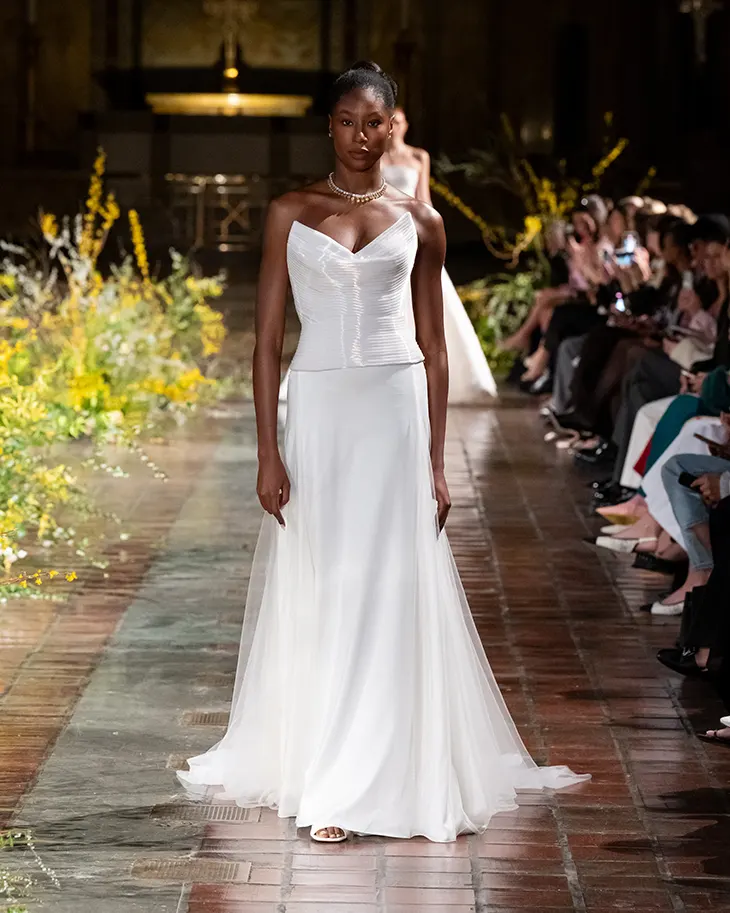
If Arabesque has a thesis, it is that softness is not the opposite of control, it is the result of it. The collection’s calmness was earned, engineered through construction and handwork rather than mood. In a year when the industry is under pressure and many brands are forced into louder gestures to compete for attention, Kwon’s decision to double down on craft felt quietly radical. Bridal ateliers are still keeping the techniques alive, still training hands, still insisting on finish, still making garments that require time. You can see that clearly in Kwon’s work, and you can feel it in the way the gowns hold themselves, poised between tradition and a more contemporary, fashion-forward line.
Discover more of the collection in our gallery:
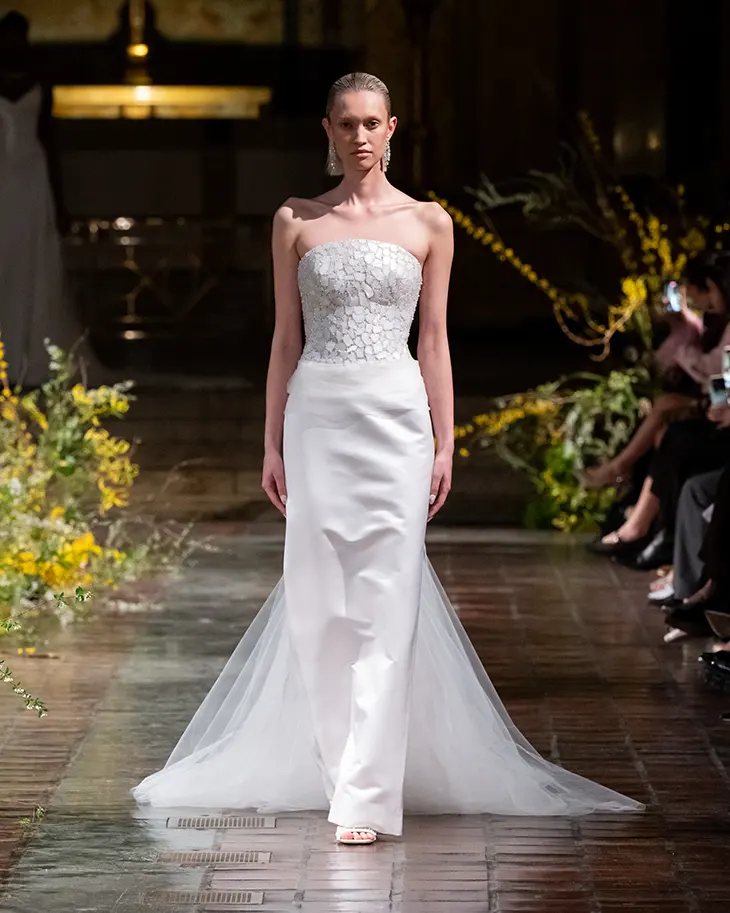
Show credits: Hair by Joseph DiMaggio for RICA Haircare and POMO, makeup by Ann Liendo, shoes by Stuart Weitzman, jewelry by Leon Diamond, nails by AIRI YAMADA, couture storage by UOVO, production by Xin Huang and Le Petite Prive.