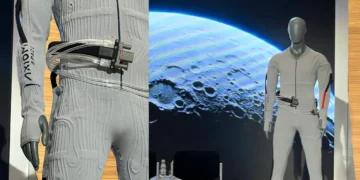



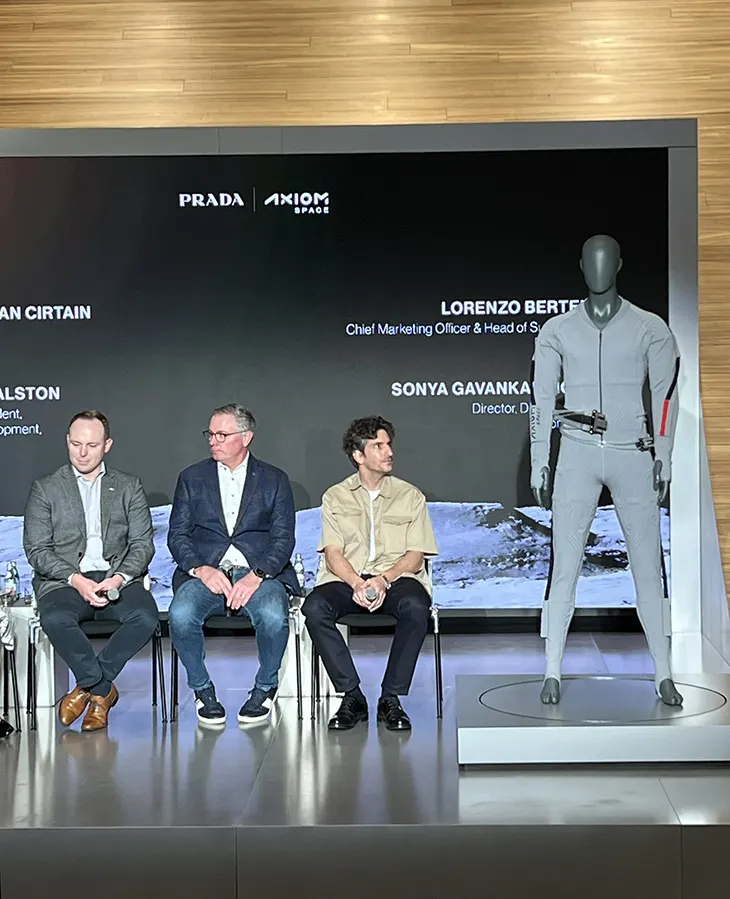
At the Prada Broadway Epicenter in New York, the Italian fashion house unveiled the next chapter of its partnership with Axiom Space, presenting the next-generation Liquid Cooling and Ventilation Garment (LCVG) that NASA astronauts will wear as they set foot on the lunar surface for the first time in more than 50 years. The press preview, held this morning at 575 Broadway, brought together some of the sharpest minds at the intersection of luxury and aerospace engineering, and offered a rare look at what happens when a fashion house decides that the moon is not out of reach.
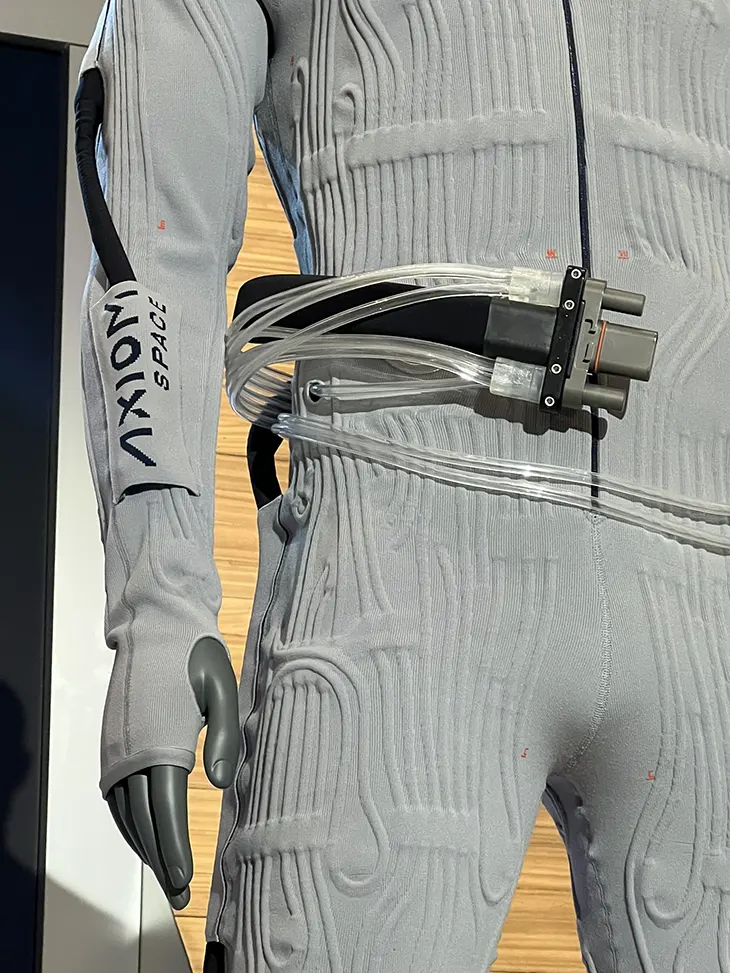
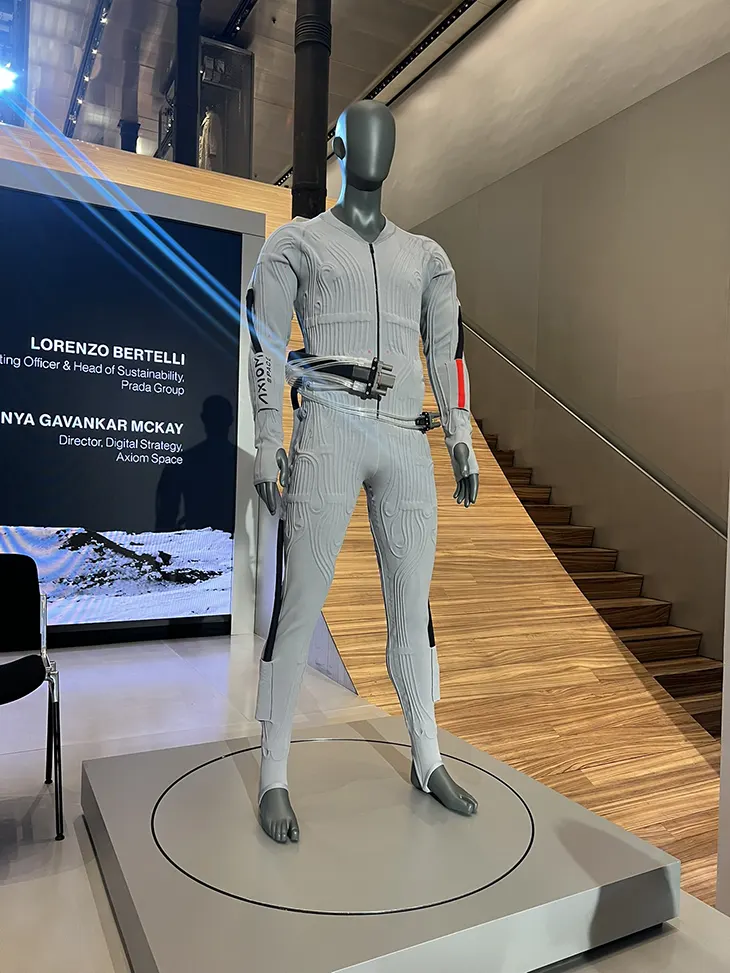
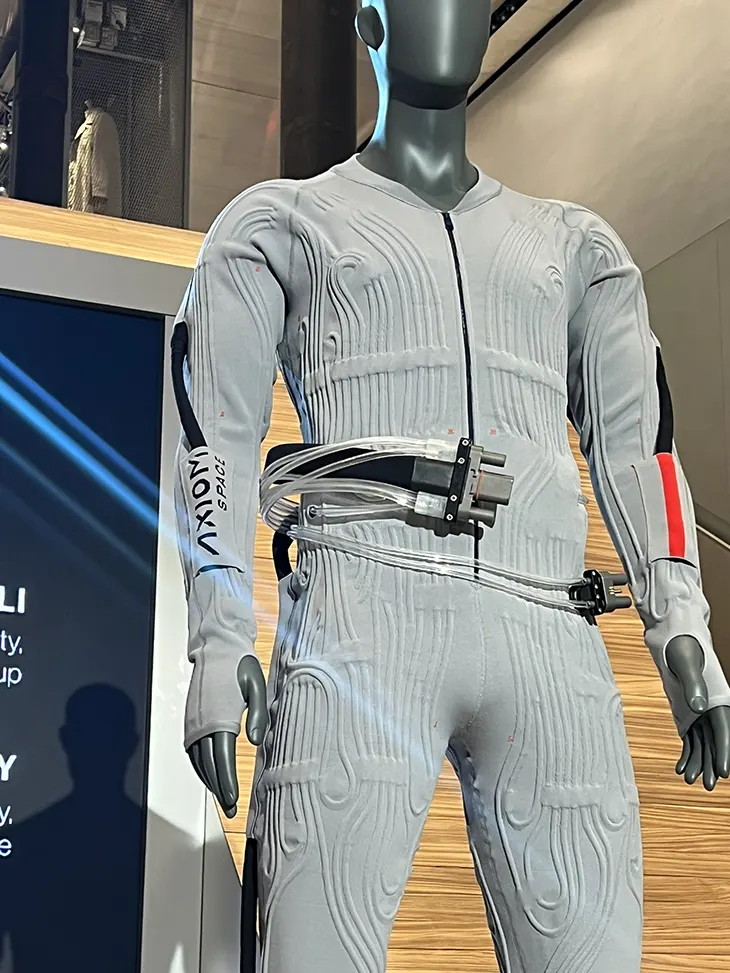
The garment itself is a feat of engineering dressed in Prada‘s characteristic restraint. Built with seamless knitting technology, integrated cooling tube tunnels woven directly into the fabric, and redundant water lines for safety redundancy, the LCVG is as far from a runway piece as one can imagine, and yet unmistakably bears the mark of a house that has always treated material innovation as its most serious discipline. The Prada Group’s Chief Marketing Officer and Head of Corporate Social Responsibility, Lorenzo Bertelli, who joined Dr. Jonathan Cirtain, CEO and President of Axiom Space, and Russell Ralston, Senior Vice President of Spacecraft Development at Axiom, for a panel discussion, made the case that this collaboration is less of a departure and more of a continuation.
“We like to push boundaries and whatever we do, from the design point of view, technology point of view, we want to give our perspective to the community,” Bertelli said. “It’s another Prada perspective on how we see things.”
That perspective, as Bertelli traced it, has deep roots. He recalled how his father launched the Luna Rossa America’s Cup team in the 1990s, less for commercial gain than for the pursuit of something more elusive: the outer edge of what the brand could do. That adventure gave the world the now-iconic America’s Cup shoes, recognized in luxury circles as among the most influential sneakers ever produced, and generated the Red Stripe that became one of Prada‘s most recognizable design signatures. None of it was planned with precision.
“If back in the day my father didn’t want to start America’s Cup, we would never have invented the Red Stripe,” Bertelli said. “Sometimes you push boundaries and not always you have a reason why.”
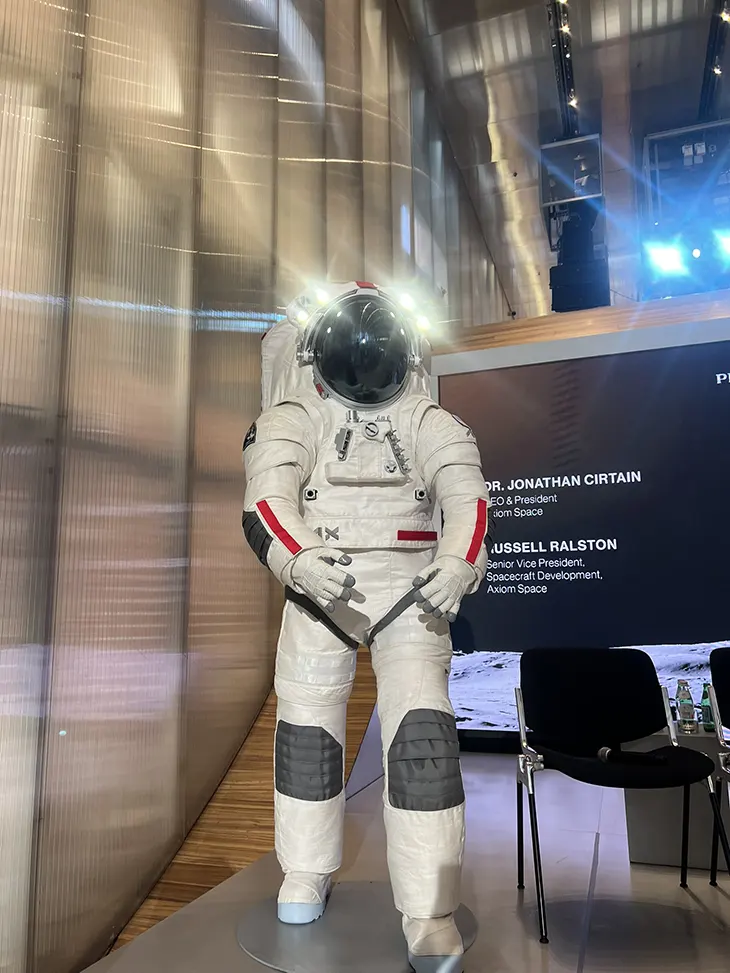
The parallel to the space collaboration is deliberate, and carries a detail almost too elegant to be coincidental. The Red Stripe, long a defining element of the Prada line, also functions in the Axiom space suit as a marker of rank, distinguishing the mission commander from other crew members.
“We find out that we are using red stripes to define the commander role compared to other roles,” Bertelli noted. “Is this a coincidence?” A symbol perhaps showing a collaboration with Axiom Space and Prada was simply meant to be.
Beyond the symbolism, the technical depth of Prada‘s contribution is significant, and rooted in something the house has cultivated quietly for decades: an industrial supply chain built for complexity. Bertelli described this as perhaps the least-discussed advantage Prada brought to the project.
“For us, solving this kind of problem is normal. We have thousands of people working in Italy producing garments, and compared to other sectors where you have a huge volume of production of the same item, in luxury you have volume across a lot of different things. For a person in our supply chain, to shift from a tuxedo to a piece like this is quite normal. They shift that in a day. They are very skilled in terms of mentality, moving from producing one option to another. Customization is always more or less our normal rate. It is very easy to be plugged into a different item.”
It is a point that cuts to the core of what makes a luxury fashion house an unexpected but logical partner for space exploration. The same organizational infrastructure that allows Prada‘s artisans to move fluidly between a hand-finished evening coat and a technical performance piece is precisely what allowed the house to engage with the engineering demands of a lunar garment, without treating it as an anomaly.
Ralston explained that Prada‘s sophisticated modeling tools allowed Axiom to optimize the length and layout of the cooling lines running through the garment, a calculation that matters enormously: too many lines and the suit becomes bulky and restrictive; too few and the astronaut risks overheating during extended extravehicular activity. Prada‘s approach, drawing on decades of experience in precision textile development, brought an elegance to that optimization that conventional aerospace suppliers have not historically prioritized.
The garment also addresses the specific, and genuinely extreme, demands of the lunar south pole, an environment entirely unlike anything the Apollo missions encountered. The region is subject to dramatic temperature differentials, an electrostatically charged plasma environment generated by solar winds, and a regolith composed of razor-sharp particles that behave like microscopic shards of glass. Each of these factors required materials that could perform under conditions no earthbound garment has ever faced.
“It’s honestly hard to describe how difficult it is to design what you’re seeing on the stage,” Ralston said, “because there are so many niche disciplines required, and all of these things have to be balanced and end up with one cohesive product.”
Bertelli noted that the seamless construction technology used in the LCVG was not available in previous generations of astronaut undergarments, and that the complexity behind the suit’s knit architecture is far greater than it appears from the outside. The cooling tubes themselves, visible as black channels running along the arms and legs, are not threaded in separately as in older garments; they are built directly into the knit, an integration that is at once more structurally sound and more refined.
For Axiom Space, the partnership is also a proof of concept for the future of human spaceflight at scale. Ralston pointed to the garment’s customizable production method as a critical long-term advantage. As space travel expands beyond a small corps of trained astronauts, the ability to produce garments that fit a wide range of body types quickly and comfortably becomes essential. The LCVG’s construction, informed by Prada‘s manufacturing expertise, is already built for that future.
The road ahead includes a formal qualification campaign, testing in the Neutral Buoyancy Lab at Johnson Space Center, vacuum chamber and thermal vacuum evaluations, and ultimately an in-space demonstration on the International Space Station, expected next year. The Artemis 3 crew announcement is anticipated Tuesday, at which point the specific astronauts who may wear this garment to the lunar surface will be named.
Cirtain framed the broader ambition with characteristic directness: “Space exploration is not only about new boundaries, but it’s for the benefit of all mankind. A lot of the things that Prada has developed in this will one day have positive human benefit for people that never go to space.”
If we look at Prada today, the collaboration is neither sponsorship nor novelty. We can see it as the logical extension of a house that has always understood innovation as inseparable from identity, whether that means a shoe for a sailor competing in the America’s Cup, a Red Stripe that becomes a luxury icon, or a garment worn on the surface of the moon. The details differ. The ambition is the same.







I need an at home version of the Prada Awiom
Space suit for the summer
this is very true innovation comes to live, i do understand prada is a business but this is where big groups like LVMH lack the effort. It is fantastic to see this, but Prada and Axiom are doing a fantastic job with their collaboration. If space travel ever becomes a thing, we will need more suits like this, so it is a great way to look into the future.
Why do I want this suit to have at home? Looks so cool and cozy