


UCCA Center for Contemporary Art presents Carsten Höller: Two from July 14, 2026, through January 31, 2027, marking the artist’s first institutional solo exhibition in China. Bringing together landmark installations alongside newly developed works, the exhibition occupies the museum as a complete architectural and psychological environment where visitors become active participants in a constantly shifting sequence of encounters. Rather than presenting individual artworks as isolated experiences, Two operates as what Höller describes as a “Laboratory of Doubt,” examining repetition, perception, time, dreams, and collective experience through a carefully constructed system of parallel realities.
ART
Few contemporary artists have explored uncertainty with the consistency of Höller. Before turning to art in the early 1990s, he trained as an agricultural scientist, a background that continues to shape his methodology. Scientific observation remains present throughout his practice, though certainty never emerges as the final objective. Instead, experimentation becomes a way of questioning established systems of knowledge, inviting visitors to suspend assumptions and experience ambiguity as a productive condition.
That premise begins before visitors even enter the exhibition. Upon arrival, each person receives a randomly assigned entrance leading into one of two parallel versions of the exhibition. One unfolds entirely in color, the other in black and white. The duplicated routes never fully mirror one another, producing subtle differences that encourage visitors to compare experiences and question the reliability of individual perception. Rather than offering a single narrative, Höller constructs multiple realities that coexist throughout the exhibition.
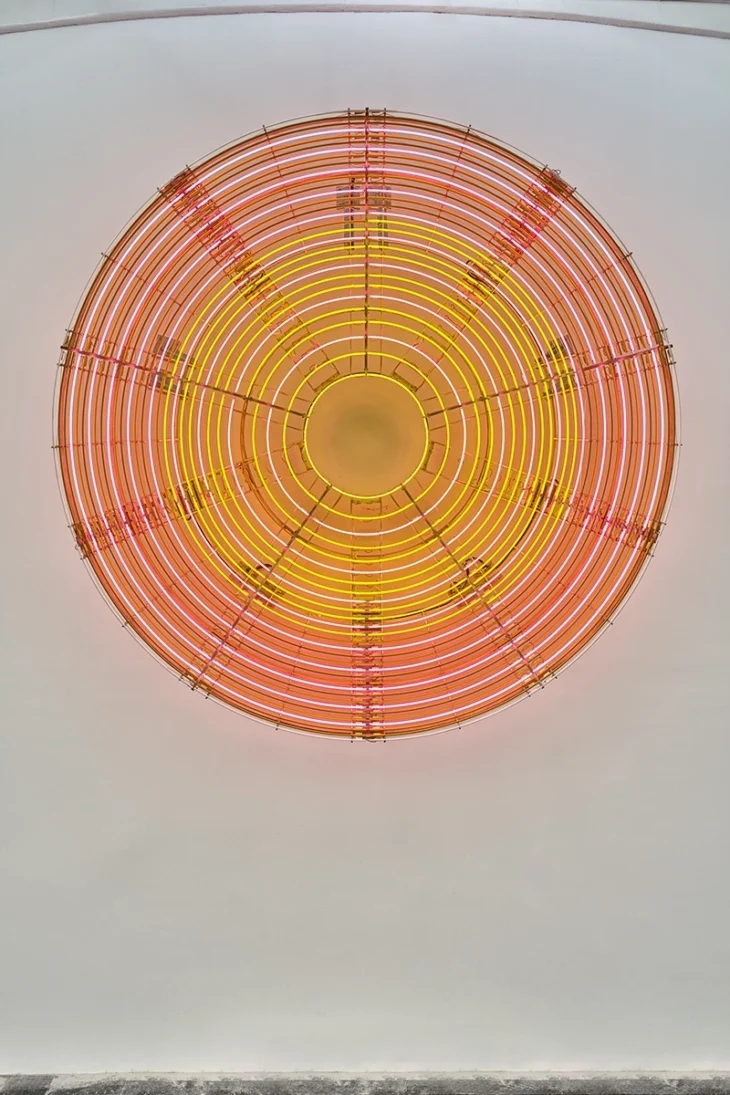
Several new installations expand these ideas through physical participation. Sliding Doors Square transforms automatic doors into an endless sequence of mirrored thresholds where reflections and unexpected encounters interrupt spatial orientation. Pill Clock releases pills containing an undisclosed substance every three seconds, translating time into an accumulating physical presence while raising questions about perception, duration, and participation. Nearby, Sexagesimal Clock and Decimal Clock reconsider how societies measure time, reminding visitors that even the systems governing daily life remain cultural constructions rather than universal truths.
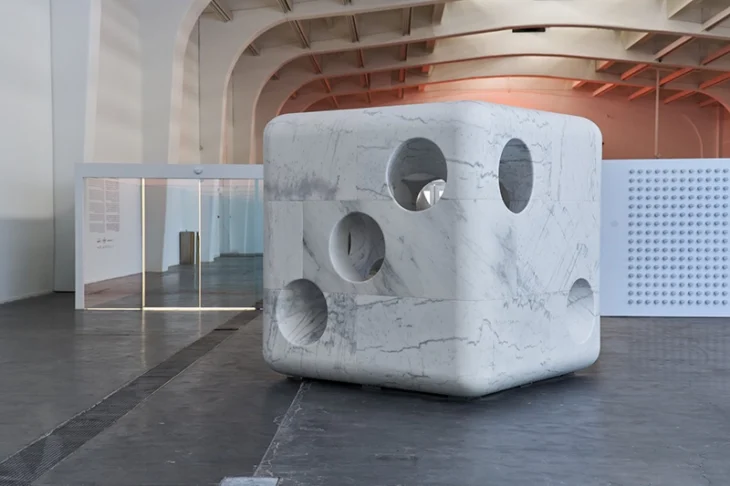
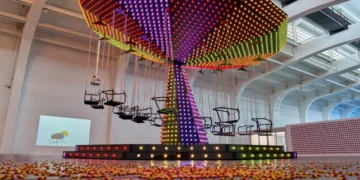
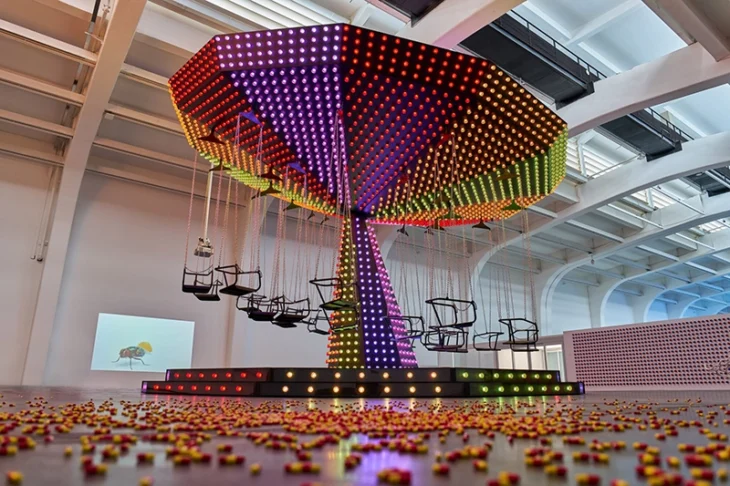
Play has long occupied a central position within Höller’s work, though never as uncomplicated entertainment. His installations borrow familiar forms only to alter the expectations attached to them. The exhibition’s tilted carousels rotate slowly enough that riders become temporarily trapped inside their own experience while simultaneously turning into performers observed by others. Elsewhere, a monumental marble dice invites visitors to climb inside its hollow core, transforming a familiar symbol of chance into an inhabitable sculpture. Interactive works such as Beijing Dots and Sluice further examine how human behavior changes when movement, cooperation, and patience determine the outcome of each encounter.
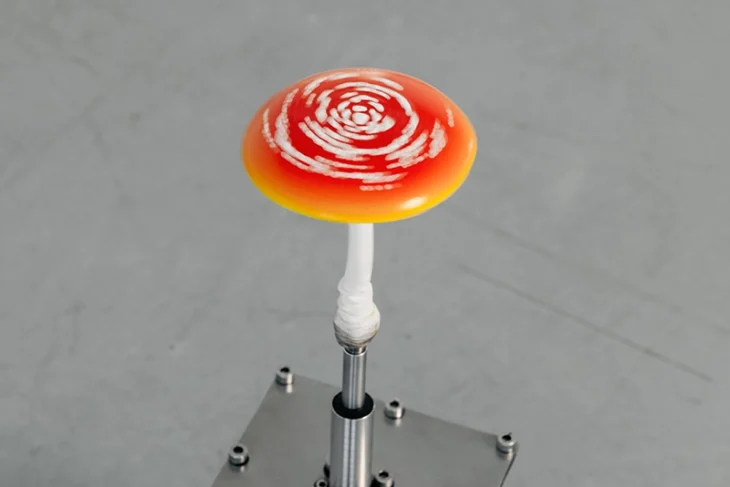
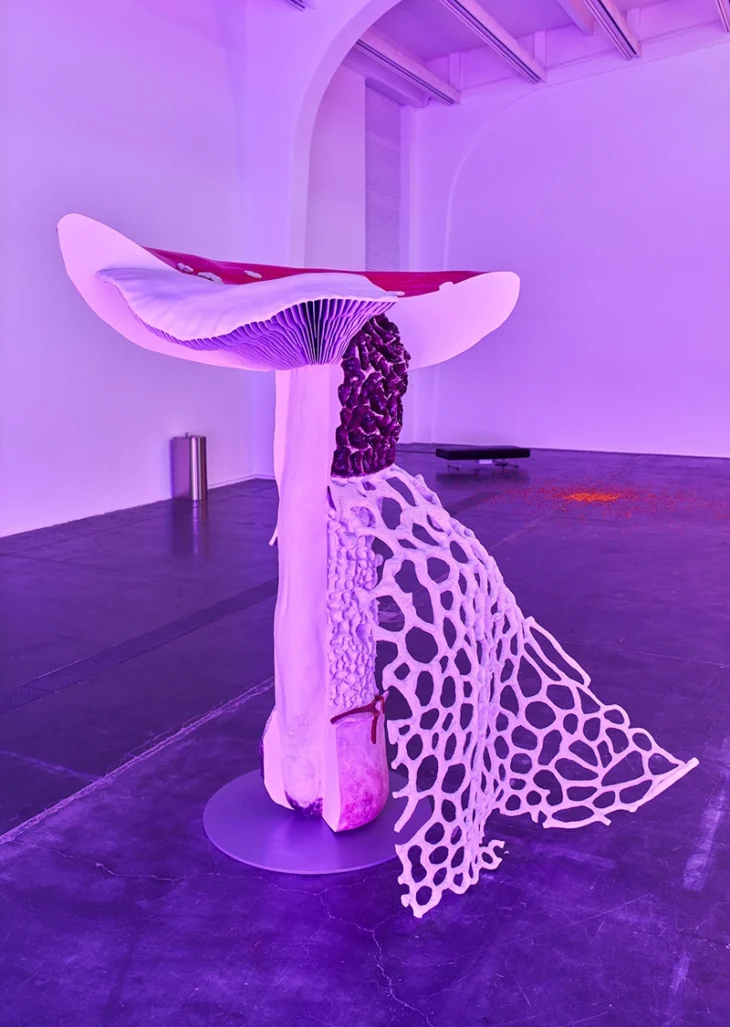
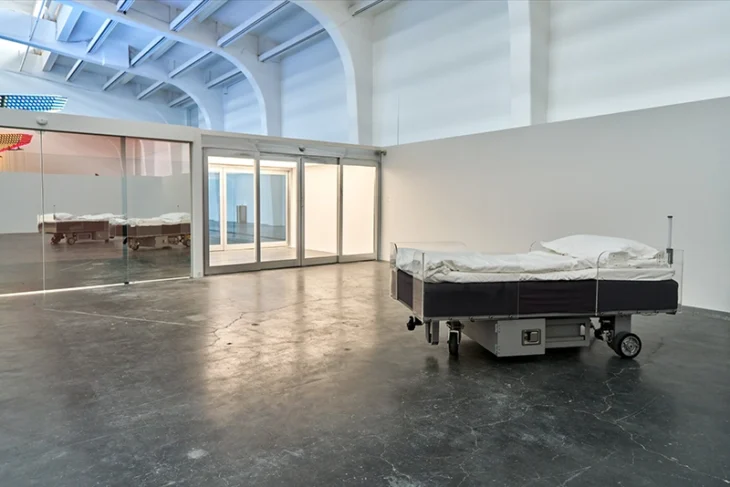
Dreams and altered states continue this investigation. Two robotic beds wander unpredictably through the galleries, allowing visitors to spend the night inside the exhibition while recording their movement across the floor. Light installations combine flashing illumination and synchronized sound to produce perceptual effects that blur distinctions between vision and hallucination. Even a rapidly spinning monochrome mushroom generates the illusion of color, demonstrating how perception frequently depends less on objective reality than on the brain’s interpretation of sensory information.
Across more than three decades, Höller has repeatedly questioned the boundaries separating science, psychology, architecture, and art. Two continues that trajectory without relying on spectacle alone. Every installation operates within a larger conceptual framework that examines how repetition produces variation, how identical forms generate difference, and how participation transforms spectators into collaborators. The exhibition never asks visitors to solve its propositions. Instead, it rewards uncertainty, encouraging prolonged attention to situations that resist immediate explanation.
For UCCA, Two introduces one of Höller’s most comprehensive investigations into perception to Chinese audiences while reaffirming the institution’s commitment to presenting internationally significant contemporary art. By replacing certainty with experimentation, Höller demonstrates that doubt itself can become an artistic medium, one capable of reshaping how visitors understand space, time, and their own relationship to the world around them.