



The auction calendar has delivered a strange pairing. Days after a Vincent van Gogh landscape sold for $190.4 million at Sotheby’s, JOOPITER announced yet another dinosaur for the block. One is a painter’s final spring. The other is a Jurassic animal that died 150 million years ago. Both are being sold to people with very deep pockets, in a world that is not exactly short on crises. So which one intrigues me more?
I will be honest. The kid in me still loves a dinosaur, and the adult never grew out of it. I cannot say the same about Van Gogh. Not as a child and not now. We know the story by heart: the ear, the madness, the genius nobody understood. The tragic figure who sold only one painting in his lifetime is the most reliable myth in art history, and it is a myth that now sells itself.
The Dealer’s Dream, Again
Here is what puzzles me. Van Gogh left behind roughly 900 paintings, close to a thousand. The Starry Night hangs at MoMA. The Musée d’Orsay holds dozens. Hundreds of them live in museums that anyone can walk into. And yet, every now and then, another one surfaces and someone wants to own it. The dream of the gallerist and the auctioneer is the same one it always was: a name so recognizable that nobody has to explain it.
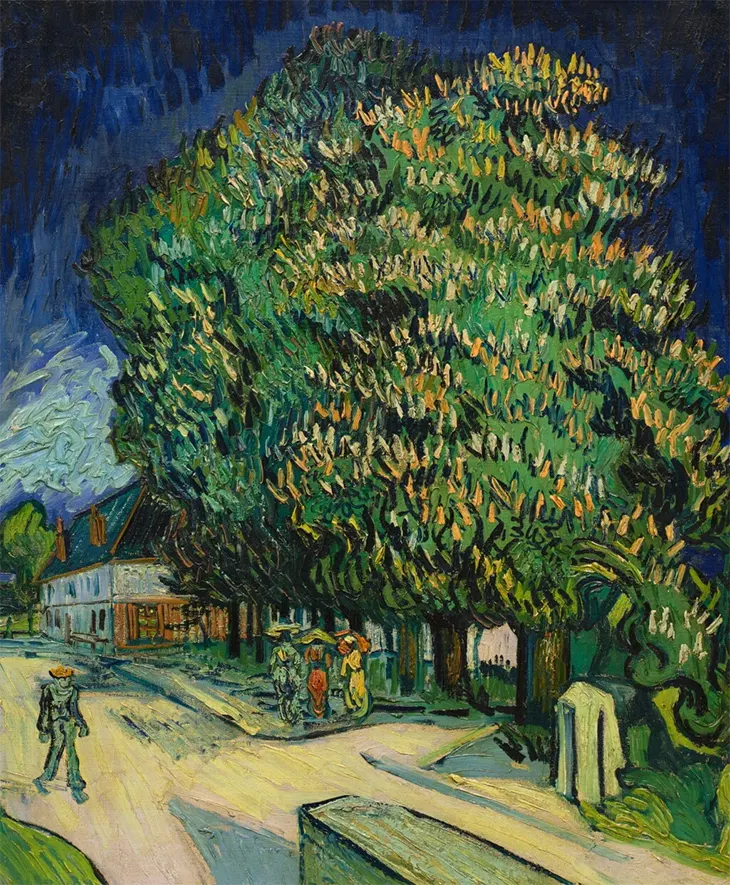
That name has real weight. Châtaigniers en fleurs (Blossoming Chestnut Trees) was painted in Auvers-sur-Oise on or just before May 24, 1890, within days of the artist arriving there. According to Sotheby’s, the canvas shows a cluster of chestnut trees at the center of the village, three women with parasols gossiping in the sun, and a man in blue work clothes strolling toward the painter’s easel. The provenance runs from Theo van Gogh through Paul Cassirer, Samuel Fischer, Wildenstein and, since 1975, the Blaquier-Arrieta collection. Van Gogh died weeks after painting it.
The $190.4 Million Night
As reported by Julia Halperin and Zachary Small in The New York Times, the painting went from top lot to top liability and back again in under a week. Heirs of the German Jewish publisher Samuel Fischer claimed it had been sold in 1936 under Nazi persecution. After a marathon negotiation on Monday, the heirs and the sellers reached an undisclosed agreement, and the sale went ahead. It then broke Van Gogh’s auction record of $117.2 million, set in 2022, and became the sixth most expensive painting ever sold at auction when adjusted for inflation.
The room, however, was reportedly cold. Auctioneer Oliver Barker spent more than three minutes trying to coax out new bidders before the dealer William Acquavella won the lot. The heirs’ lawyer described “no mood, no Champagne atmosphere.” The twelve works from the collection together brought $412 million against an estimate of $450 million, and the Times notes that Sotheby’s fell $54 million short of its predicted sales before premiums. Art adviser Philip Hoffman put it plainly: “The art market is fine, but too much money was thrown at this sale by the auction house.” The same newspaper adds that another Van Gogh from the same collection, Le Zouave, reportedly changed hands privately for around $190 million less than a year ago. The wealthy will pay for the rarest of the rare, but they have no appetite for expensive risk.
Meet Rocky
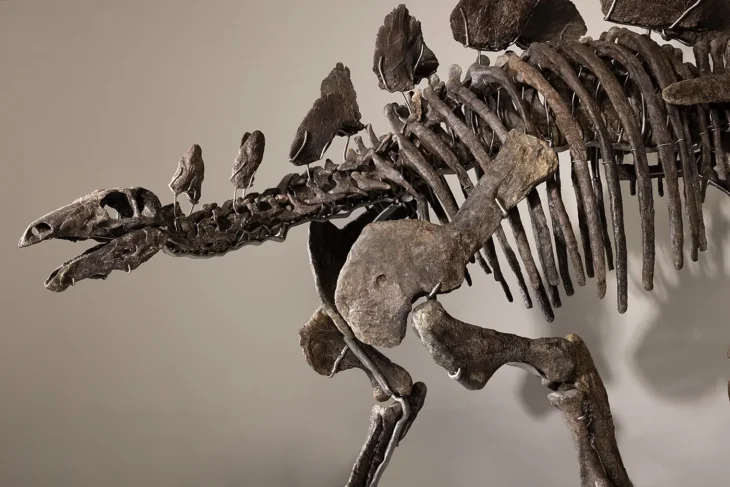
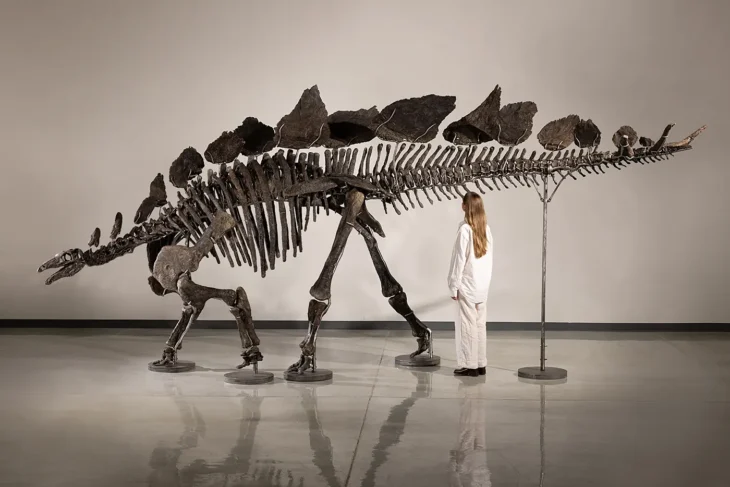
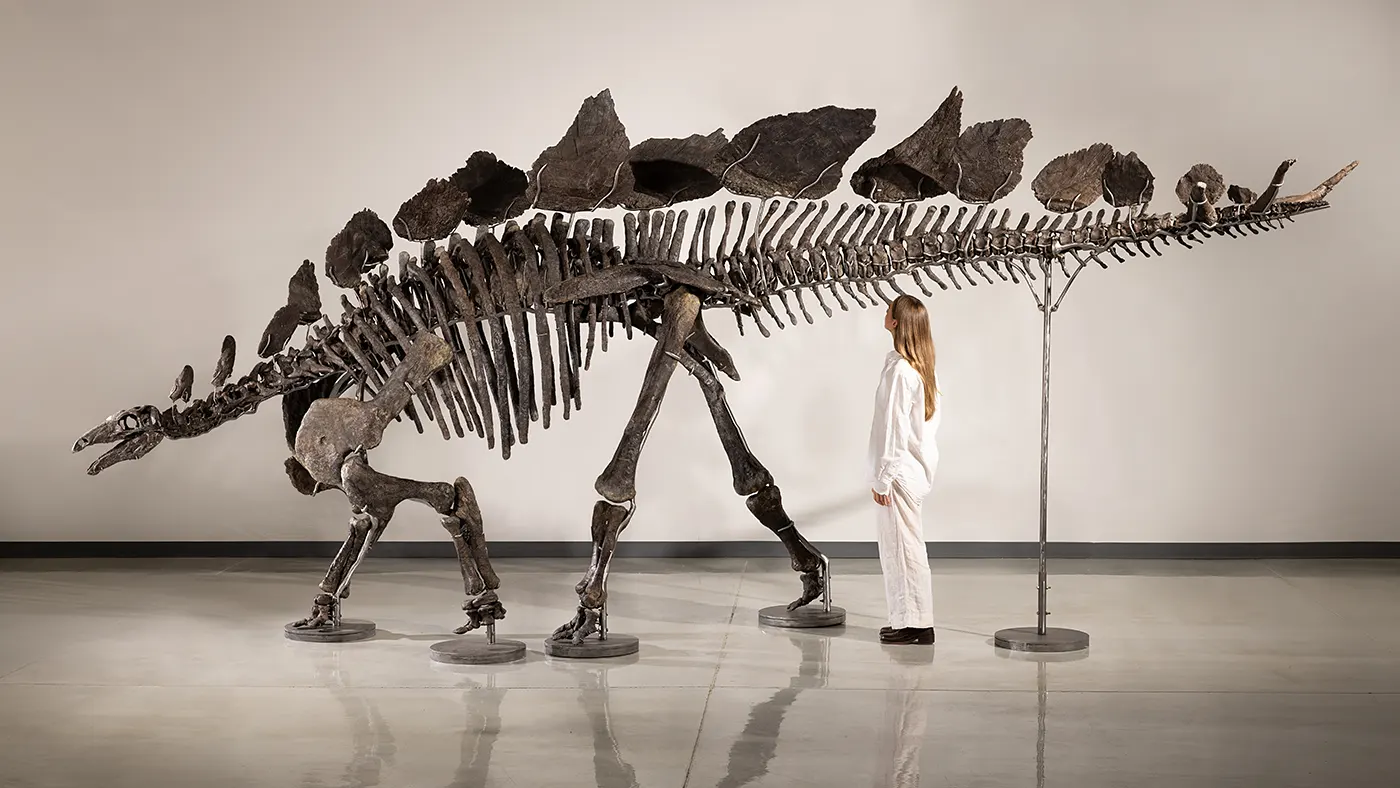
Now to the other contender. JOOPITER, the digital-first platform founded by Pharrell Williams, has announced the auction of Rocky, a fully mounted Stegosaurus from the Late Jurassic, roughly 150 million years old. The animal stands about 21 feet long and over 9 feet tall, and it carries all four of its tail spikes and 19 plates. About 65 percent of it is original fossil bone by volume.
Rocky was excavated from the legendary Bone Cabin Quarry in Albany County, Wyoming, a site first worked by the American Museum of Natural History in 1897. The dig ran from the end of the 2023 season through 2025. Most of the bones were found together in less than four square meters and are believed to belong to a single animal. Every bone has a paper trail from the quarry to the final mount in Tucson, Arizona, where master mounter Makoto Takigawa built the steel frame over ten weeks. The project took some 34,600 hours of fieldwork, preparation and mounting. Peter Larson of the Black Hills Institute believes there is enough here to place it among the top five mounted Stegosaurus skeletons in museums today.
The estimate is $6 million to $9 million. Bidding runs on JOOPITER from December 1 to 15, 2026, and Rocky will be on view in the Miami Design District during Art Basel Miami Beach, December 2 to 6. Putting a dinosaur in the middle of a contemporary art and design week is a deliberate statement about where collecting is heading. As JOOPITER’s Caitlin Donovan put it, the platform continues to redefine the boundaries of modern collecting.
More of Rocky in our gallery:
A Market That Loves a Trophy
This is not JOOPITER’s first fossil. Earlier this year, Triceratops Trey sold for $5.5 million after nearly thirty years on public display. The press release notes that a Stegosaurus set the auction record for any fossil in 2024 at $44.6 million, and calls this a moment when the dinosaur market has never been stronger. Rocky’s estimate looks modest next to that number, and next to a Van Gogh.
Which brings me back to my question. Neither of these objects is scarce in the cultural sense. There are hundreds of museums where you can stand in front of a Van Gogh, and just as many where a dinosaur towers over a school group. What is scarce is private ownership of an object that needs no explanation. A dinosaur and a Van Gogh are the easiest items in the world to process. Nobody asks what they mean. In an uncertain economy, with a cautious art market and a room that went quiet at $190 million, that clarity is exactly what money seems to be paying for.
Even the destinations are unknown. The Van Gogh went to a dealer, not an institution. Rocky could end up in a museum, a private hall or a collector’s atrium. Whichever one wins your imagination, the real story is that both are being bought as certainty. For me, the kid still wins. The dinosaur is at least honest about being 150 million years old.
For more on the market, explore our coverage in Art and News.