


When travelers map out their Grand Tour of Italy, the itinerary is almost invariably paved with marble and canvas. The Uffizi Gallery draws attention for its Renaissance masters, the Colosseum for its imperial past, and the canals of Venice for their improbable architecture. Yet there is a living, breathing heritage in Italy that predates many of the Baroque facades tourists admire today: it is a heritage rooted in soil rather than stone: the university botanical garden.
Italy is the cradle of the modern botanical garden and these were the first and foremost, scientific laboratories. In the 16th century, as the Renaissance mind turned toward the categorization of the natural world, Italian universities began cordoning off plots of land for a specific, vital purpose: the study of medicine. To walk through Italy’s most beautiful botanical gardens today is to walk through the history of pharmacology, taxonomy, and the very way we understand the plant kingdom.
From the misty, walled enclosures of the north to the tropical explosions of Sicily, these institutions remain guardians of biodiversity. They offer a quiet, verdant counter-narrative to the crowded squares, inviting visitors to examine the roots of Western science.
The birth of the botanical garden in Padua
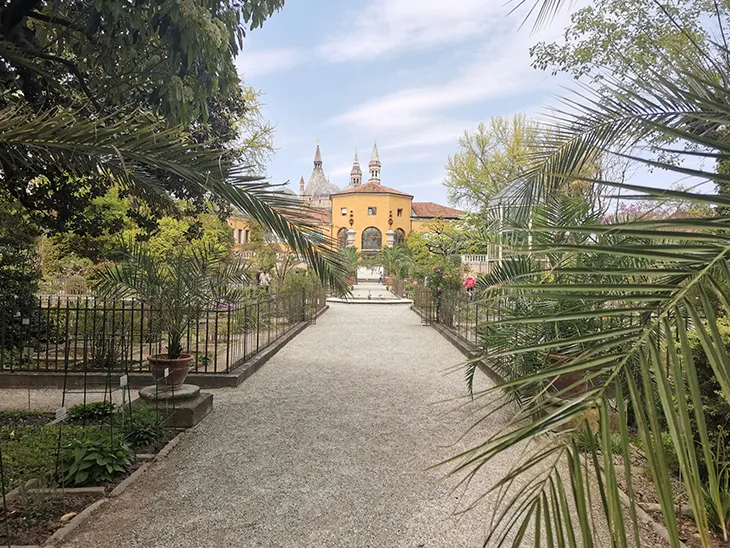
To understand the significance of these green spaces, one must look to the Veneto region in the mid-16th century. In 1545 the Senate of the Venetian Republic approved the foundation of the Orto Botanico di Padova, attached to the University of Padua, the oldest university botanical garden in the world that still remains in its original location.
The garden was not established for aesthetic contemplation: its origins were strictly utilitarian and academic. In the 1500s the primary source of medicine was nature: doctors and students needed to distinguish between therapeutic plants and toxic look-alikes. The university required a living textbook; thus, the concept of the giardino dei semplici (the garden of simples) was born. “Simples” referred to medicinal herbs used on their own, as opposed to compound drugs.
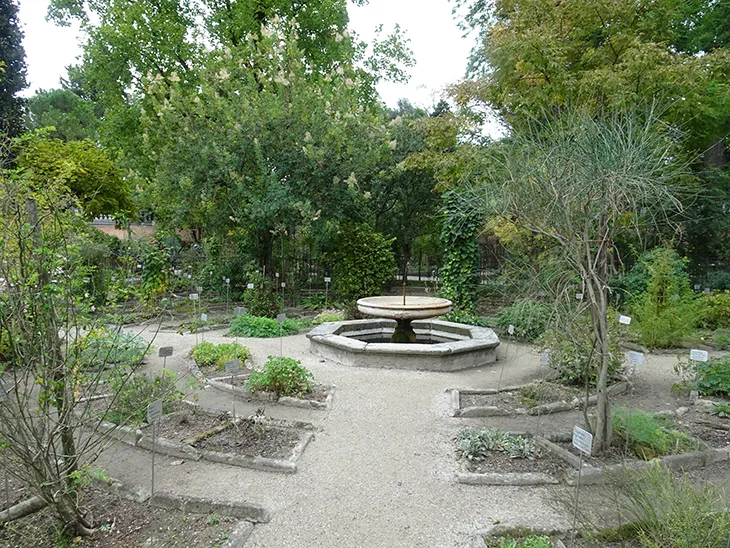
The layout of Padua’s garden reflects the cosmological view of the Renaissance: it is a circle enclosing a square, divided into four quadrants by cardinal paths, representing the world. This “Hortus Sphaericus” was designed to contain the entire vegetable kingdom within a finite space. In the center lies a fountain, symbolizing the ocean. To protect this precious collection from night thieves (because medicinal plants were incredibly valuable commodities) a circular wall was erected, which still stands today.
Walking through Padua’s garden, visitors encounter the “Goethe Palm,” a dwarf fan palm planted in 1585. It is named after the German writer who, after examining it in 1786, formulated his theory on the metamorphosis of plants and this single specimen serves as a testament to the garden’s role as a catalyst for intellectual thought. The integration of the ancient garden with the modern Biodiversity Garden greenhouses showcases the evolution from identifying cures to preserving the planet’s ecological balance.
Exploring Italy’s historic university gardens
While Padua set a standard for stability, the botanical fervor spread rapidly across the peninsula. Each major university city developed its own green archive, often driven by competitive ambition and the patronage of ruling families.
Pisa
The Orto Botanico di Pisa is a great rival to Padua. Founded in 1543 by the naturalist Luca Ghini, under the patronage of Cosimo I de’ Medici, it technically predates Padua by two years. However, the garden was relocated twice before settling in its current position near the Piazza dei Miracoli in 1591; it was here that Ghini essentially invented the herbarium (the practice of drying and pressing plants for study) changing botany from a seasonal discipline to a year-round science.
Today the Pisa garden is a quiet refuge just steps from the Leaning Tower; it houses a massive botanical museum and an arboretum that feels like a dense, ancient forest. The garden is renowned for its collection of aquatic plants and the majestic Cedar of Lebanon, planted in 1787. The layout retains the rigorous geometric order of the 16th century, reminding visitors that in the Renaissance mind, nature was something to be ordered, cataloged, and understood through reason.
Florence
In Florence, the Medici family’s influence was inescapable. The “giardino dei semplici” of Florence, established in 1545 (the same year as Padua), was another project of Cosimo I. Located initially on the outskirts of the city center, it was designed to serve the medical students of the Florentine Studio. The garden has survived the flooding of the Arno and centuries of urban expansion.
The Florentine garden is characterized by its serene atmosphere and its massive taxus trees planted in 1720 and it is a place where art and science intersect. The layout was designed by Niccolò Tribolo, who also worked on the Boboli Gardens. The collection of azaleas is spectacular in the spring, but the true value lies in the ancient cycads and the medicinal plant beds that adhere to the old classification systems. It serves as a green lung in a city dominated by stone, offering a direct link to the era when the Medici were financing the scientific exploration of the natural world.
Rome
The botanical lineage of Italy is often tied to noble bloodlines that crossed city-state borders. The Corsini family, a powerful Florentine dynasty, eventually established a significant presence in the Eternal City, acquiring the magnificent Palazzo Corsini. To trace this horticultural and aristocratic path, you can continue your tour by taking a train from Florence to Rome, where the legacy of the Corsinis houses one of the capital’s greenest treasures.
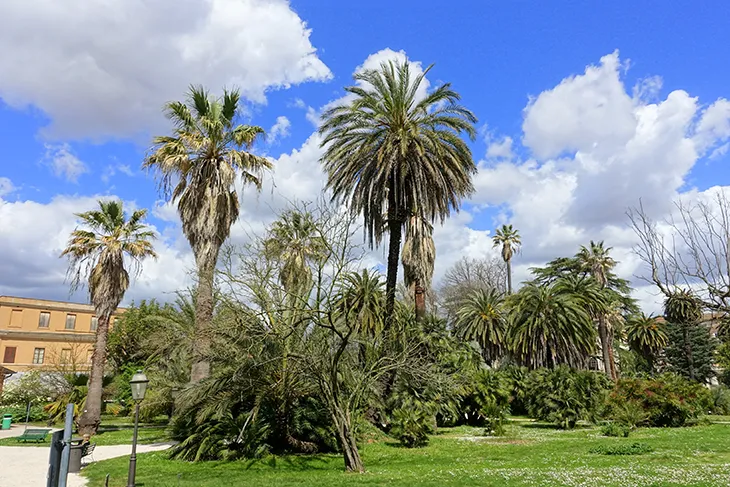
The Orto Botanico di Roma (operated by Sapienza University) is located in the park of the Villa Corsini, once the residence of Queen Christina of Sweden. Situated on the slopes of the Janiculum Hill, this is the Trastevere botanical garden, a massive 12-hectare oasis that overlooks the city. Unlike the flat, walled gardens of the north, Rome’s garden utilizes the topography of the hill to create diverse microclimates.
Here the scale is imperial: the garden boasts a monumental staircase, a bamboo forest that seems to transport you to Kyoto, and a rose garden that captures the romantic essence of Rome. The sensory garden, designed for the visually impaired, emphasizes the texture and scent of plants, returning to the tactile nature of the original “simples.” The glasshouses contain significant collections of succulents and tropical species, while the Japanese garden offers a minimalist counterpoint to the Baroque exuberance of the surrounding architecture. It is a place where the chaotic energy of Rome dissolves into the quiet rustle of leaves.
Palermo
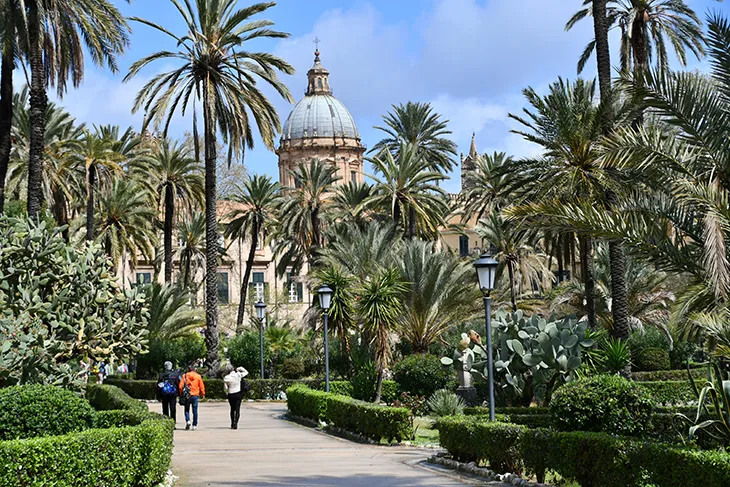
Traveling further south the climate shifts, and with it the botanical possibilities. The Orto Botanico di Palermo, founded in 1789, represents a different era, the Age of Enlightenment and the Linnaean system of classification. It also represents the gateway to the tropics. Because of Sicily’s mild climate, Palermo became the testing ground for exotic species brought back from the Americas, Africa, and Asia before they were introduced to the rest of Europe.
The symbol of the Palermo garden is the gigantic Ficus macrophylla, imported from Australia in 1845. Its aerial roots have created a cathedral of wood, a living architecture that dwarfs the human visitors. The garden features the “Gymnasium,” a neoclassical building that originally housed the school of botany, and the “Aquarium,” a large central basin for aquatic species. The diversity here is staggering, with collections of cycads that are among the most important in Europe. In Palermo the botanical garden feels less like a medieval cloister and more like a colonial expedition, showcasing the vastness of the global ecosystem.
The importance of scientific research
It is tempting to view these spaces merely as parks, or pleasant backdrops for a Sunday stroll or a quiet place to read a book. However, distinguishing the university botanical gardens of Italy from standard municipal parks is necessary. A park is for recreation; a botanical garden is a museum of living collections, maintained for the purposes of conservation, education, and scientific inquiry.
The role of these institutions has shifted from the identification of medicinal herbs to the preservation of genetic diversity. These gardens function as arks, as they maintain seed banks (germplasm banks) that store the genetic codes of endangered species, ensuring that if plants go extinct in the wild, they do not disappear from the earth entirely.
The research is important as well: botanists at these universities study plant adaptability, investigating how flora might survive in a warming world. They work on reintroducing extinct species back into their natural habitats. The “giardino dei semplici” of the Renaissance was about saving human lives through medicine; the modern university garden is about saving the planetary life support system. Furthermore, they remain centers of education, as they teach the public that plants are complex organisms that sustain our atmosphere and food systems.
When you walk past the ancient walls of Padua or beneath the giant Ficus of Palermo, you are witnessing a continuous, 500 years old scientific experiment. These gardens remind us that our survival has always been, and will always be, inextricably linked to the plant world.