


The beauty market has become less forgiving of surface appeal. McKinsey notes that consumers now expect hyperpersonalization, scrutinize quality, and are less easily convinced by image alone. Tattooing sits squarely in that shift, because unlike most aesthetic choices, it is meant to last.
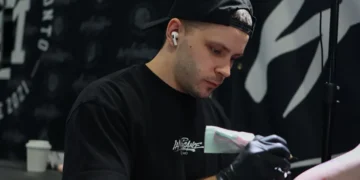
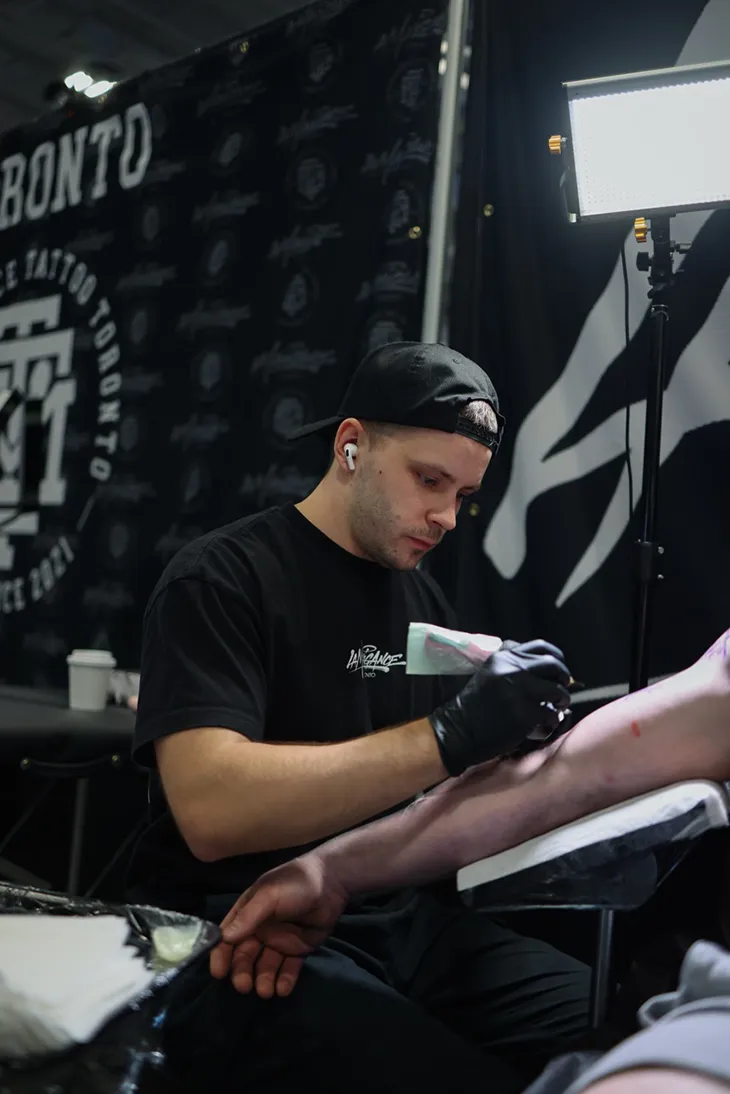
Once a tattoo meets the body, it must maintain shape, movement, and visual balance in three dimensions, Roman Sirko argues. That principle has shaped his work across different tattoo cultures: he built his practice in Ukraine, where he became one of the leading artists within a large studio network, conducted internal seminars, and reviewed other tattooists’ work. Now based in Canada, he works at La Manigance, a well-known tattoo studio in downtown Toronto. His approach earned him third place in the Best of Show category at the Quebec Tattoo Show 2024, one of the major international tattoo events, and later led to an invitation to judge at the Calgary Tattoo & Arts Festival.
In this piece, we break down Roman’s professional thinking and the three principles behind tattoos that retain their depth, clarity, and structure after healing, which can help tattoo professionals attract clients from abroad.
Start with anatomy instead of the sketch
A tattoo can lose its force the moment it is treated as a picture applied to skin. On paper, detail can do much of the work on its own. On skin, it cannot.
Roman Sirko argues that the body changes the image. As he explains it, the shoulder rounds a composition, the forearm narrows and turns it, and the back reveals whether a design can truly hold scale. That is why, in his view, a tattoo has to be built for the specific body part that will carry it. Otherwise, even well-drawn artwork can begin to break apart once it meets movement, curvature, and proportion. In Roman’s approach, the composition is developed around anatomy, so the tattoo reads as one intentional structure rather than a set of visually striking fragments.
Build depth through hierarchy, not through detail alone
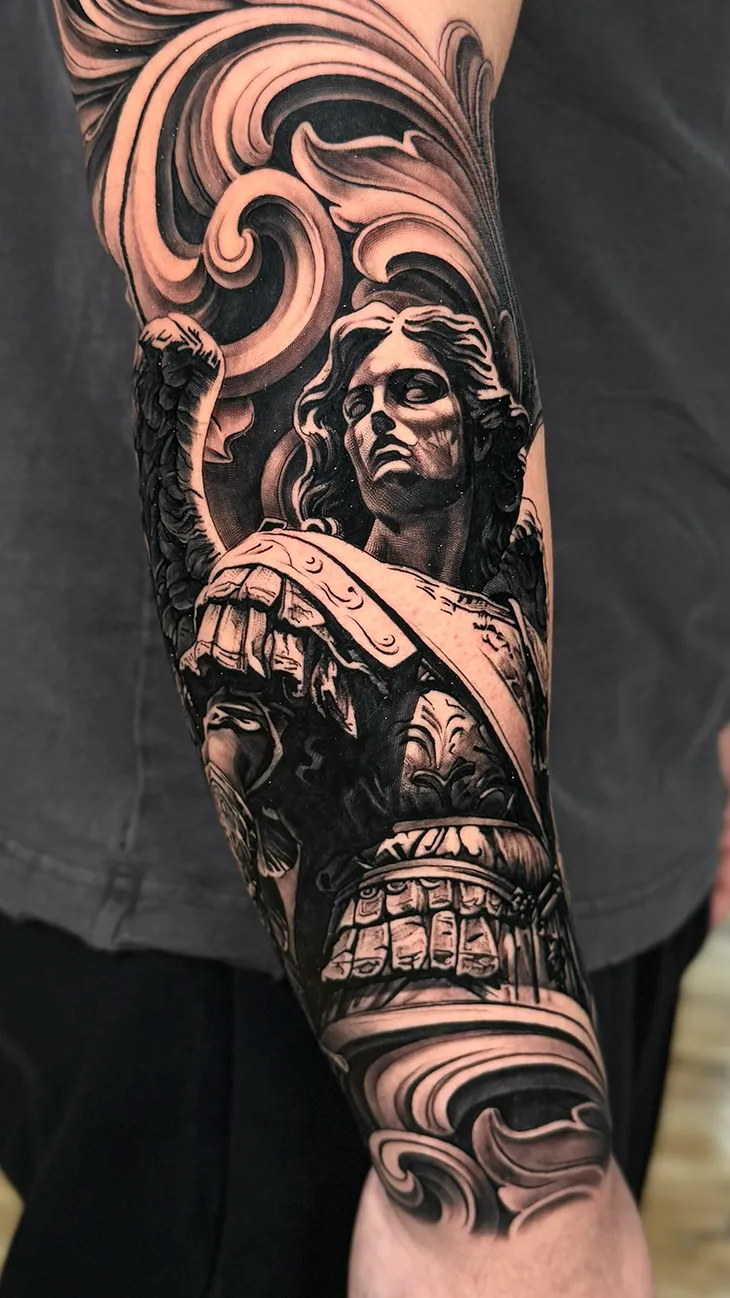
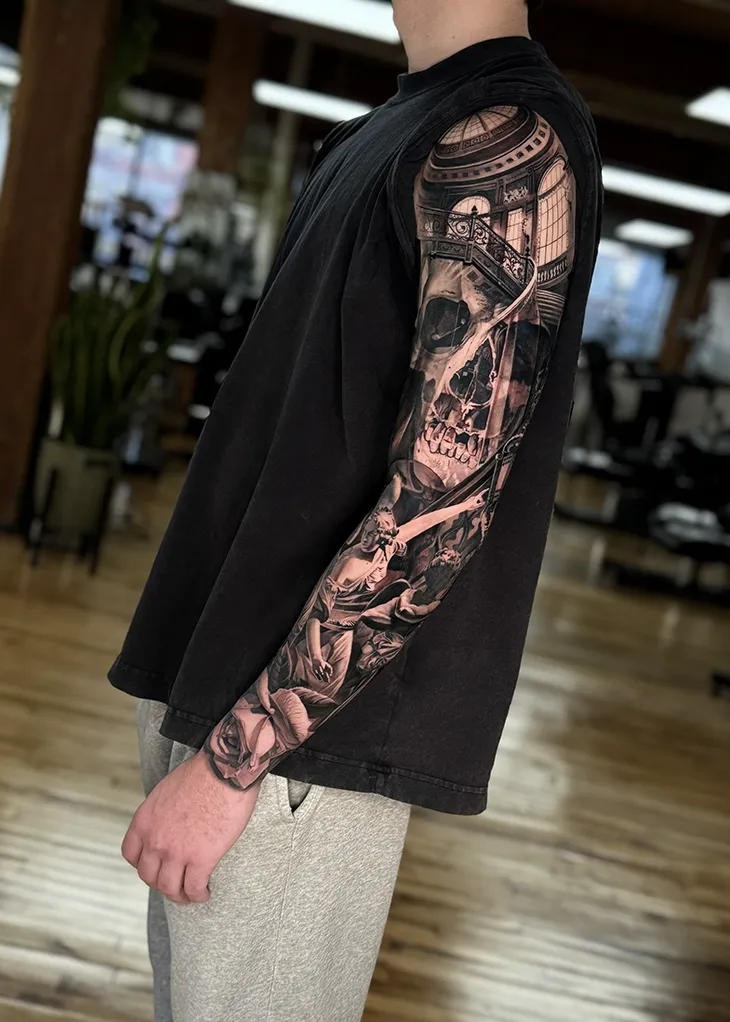
While working on large-scale compositions and cover-ups, Roman noticed that sheer density does not make a tattoo feel dimensional. Hierarchy does. Hence, he creates background planes with broader shadow fields, lets the main subject come forward through stronger contrast, and keeps secondary elements more restrained so they support the composition instead of competing with it. The point is to control what advances, what recedes, and where the eye lands first. Without that order, a large piece can flatten into one dense surface, no matter how much technical labor went into it.
One of Roman’s upper-arm pieces is built around a classical female figure set within an architectural frame; the tattoo relies on controlled recession rather than sheer density. “In that piece, I didn’t want the figure, the frame, and the lower ornamental movement to sit on the same visual level,” he says. “I pushed the background deeper, kept the strongest contrast on the figure itself, and let the lower forms open the composition instead of clogging it. That way, the shoulder still carries one image with depth, rather than several detailed elements fighting for attention.”
Judge the work by how it heals, not by how it looks fresh
Roman’s third principle is technical, but the result is visual. For that, he controls speed, amplitude, contact, extraction, depth, and density to create cleaner saturation and more predictable healing, rather than chasing an overly dramatic fresh result.
In the first couple of weeks, the skin is still recovering, the surface can look harsher than it will later, and the tones have not fully settled yet. The important thing is to let it heal properly and evaluate the work once the skin has calmed down.
Following these principles allows his work to travel across markets as well as across platforms. In Ukraine, Roman Sirko taught other tattooists inside a large studio system, and over time, other artists, along with their clients, repeatedly asked to reuse or copy designs he had created as custom one-offs. In Canada, he has built long booking lead times and attracted clients from the United States.
For many tattoo artists, audience growth depends on deliberate promotion, paid ads, frequent content tactics, giveaway mechanics, collaborations, and constant visibility work. Roman’s Instagram grew differently. He added 15,000 followers in a year without paid promotion, with growth driven primarily by the work itself: its recognizability, consistency, and organic circulation among viewers and clients.
A Japanese-style phoenix sleeve made that dynamic especially clear online, with the composition designed to wrap and move through the arm: “When I posted that Japanese-style phoenix sleeve, people were reacting to the amount of work in it as well as to how the whole composition flowed. For me, that is always the best sign that the piece is working beyond the studio.”
His expertise was recognized not only by potential clients but by the professional tattoo community as well. Among more than 300 tattoo artists from around the world, Roman Sirko took third place in the Best of Show category at Quebec Tattoo Show, a major international industry event. Later, at the Calgary Tattoo & Arts Festival, the largest show of its kind in Canada, he was invited to serve as a judge. There, he contributed his professional evaluation on a contest stage where a panel of judges inspects tattoos and selects winners across categories.
For other artists, that offers a practical lesson: a strong visual method does more than improve the tattoo. It makes the work legible at a glance, helps expertise spread online, and creates the kind of recognition that can bring in new clients and support real growth. In Roman’s case, the formula is not mysterious. Build for anatomy. Control hierarchy. Work for the healed result. Everything else, the audience, the demand, the reputation, has a better chance of following from there.