


Most digital products are designed to hold attention. Fewer are designed to build connection. Across independent animation, global brand systems, and commercial work for some of the world’s most recognized technology and media companies, San Francisco-based visual designer Ye Chen‘s practice is organized around the second question: how can the materials of motion design (timing, weight, color, the way one frame becomes the next) create the conditions for people to feel less alone?
DESIGN
Chen is a Visual Designer specializing in motion design, currently a motion graphics designer at Never Not Productions, the production company under the San Francisco creative agency Godfrey Dadich Partners. Trained in Communications Design at Pratt Institute, where he graduated with distinction, and in Art Studio at Stony Brook University, he is an active member of AIGA, the professional association for design. What distinguishes Chen is his ability to use motion systems not only for visual polish, but for emotional structure, global brand coherence, and public-purpose communication, a practice that continues to extend from commercial brand systems into work of broader social value.
An Animated Short About the Long Middle
The National Alliance on Mental Illness estimates that one in five U.S. adults experiences a mental health condition each year, a public-health context few independent animations attempt to engage. Semicolon, a three-minute animated short Chen directed and animated, has been recognized by the Independent Shorts Awards International Film Festival and Cal Film Festival, named a Finalist at Indie Short Fest, a Semifinalist at Venezia Shorts Italy and Cannes Indie Shorts Awards, and won Gold in both the Animation and Short Film categories at the 2026 Muse Creative Awards. The breadth of recognition across the United States, Italy, and France signals cross-border industry consensus rather than the enthusiasm of a single jury.
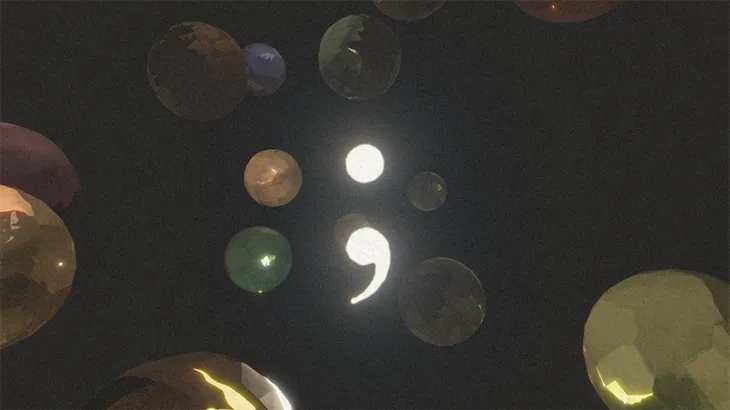
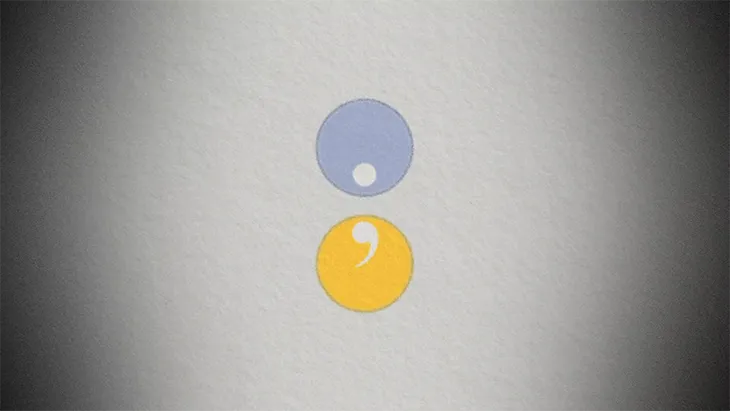
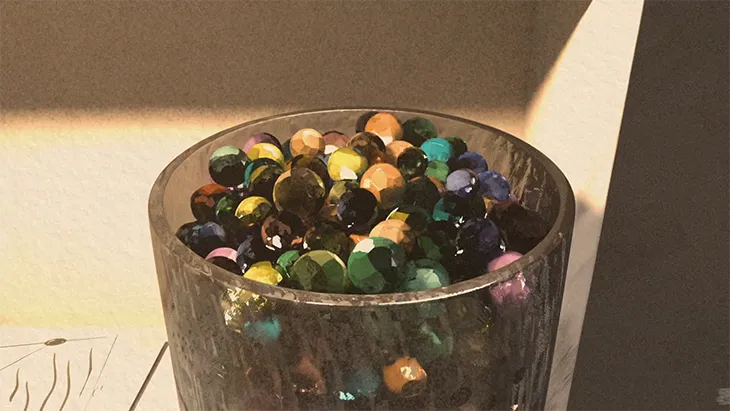
Without dialogue, the film follows a small blue glass marble, marked with a luminous period, through isolation and an encounter with an orange marble marked with a comma. Together, they form a complete semicolon, an image drawn from the global Semicolon Project, in which a semicolon stands for a sentence the author chose not to end. Working in both 3D and 2D, Chen set the painterly visual direction: hand-drawn brushstroke textures, noise and brush passes layered in post, the short rendered at twelve frames per second, sitting between stop-motion and hand-drawn animation. Across over two thousand frames, Chen drove every stage of production from storyboard through final color, sustaining a discipline normally distributed across a studio.
A companion app, also titled Semicolon, extends the film’s argument into the longer arc of recovery. Wanqing Zhang headed the design as a depression-recovery design pitch, with Chen directing motion design and Mackenzie Owen on 3D modeling. The app has been named a Gold Winner in Digital Tools and Utilities by the 2026 Indigo Design Award, with Silver recognition in UX, Interface & Navigation and in Health & Beauty & Medicine for Branding, and earned Gold for Communication UX and Silver for Ethical & Inclusive UI Design at the NY Product Design Awards. Chen directed the brand video introducing the app, carrying the film’s painterly world into a modern, minimal character system that translates the short’s symbolic animation into a vocabulary the app’s users can return to.
The short film represents the sentiment and hope, The app design is the follow-through.

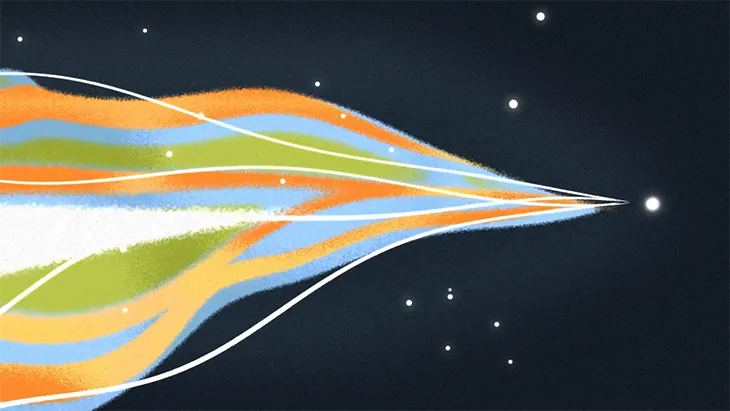
Motion + Brand
Across his agency practice, Chen has headed motion design across case films, conference identity videos, and public-facing explainers: work where complex technology, healthcare, or organizational messaging needs to be made emotionally readable. He directed motion for the WorkLab promotional series for Microsoft, the brand videos for InterSystems’ HIMSS and Global Summit/READY conferences, and the kyu Collective brand sizzle reel, alongside global campaigns for IBM, Meta, and Sony. He has also contributed motion design to a brand explainer for the California Mental Health Services Authority (CalMHSA), the statewide public-health agency that administers California’s voter-approved Mental Health Services Act. At Never Not Productions, where Chen is one of two motion graphics designers on the team, his ongoing work shapes the studio’s own visual identity, from its website and sizzle reel to its social channels. Lily Oei, Editorial Director at kyu Collective, a creative collective under Hakuhodo DY Holdings, describes Chen this way: “He was precise without being rigid, collaborative without being passive, and helped us develop and sharpen standards we’re still working with today.“
Read across, the work returns to one position. An animated short and its companion app enact the same gesture. A commercial practice carries it, quietly, into the meeting rooms of brands whose users may never meet one another. What Chen offers is not a visual style but a way of working, one that treats motion design as a language for human connection and asks the discipline to take that responsibility seriously. By treating motion design as a vehicle for the public communication of social value, from mental health to public-health information, Chen helps define a body of practice redefining what motion graphics can carry beyond commercial polish.
Words by DSCENE Editor Maya Lane.