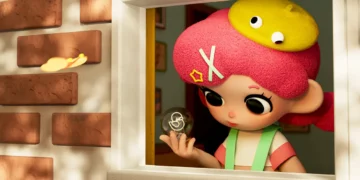



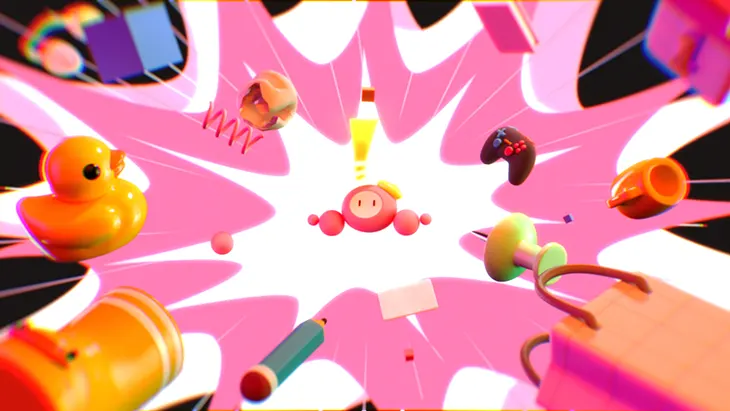
The two-minute motion-design short ADHDesigner delivers a dense surge of visual and emotional energy. Instead of relying on loose collage or rapid-cut chaos, it offers a controlled depiction of an “inspiration burst,” drawing on the nonlinear thought patterns often associated with ADHD. The film blends 2D and 3D animation, collage, symbolic imagery, and abstract narrative into a tightly structured experience.
Created by SVA graduates Zipei Zhang, Caroline Ren, and Yuling Zhou, the project benefits from the team’s shared design background and cohesive visual language. Composer “The Chicken” Joe Basile provides the percussive score that drives the film’s momentum.
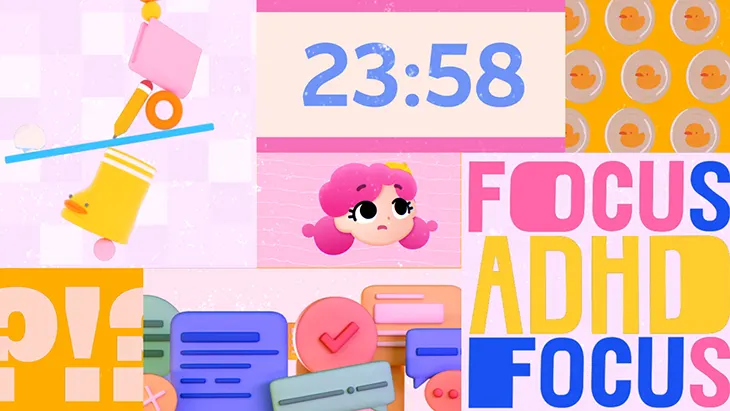
Visually, ADHDesigner adopts a striking, high-intensity language – bold color shifts, spatial distortions, and rapid transitions. Yet beneath its frenetic surface lies a clearly controlled framework. Director Zipei Zhang demonstrates an instinctive command of rhythm and visual flow, guiding viewers smoothly between flat 2D elements and fully dimensional 3D scenes. The contrast between 2D lightness and 3D depth is never too abrupt; this is in keeping with Zipei’s experience working with cross-media animation. Every time a shift in visual structure takes place, the protagonist’s life becomes shifted inside him–one sees inspiration as both story and psychology.
BROWSE ART PAGES ON DSCENE
As well as this sensory overload, the result is an artfully choreographed rather than randomly layered series of sequences. Each rupture and reconstruction in Zipei’s storyboarding is tied together into an understandable narrative arc, through storyboarding. The leap from 2D to 3D is no longer a transition that happens just in a space but becomes an emotional transition that deepens the protagonist’s shifting thinking. The effect is one of “structured chaos”; a visually predatory but strategically structured system that is decipherable even as it tests the limits of visual density.
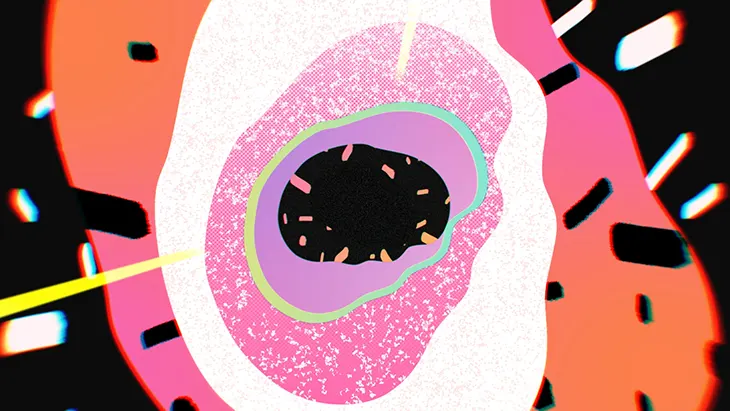
In the film’s final seconds, the Idea Explosion unfolds in a rapid-fire burst: a single lightbulb rendered in more than forty visual styles – abstract, realistic, cartoon, collage, minimalist, and illustrated. Led by Zipei Zhang, the sequence required coordination across a team of over forty artists, each contributing a distinct interpretation. Collaboration on this scale is rare in short-form motion design, yet the result never feels disjointed. Instead, the sequence functions as a unified “collective burst of consciousness,” showcasing Zipei’s precision in visual organization and her skill in managing complex creative systems.
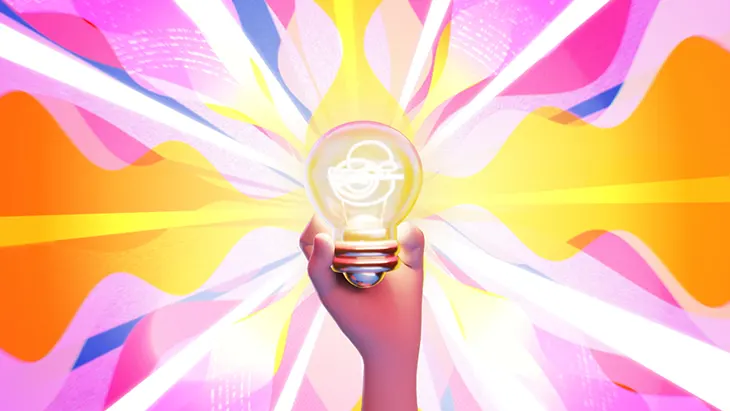
ADHDesigner ends without a clear resolution, echoing a mind that never fully comes to rest. In two minutes, the film captures the turbulence of creative ideation and shows how visual art can translate internal thought into an external experience. At its core, it is a portrait of an “inspiration burst” and an exploration of the tension between chaos and order.
The film embraces the instability often associated with ADHD thinking – shifts in color, scale, and rhythm reflect thoughts that accelerate and collide. Rather than treating chaos as a flaw, the short uses it as creative momentum. Dense yet focused, it becomes more than a motion-design showcase; it is a reflection on how ideas form, fracture, and reshape themselves within the mind.