


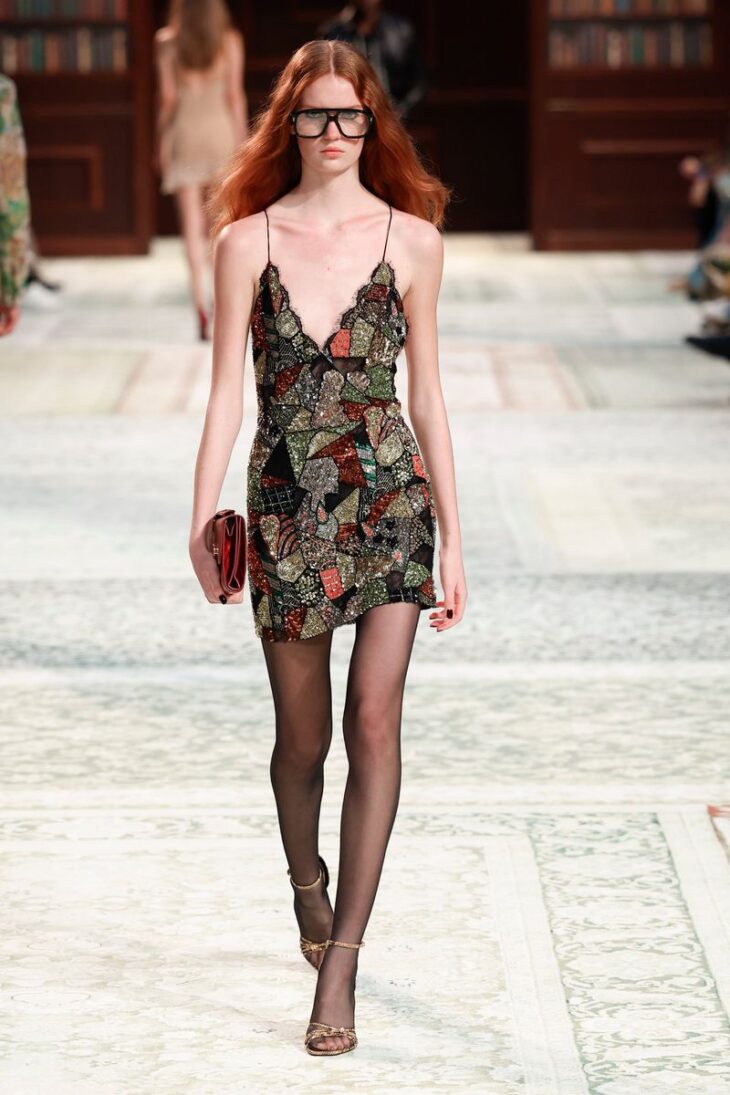
There’s a particular quality to the light in Laurel Canyon, that legendary enclave above Hollywood where Joni Mitchell once held court and the counterculture found its California soundtrack. It’s a light that softens edges, that makes everything feel slightly hazy, slightly romantic, slightly out of time. Mike Amiri has built a $300-million business on capturing that quality, that ineffable sense of Los Angeles glamour filtered through decades of cultural mythology. For Fall Winter 2026 collection presented during Paris Fashion Week, he goes deeper into that territory than ever before, presenting a men’s and women’s collection that feels less like a fashion show and more like an invitation into an idealized version of home.
Setting: An Imaginary Home in the Hills
The show space itself became a statement of intent. Rather than the typical runway configuration, Amiri constructed an environment meant to evoke the intimacy of a luxurious Laurel Canyon residence, complete with curated furniture and careworn objects that suggested lives actually lived. Guests weren’t positioned as spectators observing from outside; they were welcomed inside, immersed in the world rather than watching it pass by.
This staging choice reflects Amiri’s broader ambition. As he recently told Vogue Business, he doesn’t see his brand as a 10-year proposition but rather a 100-year house, one that creates “something so complete, where the identity is so authentic and true to itself that it can live beyond you in its own way.” The show space literalized that philosophy: these clothes exist not in the fantasy of a runway but in the actuality of living.
Inspiration: Where Two Hollywoods Meet
The collection draws from a deeply personal well. Amiri recently discovered photographs of his Iranian father in Hollywood during the 1970s, images that sparked reflection on the connection between the Hollywood his father knew and the Hollywood that shaped Amiri’s own aesthetic sensibility. That generational dialogue, filtered through Laurel Canyon’s legacy as a hub of counterculture, creativity, and music, provides the collection’s emotional foundation.
The 1970s references are unmistakable but never costume-like. Ideas from that decade, definitive for West Coast style, are translated with contemporary ideals: diversity, individuality, inclusion. Pieces cross between genders with intention rather than tokenism. Boyfriend suits are taken by girlfriends; delicate embroidered knits move from her wardrobe to his. This isn’t gender-fluid as marketing concept but as lived reality, an expression of how people actually share clothes, share lives.
Clothes: Formalwear as Personal Expression
Amiri’s quote in the show notes crystallizes the collection’s approach to tailoring: “For me, men’s formalwear is most interesting when it feels effortless and personal. I love the idea of artists wearing tailoring in an informal way, a blazer over a Henley, boots instead of dress shoes. Clothes that feel like an extension of who you are.”
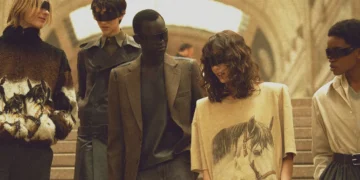
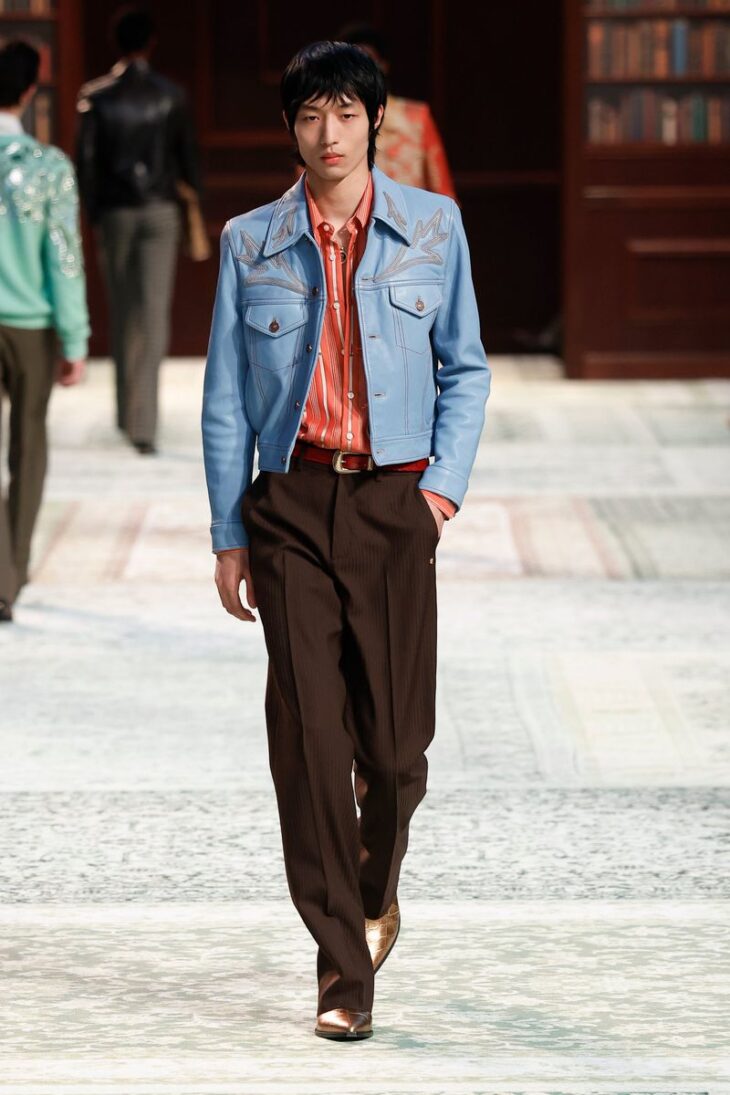
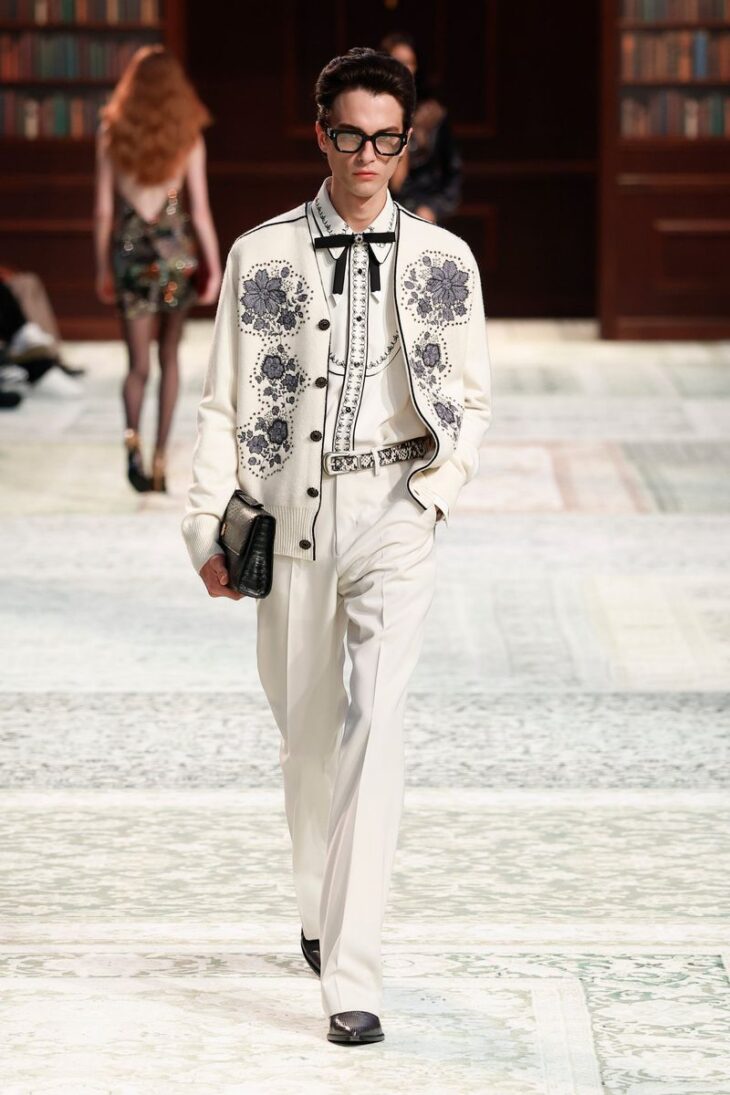
This philosophy manifests throughout the collection. Tailoring is given nonchalance, a personal dimension inspired by the hybrid wardrobes of musicians and artists. The traditional hierarchy of dressing, formal for evening, casual for day, is deliberately inverted. Suits are dressed up for daytime; denim appears for evening. The effect isn’t relaxation so much as a sense of occasion brought to daily life, the understanding that every moment deserves intention.
The material work reinforces this intimacy. Jeans are flocked with rich velvet, creating surfaces that reward close inspection. Embroideries provide punctuation and emphasis rather than overwhelming decoration. There’s a feel of the lived-in, the long-loved, garments that suggest history even when newly made.
Palette and Details: Nostalgia Hazed with Now
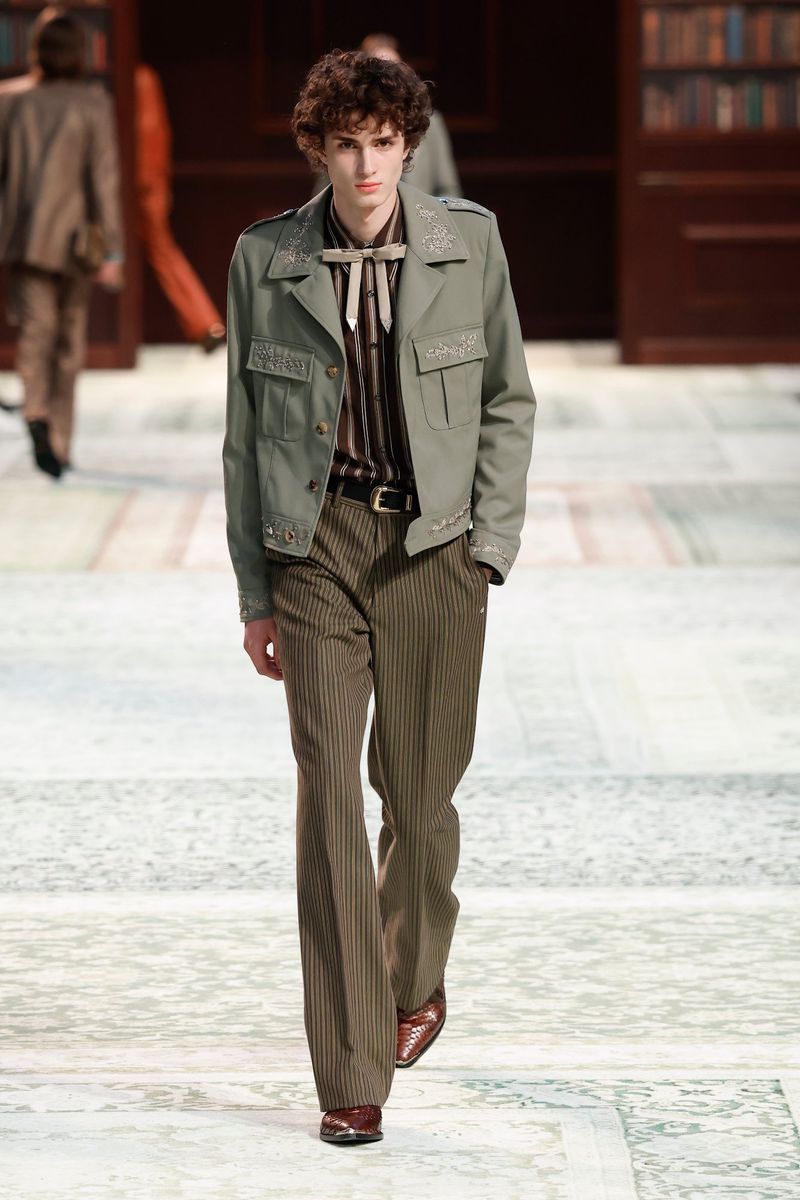
Color throughout the collection carries what the brand describes as a “hazed nostalgia,” deep merlot and burgundies, sage and mint green, bright blues that feel simultaneously vintage and contemporary. It’s a uniquely AMIRI palette, one that evokes 1970s photography without replicating it, that suggests memory rather than documentation.
The wardrobe itself reads as modern American classics reimagined through AMIRI’s particular lens: western wear, officer’s jackets, leather, and classic denim, all given detailing expressive of the brand’s savoir-faire. The notes describe this as “a conversation through craft and creativity spanning the Atlantic, connecting Laurel Canyon and Paris,” a reference to the brand’s recent expansion of its Milan operations, where a 26,000-square-metre space now headquarters sourcing and manufacturing for tailoring, fine accessories, and certain knitwear categories.
Accessories: Evolution of an AMIRI Language
The collection continues the reiteration and refinement of signature pieces within a distinct AMIRI aesthetic. Silhouettes remain identifiable through cut; signature handbags, the Honey, the East-West Pouchette clutch, are reconsidered for the season. The brand’s eyewear proposition expands with new Japanese-made frames, while the iconic original AMIRI western boots are recalibrated and updated.
Every seam becomes a streamlined form of decoration as well as a definition of silhouette. Embroideries and embellishments are designed not to dazzle but to create intimacy, their artisanship revealing itself up close. As Amiri puts it: “The closer you get, the more you feel.”
Context: Building for the Next Century
This collection arrives at a significant moment for the brand. AMIRI has grown from three people in a basement under a Thai restaurant on Sunset Boulevard to a $300-million annual business with 300 employees globally. The company completed 100 red carpet looks in 2024, all suiting, a dramatic shift from the sports tunnels and concert fits that defined earlier years. Womenswear, currently around 15 percent of the business, returns to the runway with this collection as part of a broader strategy that includes future categories like fragrance and cosmetics.
Discover more of the collection in our gallery:
Finally Fall Winter 2026 represents AMIRI at its most refined and its most personal. The collection succeeds because it doesn’t chase trends or manufacture relevance; instead, it deepens the brand’s existing vocabulary, finding new nuances in familiar territory. The Laurel Canyon reference could easily have become pastiche, but Amiri’s genuine connection to the material, both through his own LA upbringing and his father’s immigrant experience, gives it authenticity.