


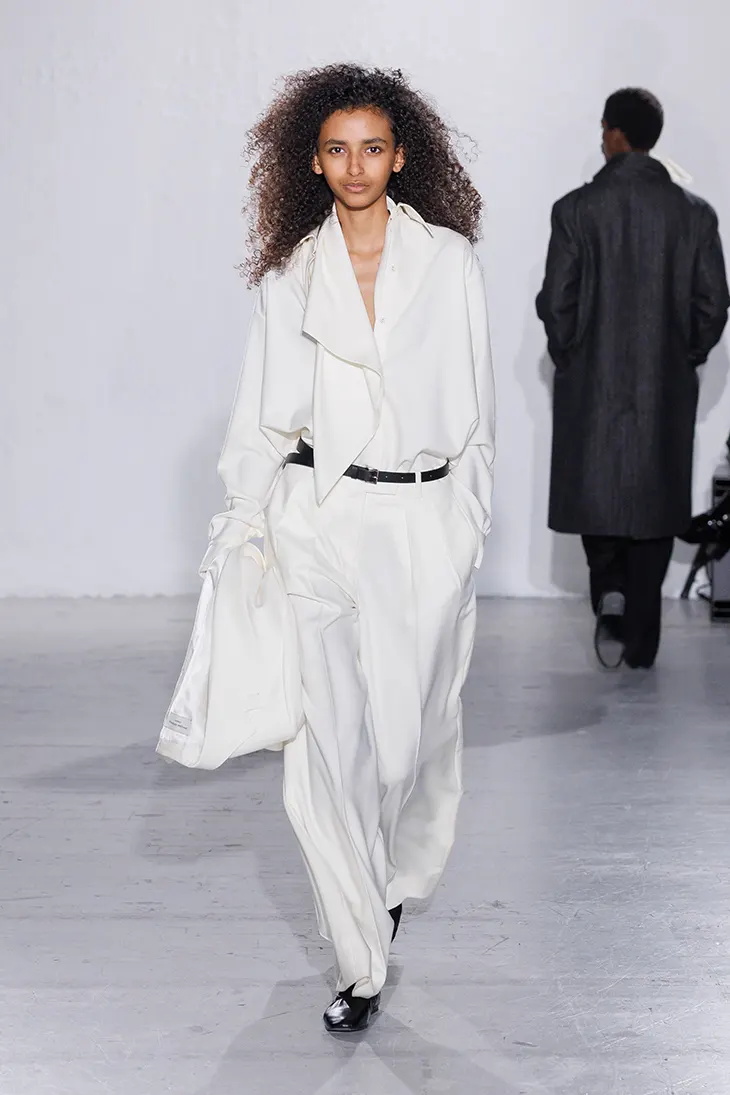
Pierre Mahéo staged his Officine Générale Fall Winter 2026 collection inside the halls of École Duperré, one of Paris’s most storied institutions for applied arts and fashion education. The venue choice was deliberate, almost autobiographical. Founded in 1864 by Élisa Lemonnier, a pioneering advocate for women’s vocational training in France, the school represents exactly what Mahéo sought to communicate this season: the value of foundations, technique, and the transmission of craft knowledge.
Where last June’s “Pariviera” collection imagined an escapist gateway on Parisian asphalt, FW26 pivots sharply inward. Mahéo describes it as a response to “the complex times we are living through,” though he stops short of political commentary. Instead, he frames the collection through the lens of education: rules, grammar, method. The building blocks that inform instinct throughout an entire career.
Palette of Restraint
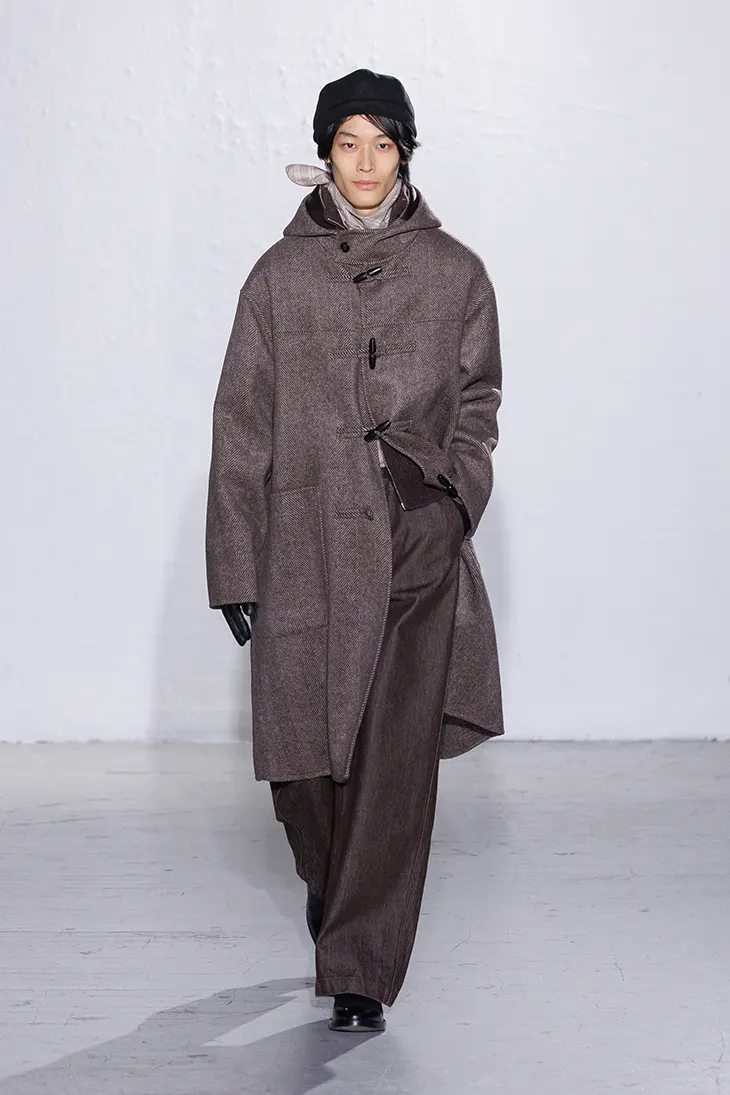
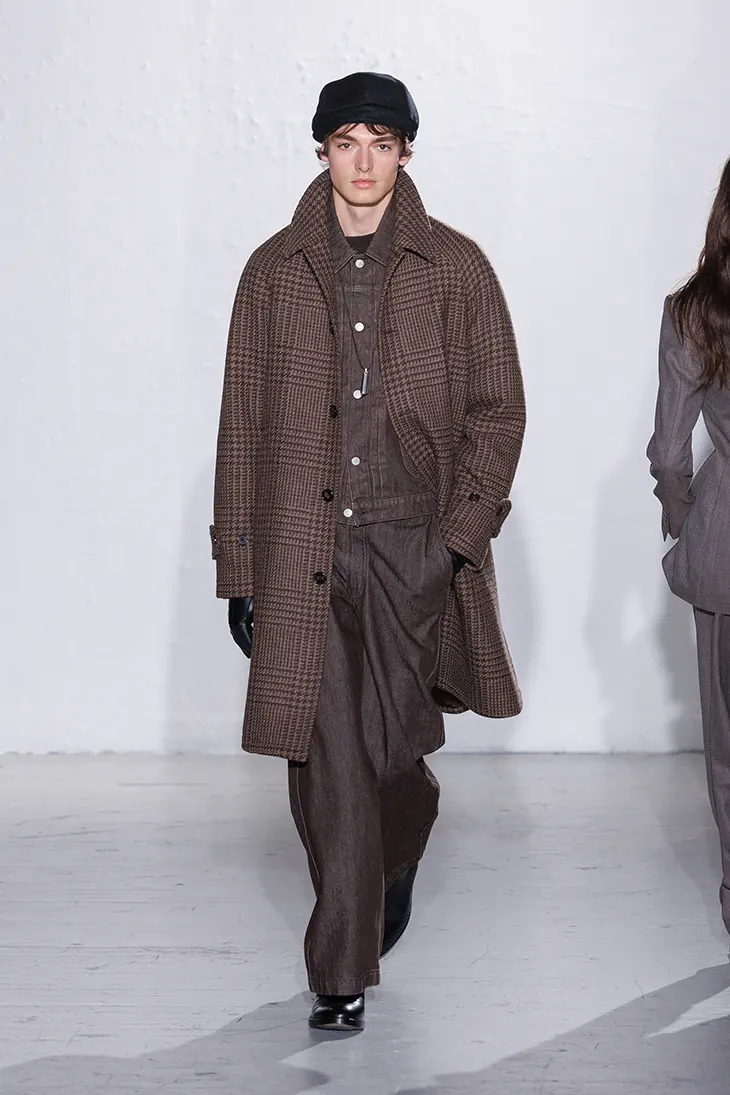
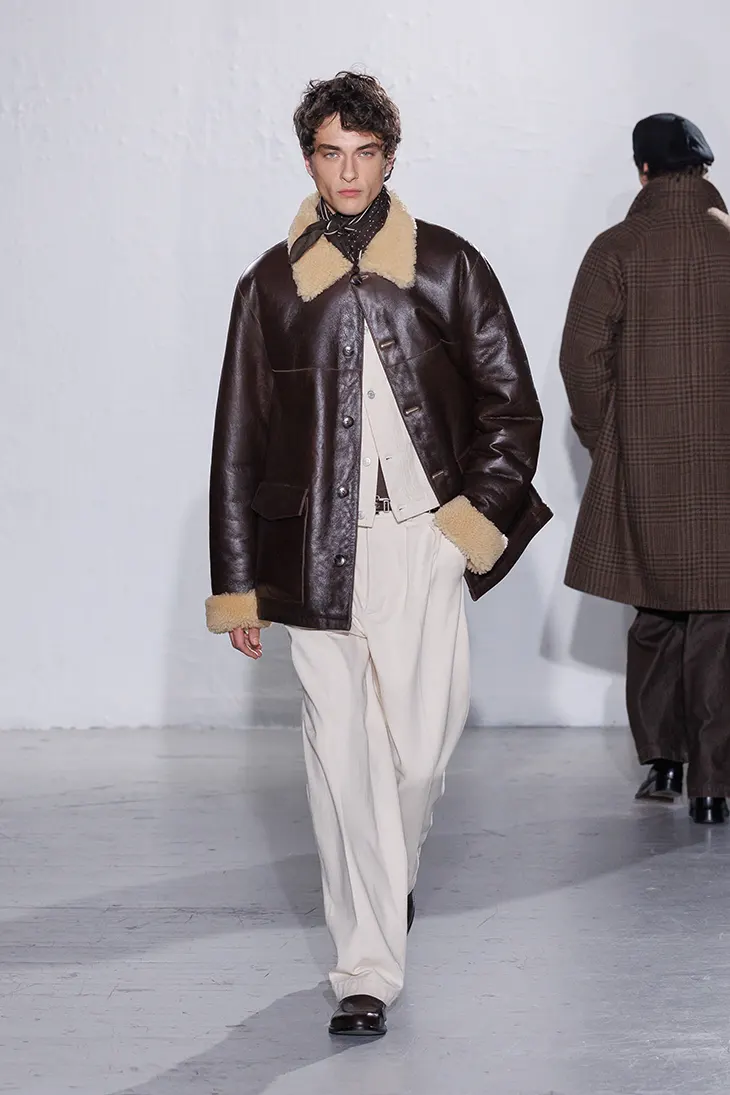
The color story reads like a masterclass in tonal discipline. Mahéo narrowed his range to what he calls his “preferred color tones, which are not primary colors.” Browns dominate, from warm chocolate to cooler taupe, punctuated by charcoal greys and soft cream. Look 05 exemplifies this approach: a Prince of Wales check overcoat in brown and rust tones worn over a matching denim jacket and wide-leg trousers. The monochromatic layering creates depth without visual noise.
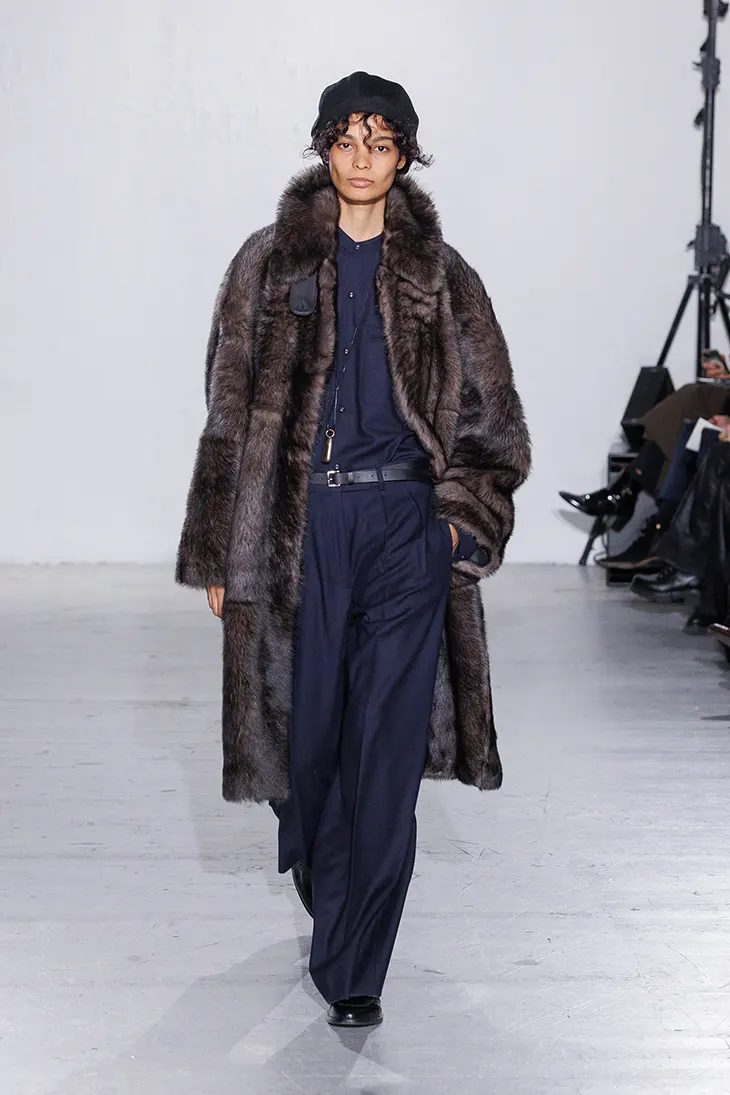
Look 02 continues the theme with a herringbone coat in oatmeal over a charcoal zip-front knit and dark trousers. The silhouette is generous but controlled, with dropped shoulders and a relaxed fit that never tips into sloppiness. Black leather gloves and a soft cap add utilitarian punctuation.
Tailoring Without Pretense
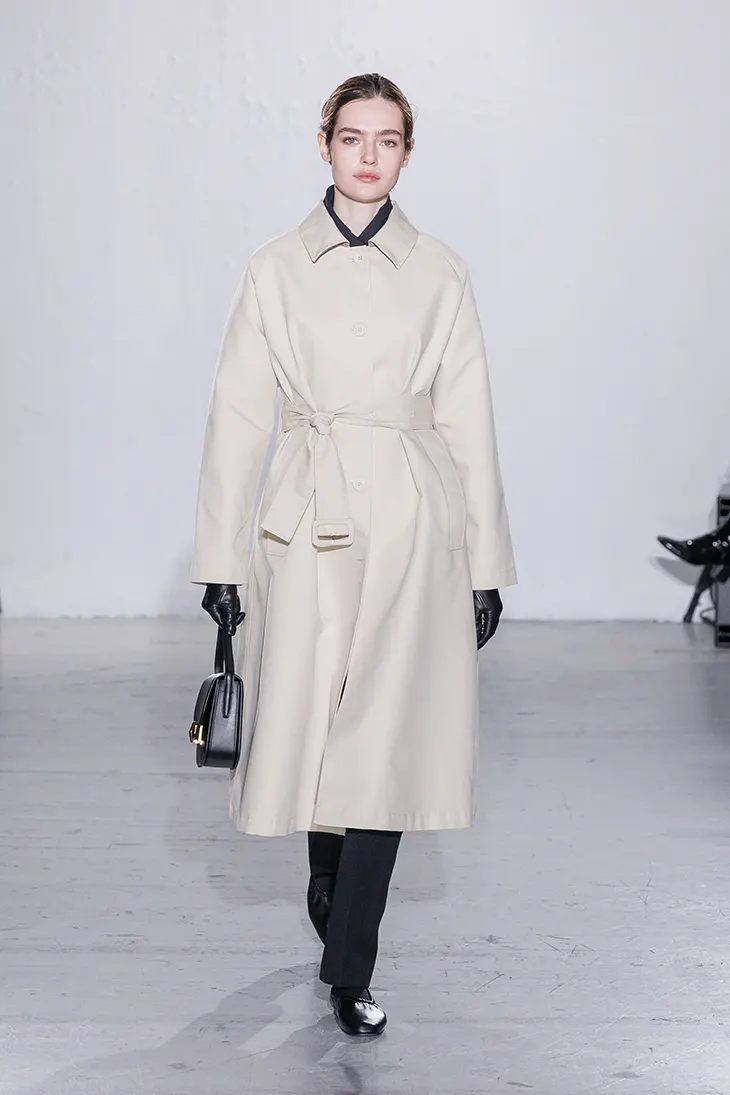
The womenswear offerings demonstrate Mahéo’s commitment to gender-fluid design principles without forcing the conversation. Look 04 presents a double-breasted grey suit with peak lapels, worn over a cream silk scarf draped at the neck. The proportions are masculine in origin but cut with enough ease to read as effortlessly feminine. The trousers break generously over burgundy leather boots.
This is tailoring stripped of seasonal gimmicks. No extraneous trim, no decorative buttons, no statement hardware. Mahéo explicitly states he “tended to simplify volumes and lines rather than add a finish, a trim, or a seasonal detail.” The result is clothing that feels immediately wearable, designed for actual wardrobes rather than editorial fantasy.
Fabric as Foundation
Material selection carries the collection’s conceptual weight. Light flannels appear in total looks, their soft hand and subtle texture providing visual interest without pattern. Wool satins add a quiet sheen to certain pieces, while cotton poplins ground the shirting. Cashmere appears sparingly, positioned as accent rather than luxury signifier.
The heritage patterns, Prince of Wales checks, herringbone, and stripes, function as vocabulary rather than decoration. These are the building blocks of menswear grammar, deployed with the confidence of someone who understands their origins. A scattering of polka dots provides the collection’s only moment of playfulness, and even these feel restrained.
École Duperré Connection
The venue deserves deeper consideration. École Duperré began as a school for young women learning dressmaking and applied arts, becoming co-educational in the late 1960s and expanding into graphic design, printing, and broader creative disciplines. Its curriculum emphasizes history, technique, and the craftsmanship connecting fashion to its artisanal roots.
For Mahéo, whose grandfather was a tailor in Brittany, this institutional context resonates personally. Since founding Officine Générale in 2012, he has built a brand predicated on continuity rather than disruption. His clothes are designed to age, to accumulate the marks of time on fabric, to become more personal through wear. The school setting reinforces this philosophy: fashion as learned discipline, not spontaneous expression.
Beyond Preppy Nostalgia
Mahéo explicitly distances this collection from preppy aesthetics, despite the academic setting. “This return to the school benches is by no means a pretext for a preppy turn at Officine Générale, quite the opposite,” he writes in his notes. The distinction matters. Where preppy fashion trades on institutional signifiers, varsity stripes, crests, and collegiate references, Mahéo focuses on the invisible architecture beneath the clothes.
The collection’s strength lies in its refusal to perform. These are not garments created specifically for a runway moment. Mahéo continues his practice of showing actual production pieces, items that will arrive in stores largely unchanged from their catwalk presentation. In an industry increasingly dominated by spectacle and unwearable statement pieces, this commitment to commercial reality feels almost radical.
Casting and Presentation
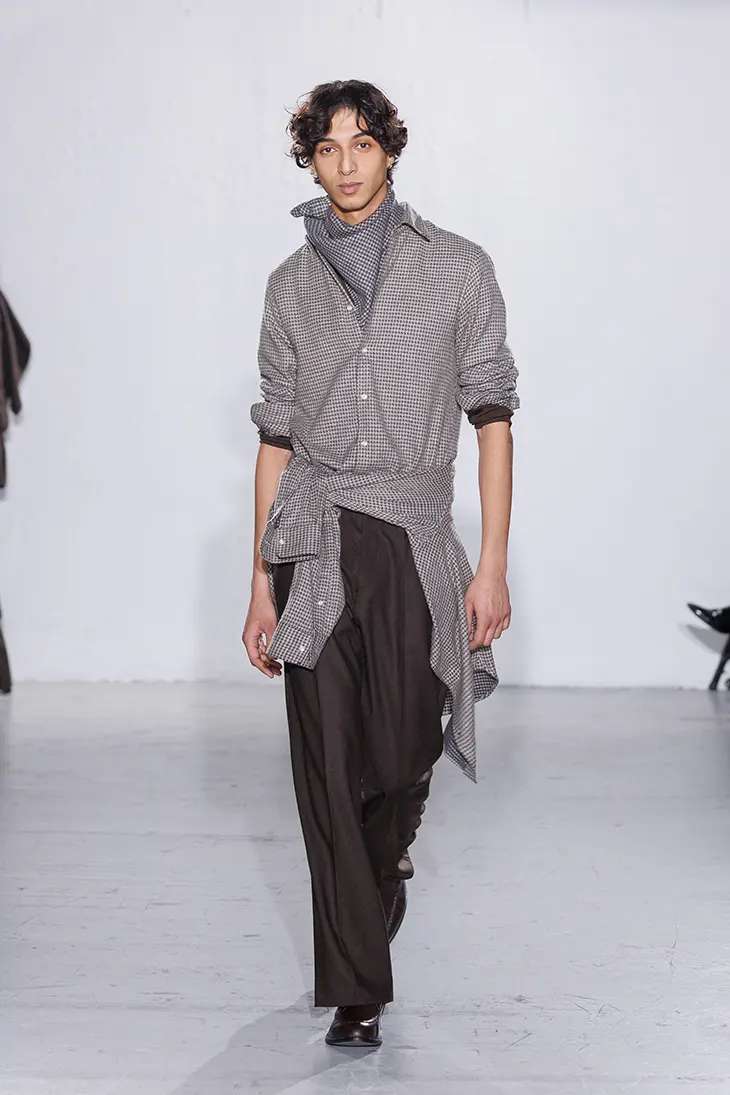
The casting reinforced the collection’s democratic spirit. Models of varying ages walked the concrete floors of the school, their expressions neutral, their gaits unhurried. The styling emphasized accessibility: hair worn naturally, makeup minimal, accessories limited to the aforementioned caps, gloves, and small leather goods.
MORE FROM PARIS FASHION WEEK
The soft black caps appearing throughout the collection deserve mention. Neither beret nor newsboy, they occupy a space between workwear and artistic bohemia. Paired with leather gloves, they suggest a character: the artist, the craftsperson, someone who works with their hands and dresses for function first.
Commercial Considerations
Officine Générale has built significant momentum in recent years, with four US stores and growing wholesale presence. The brand occupies a specific market position: elevated basics for men and women who want quality without logos, luxury without ostentation. This collection reinforces that positioning without attempting to expand it.
The price-to-quality ratio remains the brand’s core proposition. Mahéo sources fabrics carefully and manufactures in Europe, offering construction quality that punches above its price point. For retailers, this collection presents low-risk inventory: timeless pieces in versatile colors that won’t mark down aggressively at season’s end.
Finally, FW26 represents Officine Générale at its most distilled. Mahéo has stripped away anything that might distract from the fundamentals: proportion, fabric, construction, wearability. The result is a collection that photographs quietly but will perform strongly in stores.
The École Duperré setting provided conceptual framework without overwhelming the clothes. This is fashion as education, as transmission, as respect for the grammar that makes style possible. In an industry often obsessed with the new, Mahéo’s commitment to continuity feels increasingly valuable.
“Remaining faithful to my message is, for me, essential,” he concludes. After fourteen years building Officine Générale, that message has never been clearer.
Discover more of the Officine Generale collection in our gallery: