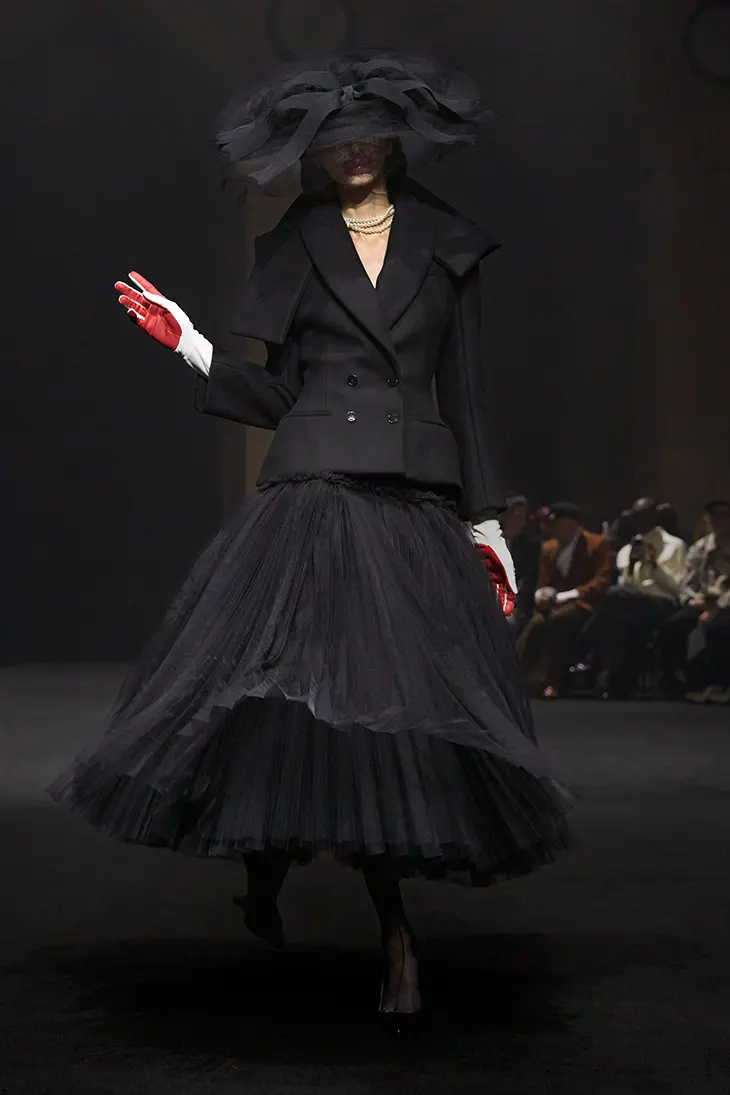



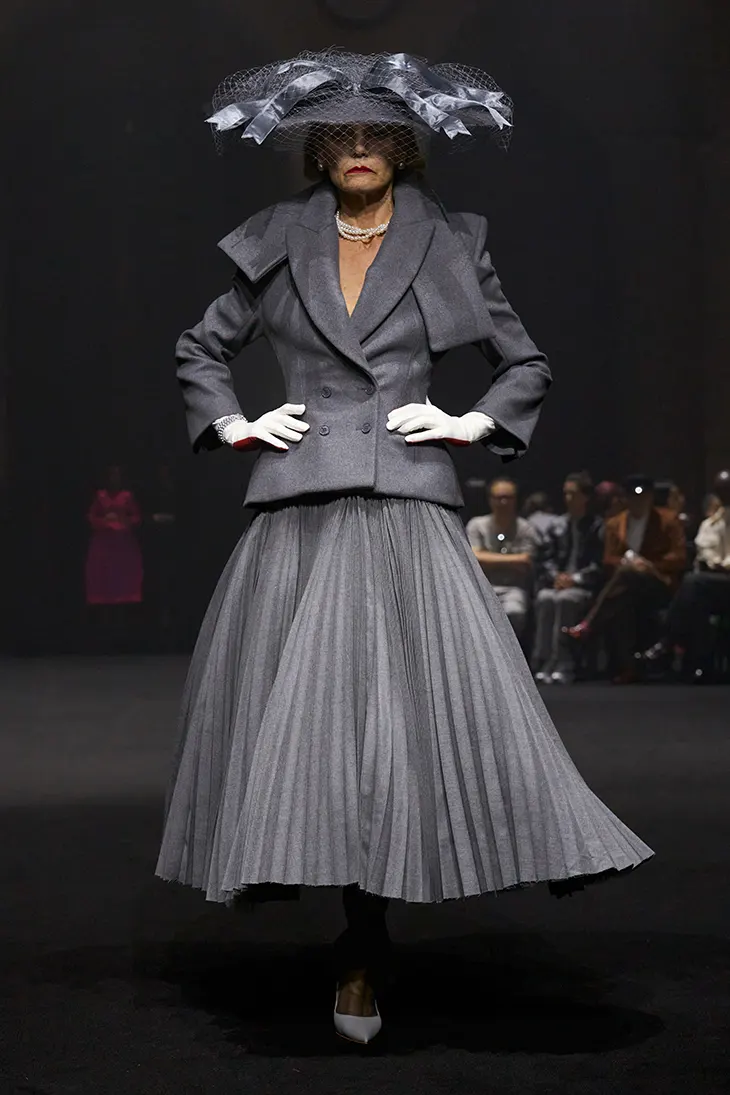
Matières Fécales Fall Winter 2026, titled The One Percent and designed by Hannah Rose Dalton and Steven Raj Bhaskaran, examines power and the ways it shapes everyday life. The designers approach the subject through personal experience and memory. One grew up in Cartierville, one of Montréal’s poorest neighborhoods. The other grew up in Westmount, the city’s wealthiest district. Their childhoods unfolded within sharply different environments shaped by contrasting access to resources, education, and privilege. One attended public school, the other private. Differences in race and circumstance shaped their early understanding of opportunity.
FALL WINTER 2026
A childhood memory becomes the starting point of the narrative. Bhaskaran recalls standing at a bus stop during a harsh Canadian winter while his mother held grocery bags. A sports car stopped at a nearby traffic light. Through tinted windows he observed a family sitting comfortably inside the vehicle. The moment created a vivid contrast between two forms of daily life. The designers consider the possibility that Dalton might have been in a similar car during her childhood. She argues that comfort within that environment carries its own complications. This exchange informs the collection’s examination of wealth and the codes associated with elite environments.
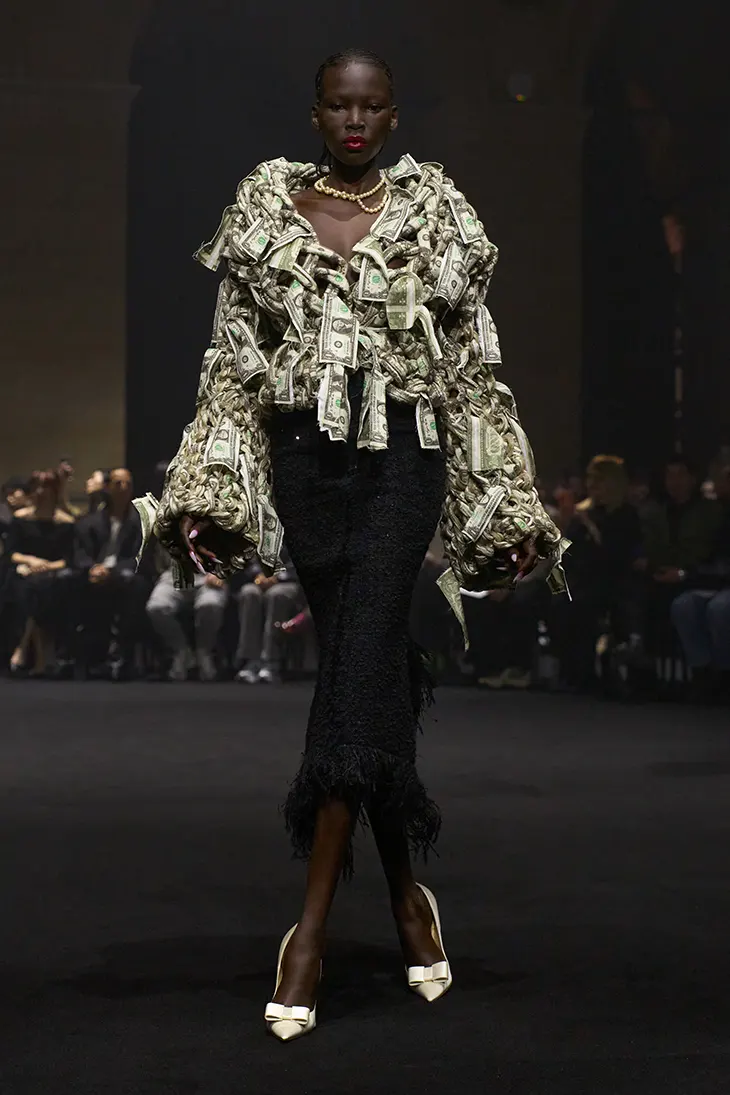
The collection studies luxury as both aspiration and exclusion. Access to wealth can empower individuals while also creating distance from those outside that circle. Matières Fécales organizes the runway into three tableaux that examine different dimensions of power. The first studies archetypes associated with elite identity. The second addresses community. The final sequence considers the future and the individuals who influence it.
The opening tableau introduces the bourgeois family. This sequence interprets high-class attire through the designers’ distorted vision of glamour. The looks question ideals of beauty and expose emotional coldness linked with elitism. Dalton and Bhaskaran refer to their reinterpretation as a “Fecalized” New Look. White lamb leather couture opera gloves titled Guilt Gloves feature red palms and accompany new heels created with Louboutin. The gloves express vulnerability and fear associated with positions of influence. A billionaire figure appears in a severe cashmere shoulder cape defined by a cross symbol pocket opening. Mille-feuille skirts incorporate built-in hip extensions and elastic cutouts, expressing the label’s Prêt à Couture concept.
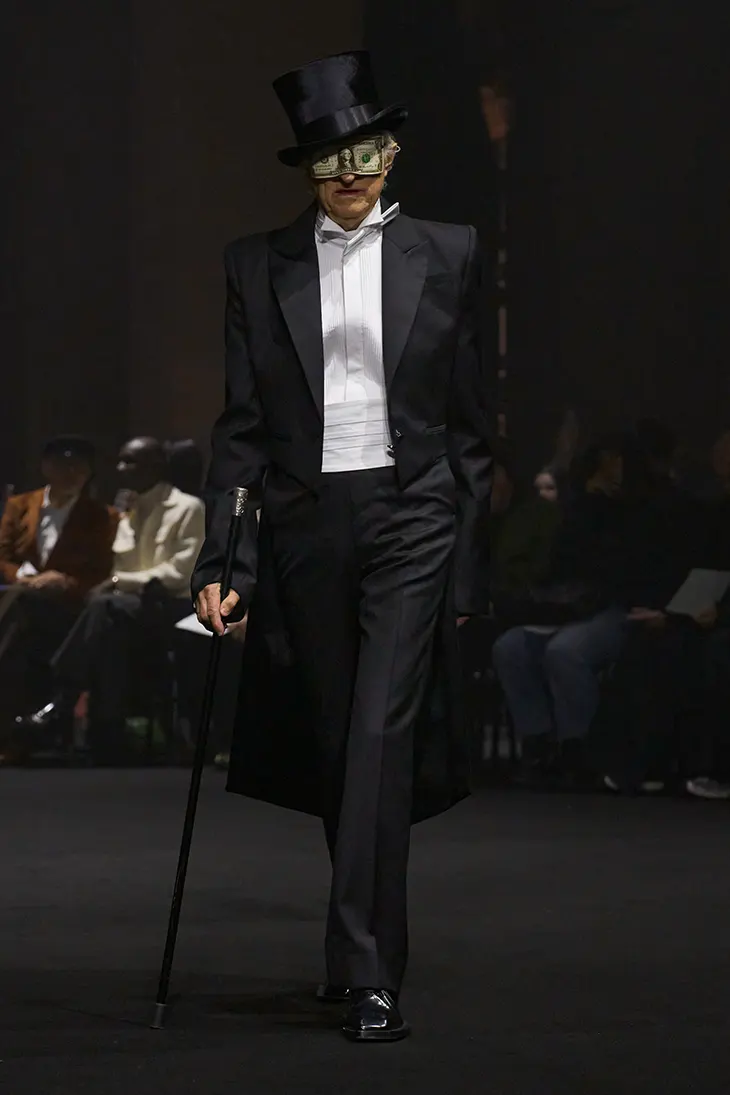
Masks that obscure vision accompany luxcore daywear. The designers select materials associated with luxury clothing. Wrap coats appear in double-faced cashmere. Tailoring includes Prince of Wales fabric sourced from Manchester. Tweed sets produced in France feature a custom déchirer treatment. The tableau concludes with oversized bow ball gowns worn by women recovering from cosmetic procedures. The designers address the physical aftermath of surgery pursued in the search for idealized beauty. Alexis Stone appears in this sequence, bringing realism connected to her own engagement with transformation.
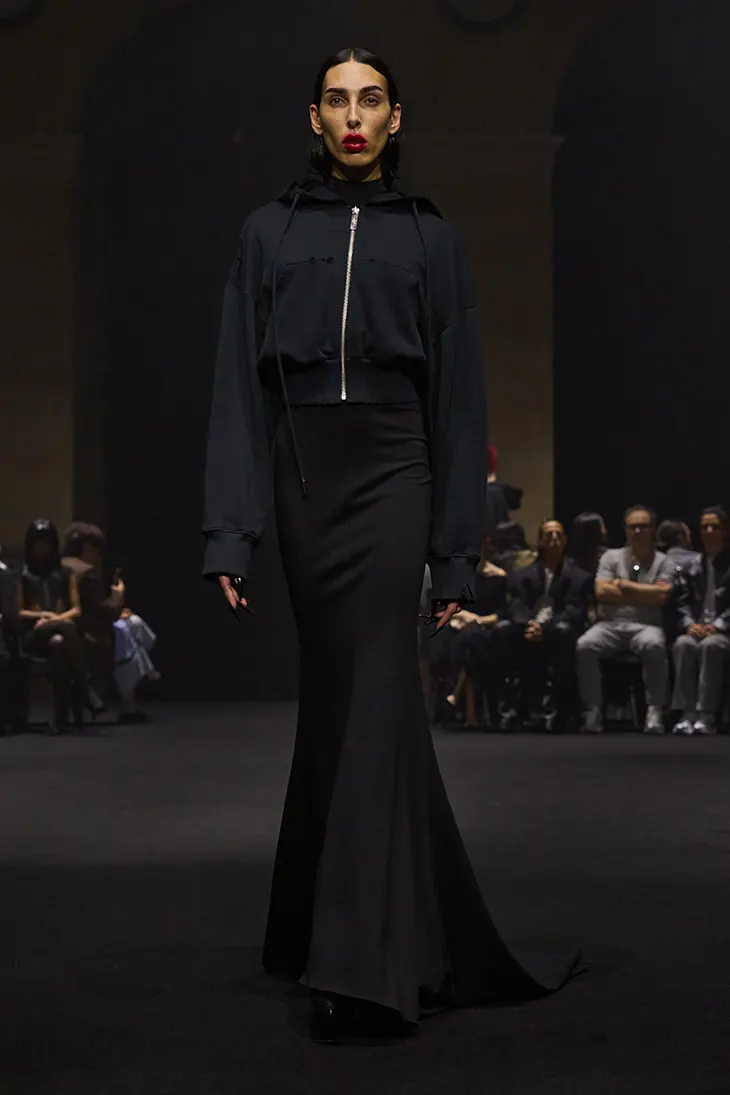
The second tableau examines the strength of community. Since their Paris debut last year, observers often describe Matières Fécales as a cult brand due to its devoted supporters. Dalton and Bhaskaran translate that relationship into clothing worn by friends and collaborators. Jersey hoodie capes with extended kangaroo pockets introduce silhouettes shaped by comfort and collective identity.
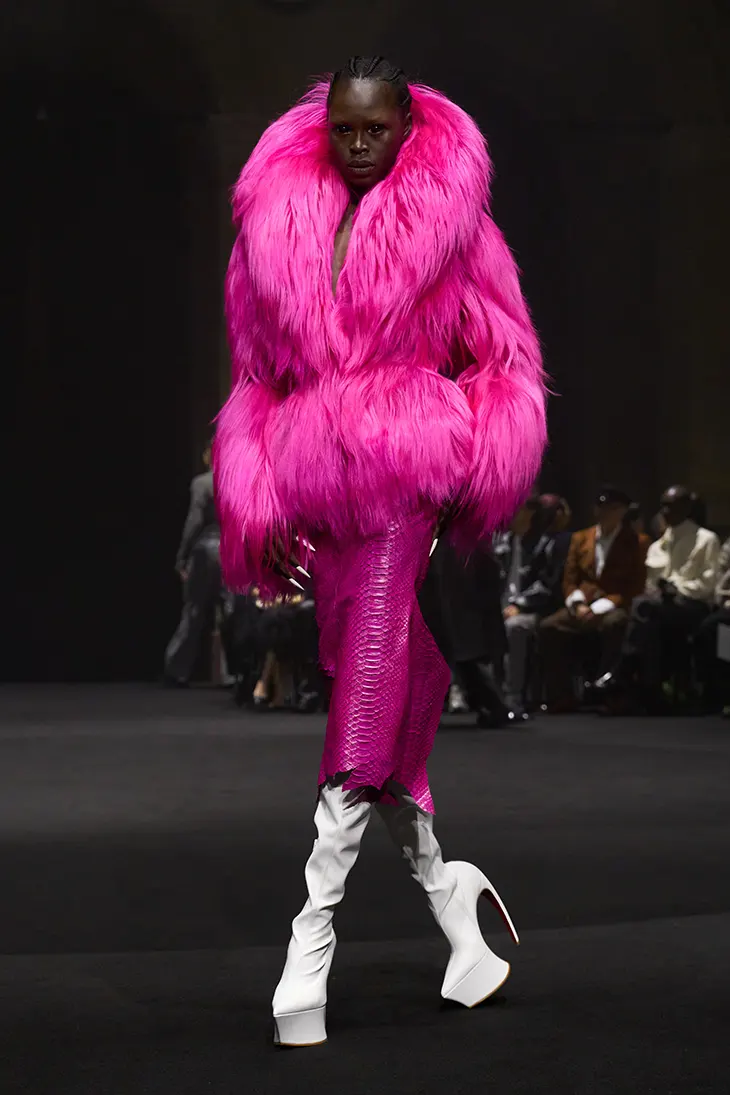
The final tableau introduces figures connected with longevity and time. Dalton leads The Immortals wearing an albino python cocoon skirt suit paired with heelless skin boots that extend from her legs. The designers reference individuals who pursue extended life through scientific research. Bryan Johnson represents that pursuit through his focus on internal health and life extension. The tableau also includes Michèle Lamy, presented as a figure who moves through time with confidence. She appears in a gown constructed from ash grey goat fur sleeves and distorted wool knit.
The collection also returns to a project first developed twelve years earlier during fashion school. Their mentor Milan Tanedjikov asked students to imagine fashion in 2026. Dalton and Bhaskaran titled their proposal The One Percent. The Fall Winter 2026 collection continues that concept. Tanedjikov attends the show as a guest in the front row. Debra Shaw closes the runway wearing the same silhouette originally drawn for that early project, a reinterpretation of the form associated with an Elizabethan queen.