


For most of the last century, a product’s public life began with a single frame. Someone built a set, lit it, styled it, and photographed the object at its most persuasive angle. That image did everything, created the desire, established the world, told you what kind of person owned this thing. It still does a great deal, but it no longer works alone. A chair now exists as a campaign shot, a cropped product view, a social clip, a rotating asset, a showroom object, and increasingly as something you can stand in your own living room and walk around. The product image has stopped being a frame and become a system.
The campaign image creates desire
Nothing has replaced what editorial imagery does best, and it’s worth being clear about that before discussing what comes after it.
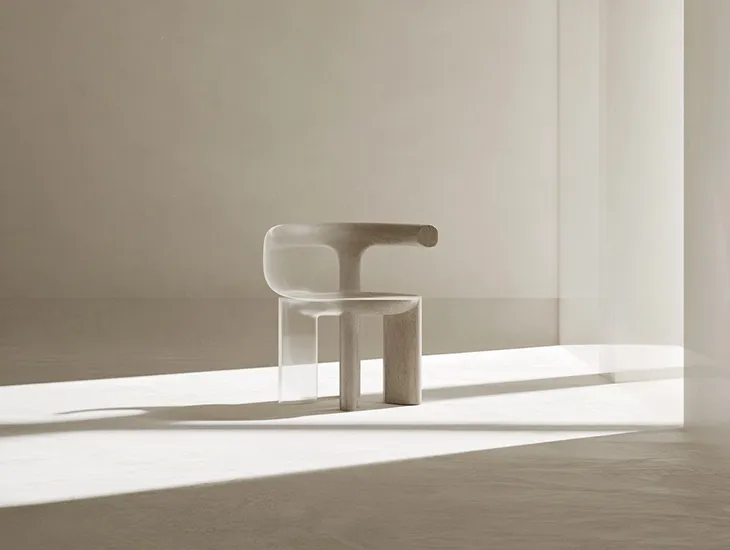
A campaign frame is an argument about atmosphere. The set design, the styling, the light, the way a composition holds a single object at its centre, all of it works to make you want something before you’ve assessed whether you need it. Fashion has understood this longest, but design brands have absorbed the same grammar. A lamp photographed in a particular kind of room is telling you about a life, not a light source.
That work is emotional and it happens quickly. What it doesn’t do is answer practical questions, and it was never supposed to. Desire and information are different jobs.
The product page asks for detail
The moment someone moves from wanting to considering, the questions change entirely. How large is it. What is that surface actually made of. Does the finish read warm or cool. What does the back look like. Which of the four variants is the one in the photograph.
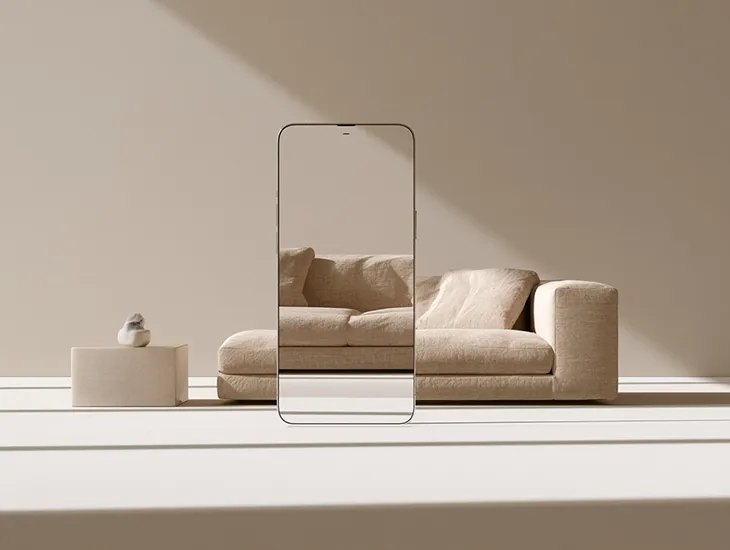
A product page has to speak a different visual language to answer those, close-ups that hold up under scrutiny, honest material detail, scale references, rotating views. For design-led categories where scale, material, and placement change how an object is perceived, AR product visualization gives brands a way to move beyond the static product image and let customers preview furniture, lighting, appliances, décor, windows, or doors in their own environment.
Which is a meaningful shift in what an image is being asked to do. The campaign frame asks how does this look. The AR preview asks where does this belong, and that’s a question no photograph has ever been able to answer.
The room becomes part of the product
Anyone who works in interiors knows that furniture is never fully understood in isolation. An object’s proportions are relative. A cabinet that reads as elegant in a photographer’s studio can read as heavy against a low ceiling. A pale oak table looks like a different piece entirely on dark floorboards.
This is the awkward truth at the centre of selling design objects online: the product isn’t really the product. The product plus the room is the product. A sculptural chair positioned in a spare, high-ceilinged apartment is a different proposition from the same chair in a Victorian terrace with patterned wallpaper, and the buyer, not the brand, owns the second half of that equation.
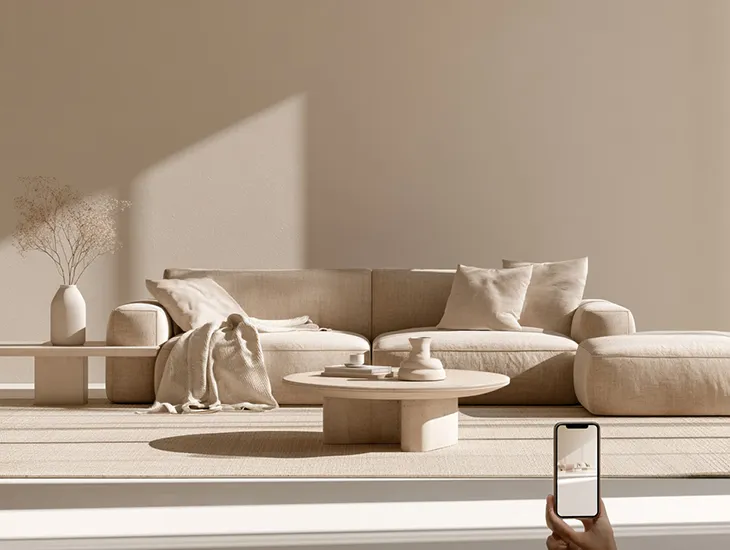
AR closes the gap by handing the object over to the buyer’s own context. Their light, their floor, their ceiling height, their existing furniture standing a metre away. Placement stops being an act of imagination and becomes something you can look at.
The virtual showroom becomes a brand space
The same assets that make a product previewable also make it presentable without a building.
Physical showrooms are expensive, geographically limited, and constrained by what will fit inside them. A digital showroom carries no such limits, a full collection, every colourway, at any scale, available simultaneously in Milan and Seoul and wherever a buyer happens to be sitting. Interactive catalogues extend this further. Product launches can happen to a global audience on the day of announcement rather than the day the pieces arrive by freight.
For design brands, the interesting part isn’t the logistics. It’s that a virtual showroom is a curated space, which means it’s a creative brief. How a collection is arranged, lit, and moved through says as much about a brand as a physical space would. The best of these feel authored. The weakest feel like a folder of models on a white plane.
AR still needs creative direction
Which leads to the caveat, and it matters. Technology without taste weakens the experience it was meant to improve.
Not every product needs AR, and building it for objects where placement isn’t the question is effort spent on novelty. Where it is warranted, the asset has to be right: proportions accurate to the millimetre, because an AR preview that misrepresents scale actively misleads. Materials have to behave credibly, a fabric that reads as plastic under a phone’s rendering pipeline undermines the very quality the brand is selling. Lighting has to respond to the real environment rather than sitting flatly on top of it.
And the whole thing has to belong to the brand‘s visual world. An AR model that looks like a generic 3D object dropped into a room, when every other touchpoint has been carefully art-directed, creates a discontinuity a design-literate customer will notice immediately. The digital asset deserves the same attention as the campaign image, because for many customers it is the campaign image.
The product image becomes an experience
What’s emerging is less a replacement than an expansion. A single object now moves through a sequence of visual states, the editorial frame that creates the want, the rendered asset that serves the catalogue, the product-page detail that answers the doubt, the interactive model that lets someone turn it over, the AR preview that places it, the social clip that circulates it, the showroom object that presents it in company.
The brands doing this well aren’t treating those as separate deliverables handled by separate teams. They’re treating them as one visual language expressed in different registers, the same material honesty, the same lighting sensibility, the same restraint or exuberance, carried across every state the object appears in. Consistency across that sequence is becoming a design discipline in its own right.
Finally, AR isn’t retiring the product image. It’s extending it into a place photography could never reach, the buyer’s own room, at their own scale, under their own light. The campaign frame will keep doing what it has always done, which is to make people want things. What’s changed is that the wanting can now be followed, immediately, by the seeing. For design-led brands, that’s less a technical upgrade than a new surface to art-direct, and the ones who treat it that way will be the ones whose digital objects feel like they came from somewhere.