



The fashion world mourns today as Valentino Garavani, the legendary Italian couturier who single-handedly elevated Italian fashion to global prominence, has died at his Roman residence surrounded by loved ones. He was 93 years old.
Singular Vision That Shaped Modern Glamour
Valentino Garavani was not merely a designer; he was an architect of dreams, a craftsman of desire, and the last true emperor of haute couture. His passing marks the end of an era when fashion was synonymous with uncompromising elegance, meticulous craftsmanship, and an almost religious devotion to making women feel beautiful.
“I know what women want. They want to be beautiful,” Valentino once declared with characteristic simplicity. This philosophy, unwavering across six decades of creative output, produced some of the most memorable gowns in fashion history. His signature Valentino Red became as recognizable as any corporate logo, yet infinitely more romantic.
From Voghera to Via Condotti: The Making of a Legend
Born on May 11, 1932, in the quiet Lombardy town of Voghera, Valentino demonstrated an early fascination with fashion that would prove prophetic. At 17, he departed for Paris to study at the École des Beaux-Arts and the Chambre Syndicale de la Couture, absorbing the traditions of French haute couture that would later inform his distinctly Italian interpretation of elegance.
Returning to Rome in 1959, he established his atelier on Via Condotti, and by 1960, the House of Valentino was formally founded alongside his business partner and longtime companion, Giancarlo Giammetti. Their partnership, spanning more than 50 years, would prove as legendary as the designs themselves.
The pivotal moment arrived in 1962 when Valentino closed that year’s edition of Pitti Immagine with a haute couture show that effectively placed Rome and Italy on the international fashion map. While Italian fashion existed before Valentino, his emergence broke the dam that had separated French fashion from its Italian counterpart, projecting both into a shared future of global influence.
The Couturier of First Ladies and Hollywood Royalty
Valentino’s client list reads like a who’s who of 20th-century glamour. His relationship with Jacqueline Kennedy began in 1964 when the former First Lady discovered his work and purchased six couture dresses, wearing them throughout her mourning period for President John F. Kennedy. When she married Aristotle Onassis in 1968, she chose a white Chantilly lace dress with a pleated skirt from Valentino’s celebrated 1967 “white” collection.
Elizabeth Taylor’s love affair with the designer began after she wore a white feather-trimmed Valentino gown to the premiere of Spartacus in 1960. So enchanted was she that she traveled to Rome’s headquarters demanding more pieces, beginning a friendship that would span decades.
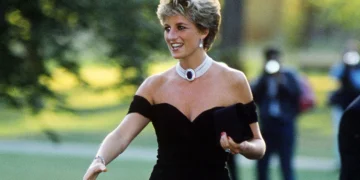
Princess Diana found in Valentino an emotional support designer during tumultuous times, their relationship deepening to the point where she would holiday on his private yacht, T. M. Blue One, seeking refuge from the relentless paparazzi.
Red Carpet Dominance and the Theatre of Clothes
Valentino understood the theatre of clothes like few others. His eveningwear possessed an almost supernatural ability to transform its wearer, creating entrances that seemed to halt time itself. Julia Roberts’s black and white vintage Valentino gown at the 2001 Oscars, worn when she accepted her award for Erin Brockovich, remains one of the most impactful red-carpet moments in Academy history.
Sophia Loren, Jessica Lange, Reese Witherspoon, Cate Blanchett, and Jennifer Lopez represent merely a fraction of the luminaries who reached for Valentino on Oscar night, understanding that however striking the gown, it would never overwhelm them.
A Hero of Two Worlds
What distinguished Valentino from his contemporaries was his mastery of both couture and ready-to-wear, a duality that made him both hieratic and hyper-popular in the collective consciousness. He was the last exponent of a great tradition of Italian couturiers that, from the 1970s onward, was gradually replaced by the masters of prêt-à-porter.
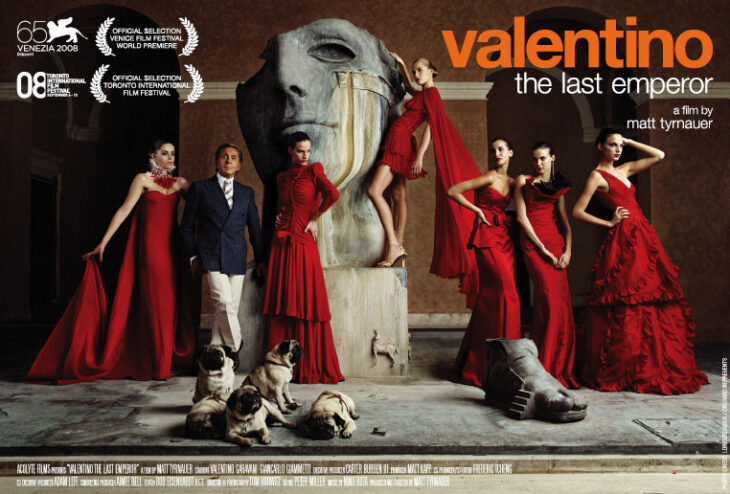
His lifestyle became as iconic as his designs: photographs with Jacqueline Onassis in Capri, castles in France and palaces in Rome, three hundred custom-made suits from Caraceni, waltzes with Elizabeth Taylor. The famous pugs, the yacht where André Leon Talley would visit, the birthday song sung in New York by Aretha Franklin, Placido Domingo, and Bette Midler.
Beyond Fashion: Activism and Cultural Legacy
Despite his natural discretion, Valentino never shied from speaking his mind. His Peace Dress, created during the Gulf War, and his early commitment to the fight against AIDS demonstrated a social conscience that extended beyond the atelier. The establishment of his academy in Rome, dedicated to artistic performances and cultural activities, ensured his influence would transcend fashion.
Donna Sotto le Stelle, the dazzling summer kermesse that saw the couturier parade on the steps of Trinità de’ Monti in Rome alongside other Italian fashion luminaries, remains silkscreened in the memories of at least two generations of Italians.
The Final Bow and Continuing Legacy
When Valentino retired in 2008 with a swansong show at Paris’s Musée Rodin featuring Claudia Schiffer, Shalom Harlow, and Naomi Campbell, he left having rigorously preserved the traditions of couture while remaining in creative control of his own house.
The brand continues under Alessandro Michele, who presented his debut collection in January 2025, following the lauded tenure of Pierpaolo Piccioli. Both were hand-picked successors, yet as any observer would acknowledge, only Valentino was Valentino.
In an era of disposable trends and disposable clothing, his consummate skill as a brand builder left behind a legacy that serves as a lesson: listen to your heart, stay true to your vision, and never falter. As one tribute eloquently noted, suddenly the world feels underdressed.
Valentino Garavani is survived by his partner of more than six decades, Giancarlo Giammetti. The fashion world has lost its last emperor, but his vision of beauty, elegance, and uncompromising craftsmanship will endure for generations to come.