


Emmy-nominated production designer Sara K White has built a career in film and television creating environments where space reveals character and emotion. With a background in interior design and creative writing, she has taken on projects ranging from everyday domestic scenes to tense psychological drama, earning an Emmy nomination for The Flight Attendant. Her practice focuses on translating character, power, and emotion into physical settings that support performance and narrative.
EXCLUSIVE INTERVIEWS
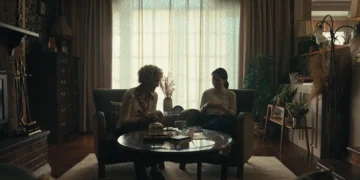
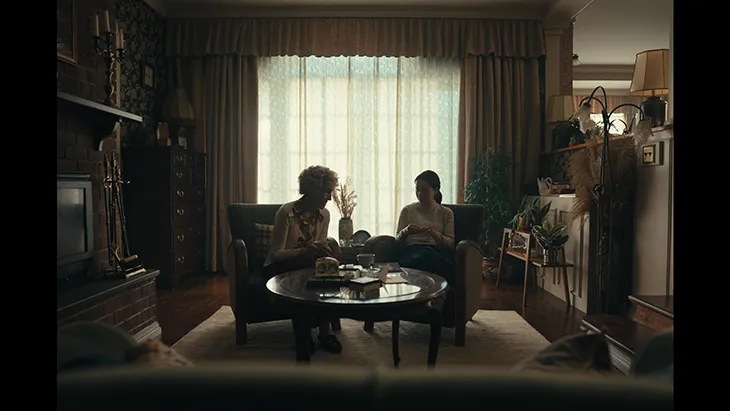
White’s latest project is Ponies, a spy thriller set in 1977 Moscow, starring Emilia Clarke and Haley Lu Richardson. The series follows two American embassy secretaries who become entangled in Cold War espionage after their husbands’ deaths. For Ponies, White developed a visual language rooted in research across Russian art, architecture, and domestic design, rejecting the familiar desaturated Cold War aesthetic in favor of color, pattern, and material contrast.
In a DSCENE Magazine exclusive interview with our editor Ana Markovic, White discusses her approach to using space as a storytelling tool, from designing technically complex institutional interiors to embedding narrative cues in everyday objects and domestic layouts. She reflects on working within Budapest’s architectural landmarks, engineering the CIA’s “Bubble,” and using design to communicate power, gender, and surveillance without overt signals.
Read our full interview below:
You began your career with a background in interior design. What first drew you to production design, and how did that training shape the way you approach space in a narrative context?
I’ve always been drawn to the way people connect with spaces. When I was a kid, the most exciting part of playing with any dolls was making their apartment. In college, studying for interior design, it was the client briefs that were central to determining the shape and look of a space. I minored in creative writing as well – so story was always foregrounded for me. But sadly, real world clients were not as interested in sharing their life history and subconscious biases as I’d hoped.
I stumbled into Production Design through a group of friends and rediscovered that sense of play and creativity – and was also thrilled to be able to design environments for a range of clients not offered at the firm. Some shows let you time travel, design for mermaids and ghosts, or to flesh out the world of a single mother struggling to feed her kids, someone who never could have called an interior designer to help plan out her space. That part has been very gratifying.
Across projects like Mrs. Fletcher, Swarm, and The Flight Attendant, you’ve worked with domestic realism, psychological tension, and layered interior worlds. How have those different approaches shaped the way you now think about atmosphere and storytelling through space?
I try to make sure every show opens up a new world to me – be it the style of the physical spaces or the kinds of tension I’m helping to convey. With each project, I’m hoping my pencil gets a bit sharper because I’m practicing seeing the script through different eyes than mine – both the characters and the audience. It’s allowed me to lead with the emotion of a scene first, more than I did when I started my career.
When starting a new project, what do you look for in a script to understand how space should behave, and when Ponies came to you, what immediately stood out as the primary design challenge?
I’m always conscious of the tone of a project and a character’s journey. The way space and color will expand and contract around those elements has to be informed by it. With PONIES, what was so special was the lightness and irreverence shown to the heavy political landscape of the Cold War in Moscow. Immediately, I knew we were going to be working with color to pull that in front of the viewer.
Beyond that, trying to capture Moscow in the 70s in present-day Budapest – well, I knew that was going to challenge me at every level. The locations available were incredible, but having the right research and learning the Hungarian system provided very real challenges for each design we brought to life.
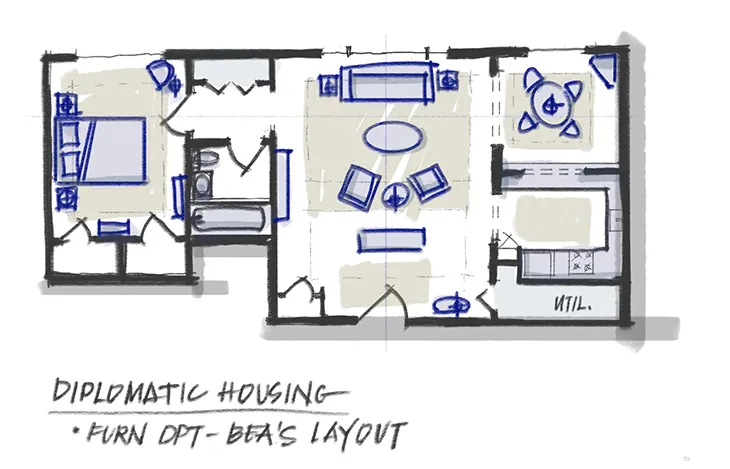
With the series set in 1977 Moscow, what visual questions guided your approach, and what references or research ultimately informed your decisions around color, pattern, and the espionage tone of the sets?
I was lucky to have a few months in New York before I left to research the era and region. I spent weeks at the New York Public Library looking at photo essays of Moscow, researching Russia’s artistic heritage and learning about the socio-political forces that were pushing and pulling on the country at the time.
The 1975 edition of “Moscow” by Yuri Balanenko was hugely informative, as well as some vintage home movies compiled on YouTube by the Archival Footage Service. I also watched many Russian-made films that were popular in the era to look for the little details – films like “Autumn Marathon,” which was notable for the lack of propagandist push when showing the life of the characters.
These references gave me bold, even primary-leaning, colors. Armed with that veracity, Susanna, David and Anastasia and I felt confident adding chroma back into the Cold War aesthetics. So often the world of the Cold War and the Disco 70s don’t overlap, but they truly were happening at the same time, and we wanted to see it come alive!
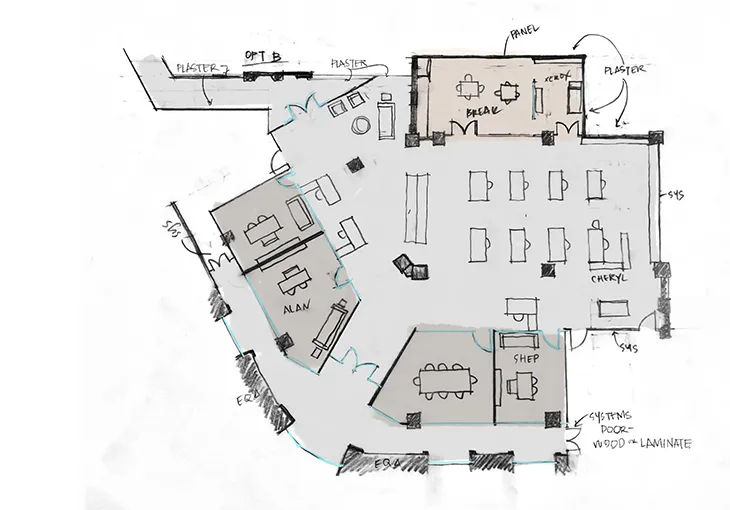
The production design includes both Soviet interiors and American institutional spaces, including the American Embassy with its layered structure. How did you approach visual continuity and contrast between these environments, and what role did material choices play in defining their differences?
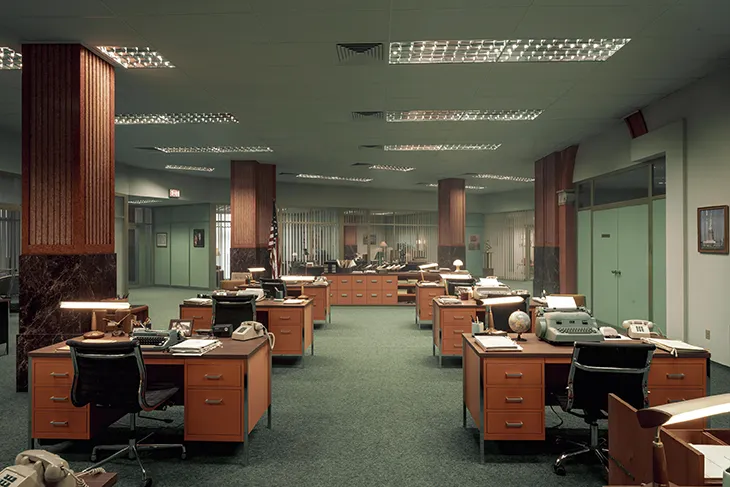
It was important to me that everyone in the American Embassy office felt surrounded by Russia, intruding on them at every possible turn. The Russian building that houses the Embassy asserts itself in every space – the columns punctuating the office floor, the fireplace peaking out of the wall, the heavy structure that shrank the space in the CIA office.
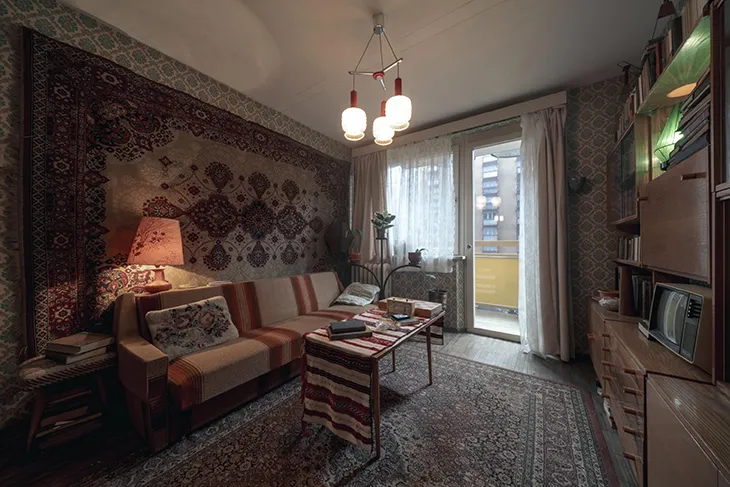
It was only in the apartments where the real “open plan” layout that was popular in America at the time was able to be purely expressed. That was contrasted heavily by the apartments of our Soviet characters, Sasha and Andrei, which are small and constantly bisected by walls and doors.
With materials, I was inspired by the locations we were finding and selecting – certain materials, including certain red-toned marbles, showed up again and again in our “Russian” spaces, so it became a great touchstone for us. Whenever it shows up in an American space, you can be sure Russia’s there.
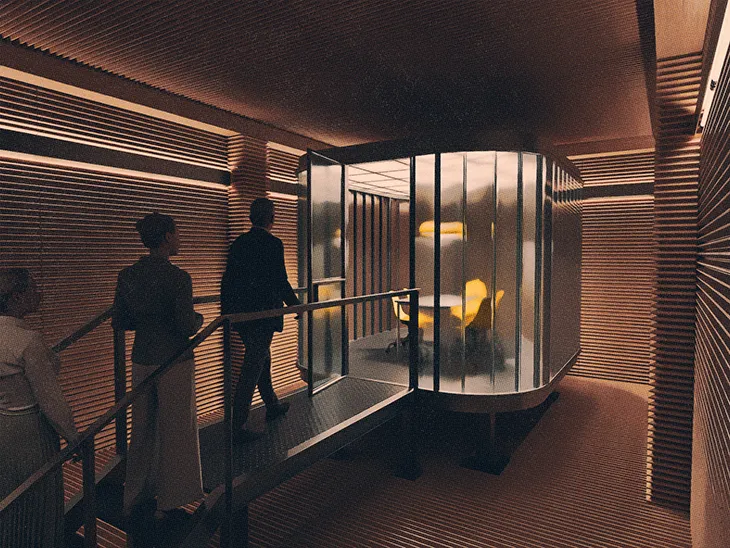
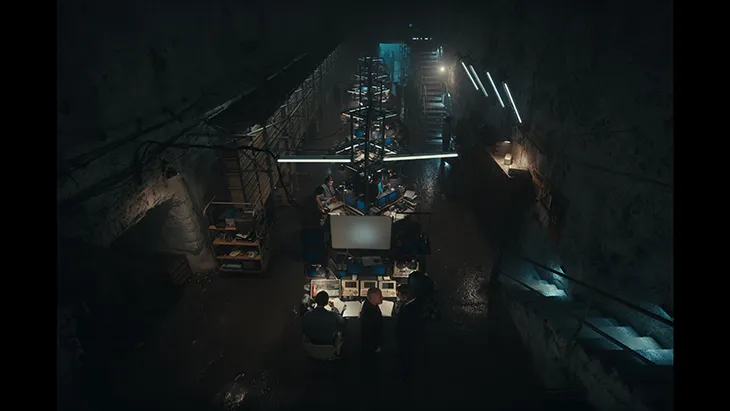
The CIA “Bubble” became one of the most complex sets in the series. What was the initial concept for that space, and how did sound control influence its overall form?
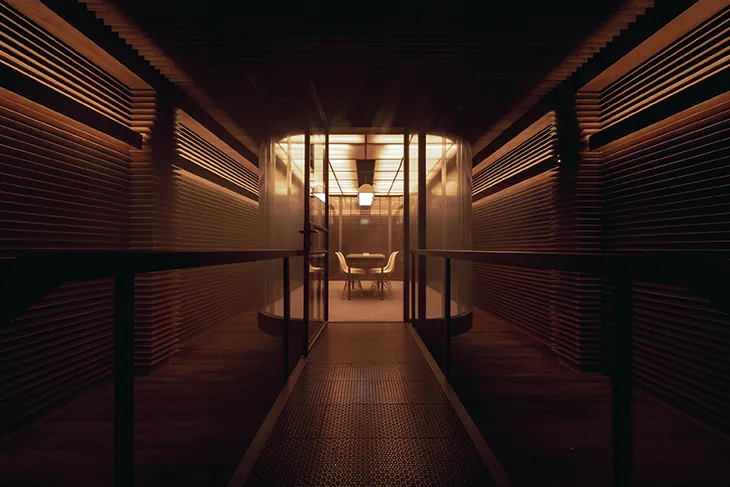
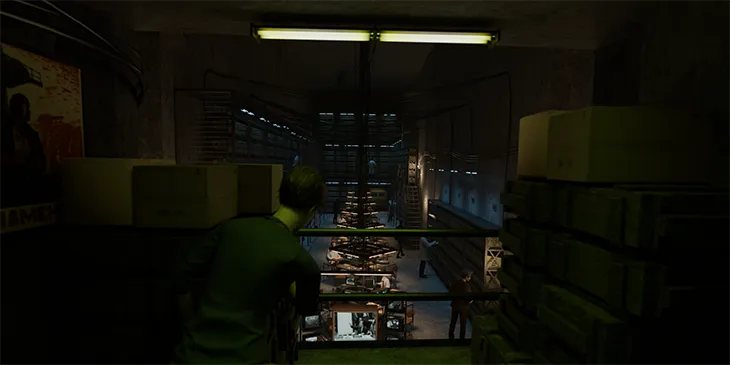
The basis for the design stemmed from one sentence in a research book from our showrunner, David Iserson, that simply said it was a secure glass room, set up above the floor. Frankly, it’s a space we’ve seen in many films, so we had to run through a few iterations to find something that really felt unique and specific to our region and era.
I pulled again from materials and shapes that I found in the historic architecture in the region, which convinced me to use ferrous channel glass for the bubble walls. We researched recording studios of the era, the wood baffles were inspired by those. And the bubble itself was balanced on large rubber feet to help mitigate any sound transmission between the steel and the concrete floor.
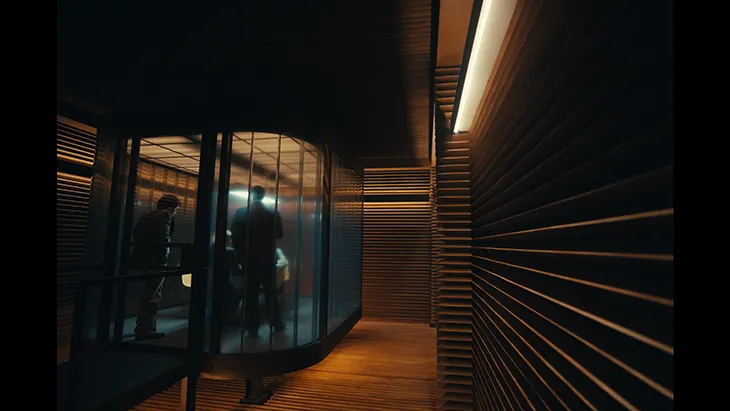
The build involved pyramid-shaped sound baffles, curved steel framing, custom plexiglass, and removable sections for the camera. What were the biggest challenges in translating that design into a working set?
The size of the plexiglass we needed for our channels was very difficult to come by, it took us weeks to find a vendor who had the materials and the capacity to heat and bend the elements the way we needed. In order to get the subtle green tint of the ferrous glass, and to control the reflections we were getting of the plexi, we had to apply a film to each layer of glass. Getting those films to lay perfectly and hitting exactly the right color was not an easy task.
In our concept art during design development, the pyramid baffles were visually striking, but figuring out how to make them and create a workable set around them was a challenge. We ended up making the baffles on the walls and ceiling out of foam and sealing and scenic’ing them to match the warm wood tone. The baffles on the floor were made from hard wood, with sharp points, which were wont to crack the moment anyone put weight on them. To protect them and create pathways, we made padded plywood sheets that we put, soft side down, to disperse the weight of the crew and gear. And then, of course, we had a paint crew running behind each shoot day to make sure any dings were touched up.
It took a lot of engineering and labor to create the space, but I’m so proud of how it turned out.
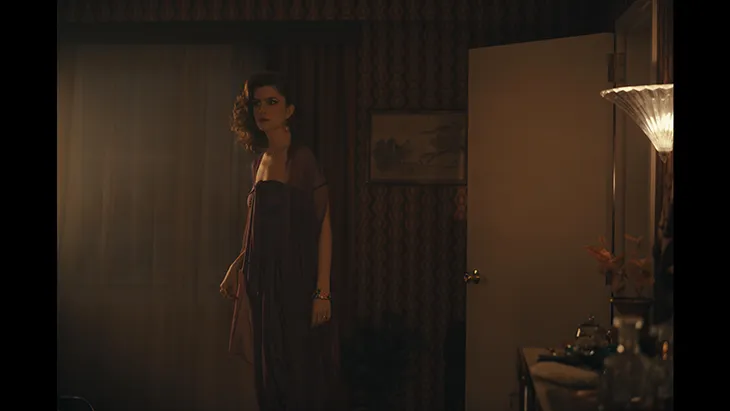
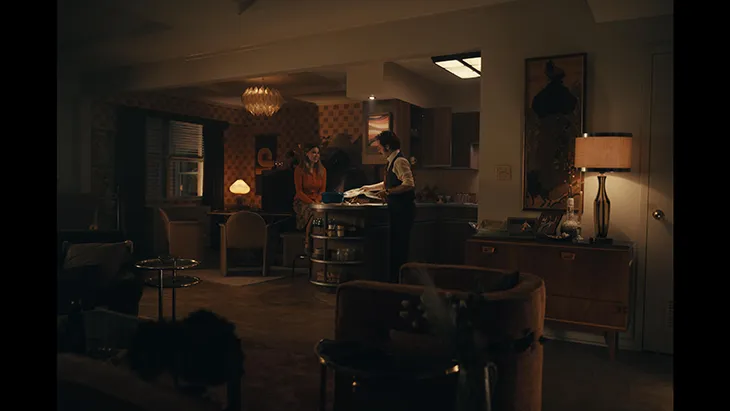
A lot of meaning in Ponies comes through everyday objects and visual detail, from custom-built furniture and appliances to bolder decorative elements. How did those choices help you depict life behind the Iron Curtain while also suggesting character history or relationships without spelling them out?
Some of the most fun I had on this project was going through the hauls my Set Decorator, Panni Lutter, would bring in from the flea markets. Each object she brought to us had a unique design flair that would speak to our characters. A framed needlepoint for Bea, which spoke to her tightly wound nature and lean toward the traditional. A boldly woven natural textile for Twila’s kitchen island that gave us insight into the world she came from.
Creating the lives of our characters was all about layering those unique elements into the bigger furnishings that spoke more clearly to the period. That way, when the audience sees the combination it truly is greater than the sum of it’s parts – no matter how wowed I was by the neon green string lamp in Sasha’s apartment.
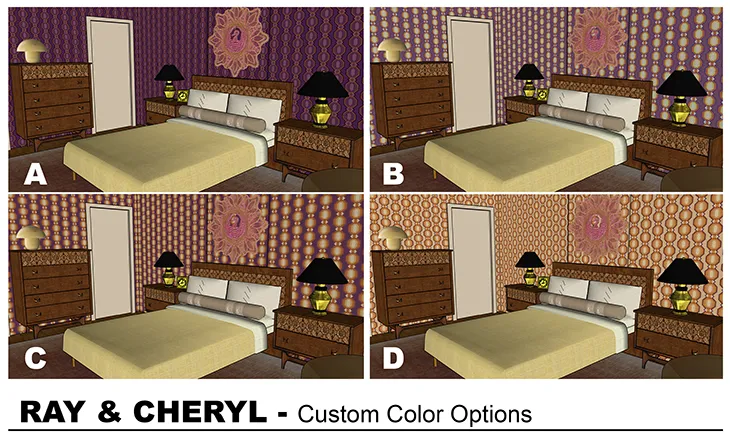
We often looked at the relationship each character has to the “other side” and brought in details to underline that. With Sasha, not only does he read pulpy western romance novels, which are stacked up on his shelves, but he has some smuggled western music by his record player. In Cheryl’s apartment, we brought in bears and red stars in her kid’s bedroom, and her headboard is implanted with the ruddy marble that clad our Soviet buildings. The notes are sometimes well hidden easter eggs, but they’re there!
The series includes an Elton John concert set in Moscow. How did you approach designing his dressing room to suggest a future trajectory that the moment itself could not yet reveal?
It was so hard to know the spectacular icon that Elton John becomes and not be able to spangle everything in that room! We did use some furniture that has bold choices – the dressing table he’s sitting at is covered in purple velvet, which is super over the top, but we sunk it into a palette of mauves so it seems at home.
We paid homage to his future wardrobe by sneaking a few sparkles and some wild hats into the clothing racks. I hope underlining his fame, and hinting at iconic elements, may help some of the audience key into how important this concert was to international politics. It paved the way for a time of connection that was unprecedented, and sadly has not continued to today.
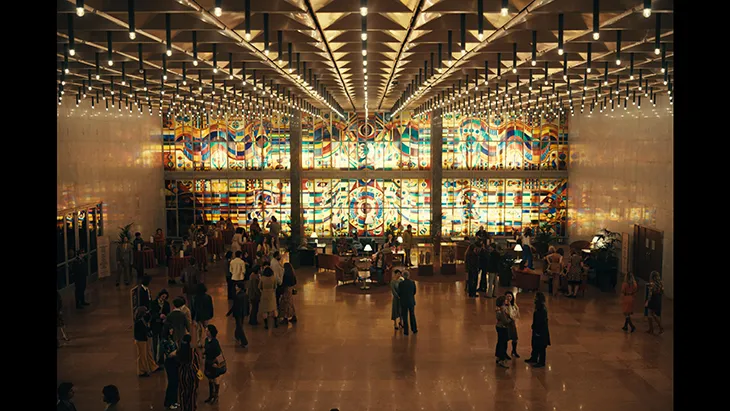
You worked inside several significant architectural spaces in Budapest, including Hotel Budapest before its demolition. How did the knowledge that some of these locations would soon disappear affect the way you documented, adapted, or designed within them?
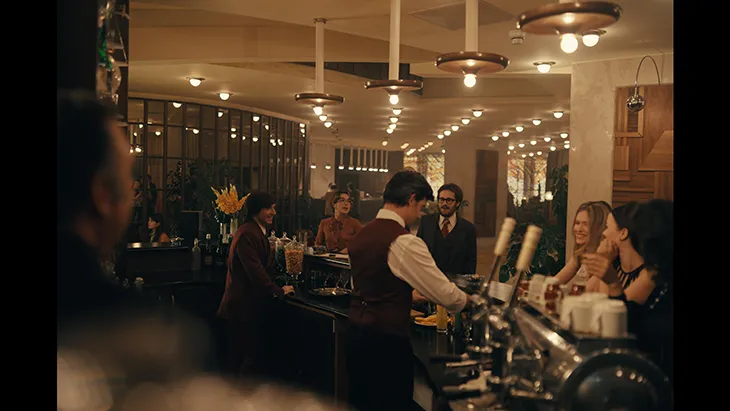
My responsibility was always first to the script and the story, and that can never waver when you’re going into a location, no matter how precious. But the ability to exploit an excellent location, to pull everything I can into the frame by working with our director and DP was certainly at the fore when we were thinking about Hotel Budapest. There were so many exciting architectural elements, the circular stair, the recessed lighting polka dotted across the ceilings, the curved hallways – it was a thrill to work with Callan Green, our DP, to find the frames that did the most.
One thing we had to custom-create, however, was the hotel rooms and en suites themselves. The existing rooms were too tight for us to block the scenes and fit the camera, so we built it from scratch in an old conference room. We had fun with our wallpapers, custom-painted burgundy and tangerine bathroom tiles. It was important to me that we give a Twila a seductive space as she discovers her sexuality.
Women’s professional lives play a big role in the series. How did the reality of women working in the Eastern Bloc influence how you approached offices, homes, and shared interiors?
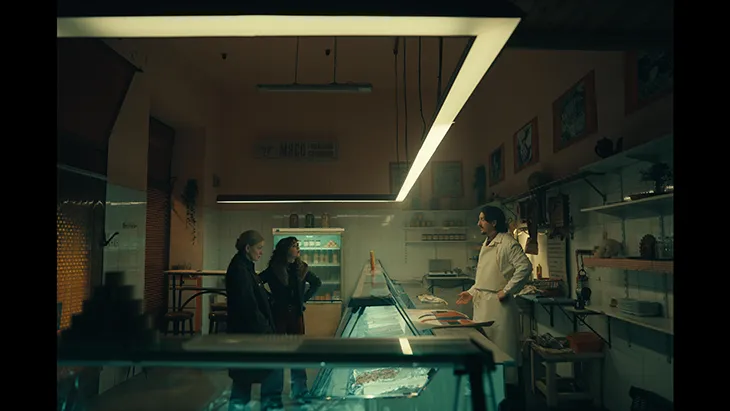
Especially given the turn back toward tradition that we’re seeing in some parts of society now, I was struck by the way the USSR integrated women into all parts of society. Women worked alongside men in many industries, and the expectations on productivity and involvement were – at least officially – equal. Florals and filigree was equally found in men’s and women’s spaces, which I absolutely loved and exploited everywhere I could.
The one uniquely female space we had in the film was at the end – the beauty salon. The boldness of the huge mural and bright poppy colors were all based on photos from our Russian researcher. It was such a relief to find that bold whimsical choices were a part of these women’s world, it gave us a great opportunity to keep underlining the breadth of the lived experience.
Production design exists in constant dialogue with direction, cinematography, and performance. Where do you see the boundaries of authorship in production design on a series like Ponies? What parts of the work remain firmly yours, and where does collaboration take over?
Each set I design is in service of a vision – I rely on the writers, showrunners and directors the broad landscape, and lean over to the cinematographer to figure out how to fit it into the spaces we have. Making sure that a set, no matter how specifically designed, is also shootable, is obviously critical. The Bubble, for example, required special material and joinery solutions in order to wild out walls and elements so we could see our characters in the small room that contained all the secrets of the CIA.
I truly like to think of my work as creating that container for the emotional arcs of our characters. How it’s designed is often informed by how it will be shot or how the actors will move through it, and I know that the audience will notice those things much more than the kind of flooring they’re walking on. But the choice of a floor or a ceiling detail, of an errant pair of glasses on a table, all of that is my responsibility to get right, and I take it very seriously. Once a director and actors are on set, though, their authority over character is total. Sometimes those glasses go in a drawer.
When audiences watch Ponies, what is one design detail you hope they notice instinctively, even if they can’t immediately explain why it matters?
I hope the audience is informed by the juxtaposition of a sense of openness in the American spaces, and the tight control of Soviet spaces. Both can create tension and fear – are you forced to be exposed more than you want? Are you unable to escape a maze you were born into? Neither government is being honest, but they go about it very differently.
After completing Ponies, what questions about space or storytelling do you find yourself more interested in exploring next?
I’m excited to be working on a project that takes me into some fantasy-oriented spaces that were created solely by the mind of our characters. They’re already teaching me incredible things!
Follow Sara K White on instagram.
Ponies is currently streaming on Peacock.