


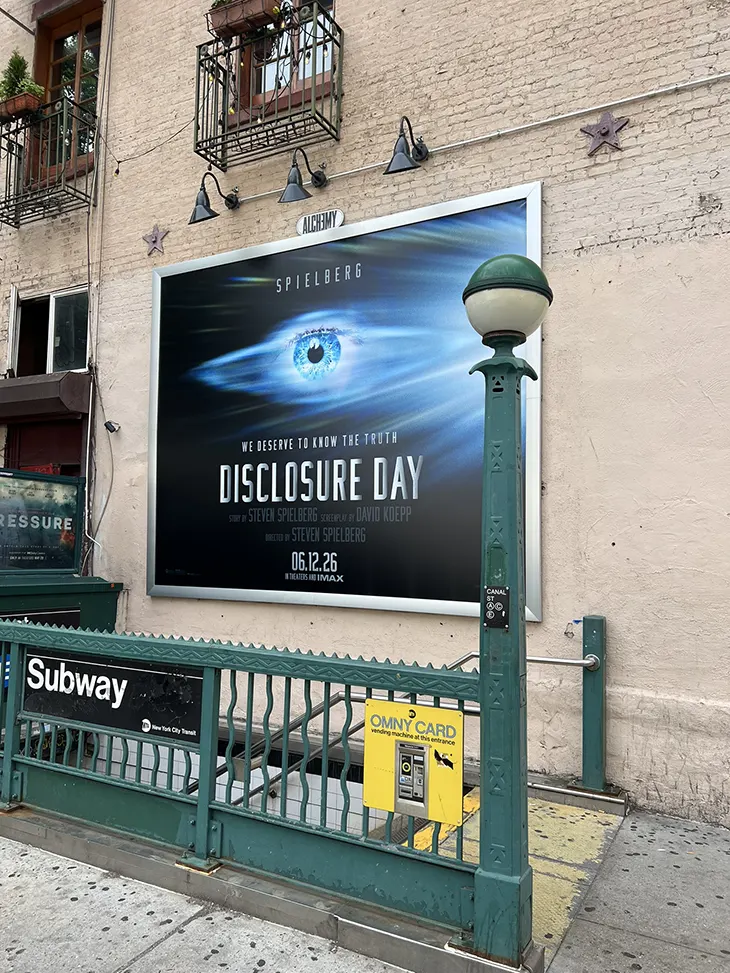
Steven Spielberg returns to sci-fi with Disclosure Day, a film that arrives with all the weight of a cultural event and, at its best, earns some of that anticipation. Scripted by David Koepp from a story by Spielberg himself, the film centers on Margaret Fairchild (Emily Blunt), a cybersecurity expert unwittingly drawn into a decades-old government cover-up surrounding extraterrestrial contact. She is pulled into the orbit of Dr. Daniel Kellner (Josh O’Connor), a scientist-turned-whistleblower who has uncovered a seismic truth while working for the shadowy Wardex Corporation, and together they race to expose it, chased by Wardex’s calculating leader Noah Scanlon (Colin Firth) while aided by an underground network of truth-seekers helmed by scientist Hugo Wakefield (Colman Domingo).
The premise is classically Spielbergian: ordinary people caught in extraordinary circumstances, forced to confront what the powerful have chosen to conceal. And for stretches, Disclosure Day is genuinely thrilling. Koepp‘s screenplay moves with precision, the cinematography is rich, and John Williams‘ score, as ever, does the emotional heavy lifting that the script occasionally neglects.
The Cast: Uneven Ensemble
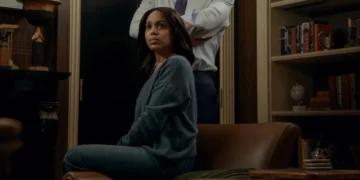
Emily Blunt is extraordinary. There is no softer way to put it. Margaret Fairchild is the kind of role that a lesser actress would simply ride on charm and physicality. Blunt tears into it with everything she has, grounding a character who speaks alien languages and survives government-sanctioned manhunts in something recognizably human and wounded. It is the role of her career, and she knows it.
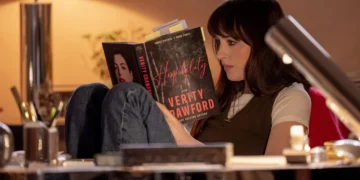
Josh O’Connor, fresh off strong dramatic turns elsewhere, is technically proficient but curiously blank as Dr. Daniel Kellner. He establishes himself as someone capable of carrying a major blockbuster without embarrassing himself, but he brings little that feels specific or surprising to the role. Kellner is written as brilliant and idealistic, and O’Connor delivers exactly that, nothing more.
Colin Firth is a problem. As the corporate antagonist Noah Scanlon, he veers persistently toward the comical. Whether this is a choice or a miscalculation is hard to say, but scenes that should carry menace land as pantomime. Firth has the range for something like this, which makes the misstep more puzzling.
Colman Domingo has spent recent years collecting essentially the same character: the wise, calm, morally anchored guide who speaks truth to chaos. Hugo Wakefield is that character again, this time wearing a scientist’s credentials. Domingo is good because he is always good. He is also, at this point, entirely predictable.
Disclosure Day is not content to let its alien conspiracy exist in a moral or philosophical vacuum. The narrative makes repeated, pointed gestures toward Christian theology
The Religion Problem
The film’s most uncomfortable element is its relationship to faith, Christianity only. Disclosure Day is not content to let its alien conspiracy exist in a moral or philosophical vacuum. The narrative makes repeated, pointed gestures toward Christian theology, framing the extraterrestrial revelation in terms that feel less like thematic exploration and more like doctrinal nudge. The purpose, almost propagandic in its persistence, pierces through the storyline in ways that feel grafted rather than organic.
One might argue that Spielberg is examining how humanity imposes familiar spiritual frameworks onto the unknown, a genuinely interesting idea. But the film does not interrogate this tendency so much as indulge it, and the distinction matters. The questions about alien life and conspiracy that Disclosure Day raises do not require a theological scaffolding to be resonant. The scaffolding is there because someone chose to put it there.
The Tonal Collapse
Compounding the issue is the film’s periodic collapse into something uncomfortably close to a children’s movie. There are sequences, handled with a lightness that clashes badly with the surrounding thriller, in which animals are given humanlike qualities and treated with a Disneyesque warmth entirely at odds with the stakes the film has otherwise established. It is jarring every time it happens, and it happens more than once. Whether this reflects commercial compromise or a genuine creative instinct, the result is the same: it breaks the spell.
The Originality Question
Critics have positioned Disclosure Day as a triumphant return, and the film does carry a genuine confidence that Spielberg has not always shown in his recent work. But the question of originality lingers. The DNA of Close Encounters of the Third Kind, E.T., and even elements of War of the Worlds run through the film’s veins too visibly. Koepp‘s screenplay is skilled at synthesis, but synthesis is not invention. For a filmmaker with Spielberg‘s catalogue, the line between paying tribute to yourself and repeating yourself is thin, and Disclosure Day sometimes crosses it.
For a filmmaker with Spielberg’s catalogue, the line between paying tribute to yourself and repeating yourself is thin, and Disclosure Day sometimes crosses it.
Is this the best film in Spielberg‘s opus? Most definitely not. It is a competent and sometimes thrilling blockbuster, elevated significantly by one extraordinary performance and dragged down by tonal inconsistency, a cast of uneven contributions, and an ideological subtext that the film neither earns nor interrogates with sufficient rigor.
Disclosure Day is worth seeing, largely for Blunt, and for moments where the old Spielberg magic still flickers. But the reverence being lavished on it tells you more about the state of Hollywood than about the quality of this specific film, already deemed a box office hit on its first day.
The irony is that Spielberg, a filmmaker who has spent his career returning obsessively to the unknown, seems here to be afraid of exactly that. The religious sentiment, the Disney-lite detours, the familiar faces doing familiar things: all of it feels like a director hedging against the very openness his film asks its audience to embrace. Disclosure Day tells you not to be afraid of what you don’t know, then spends three hours making sure you never have to sit with that discomfort for long.
For more cinema coverage, visit DSCENE Cinema.